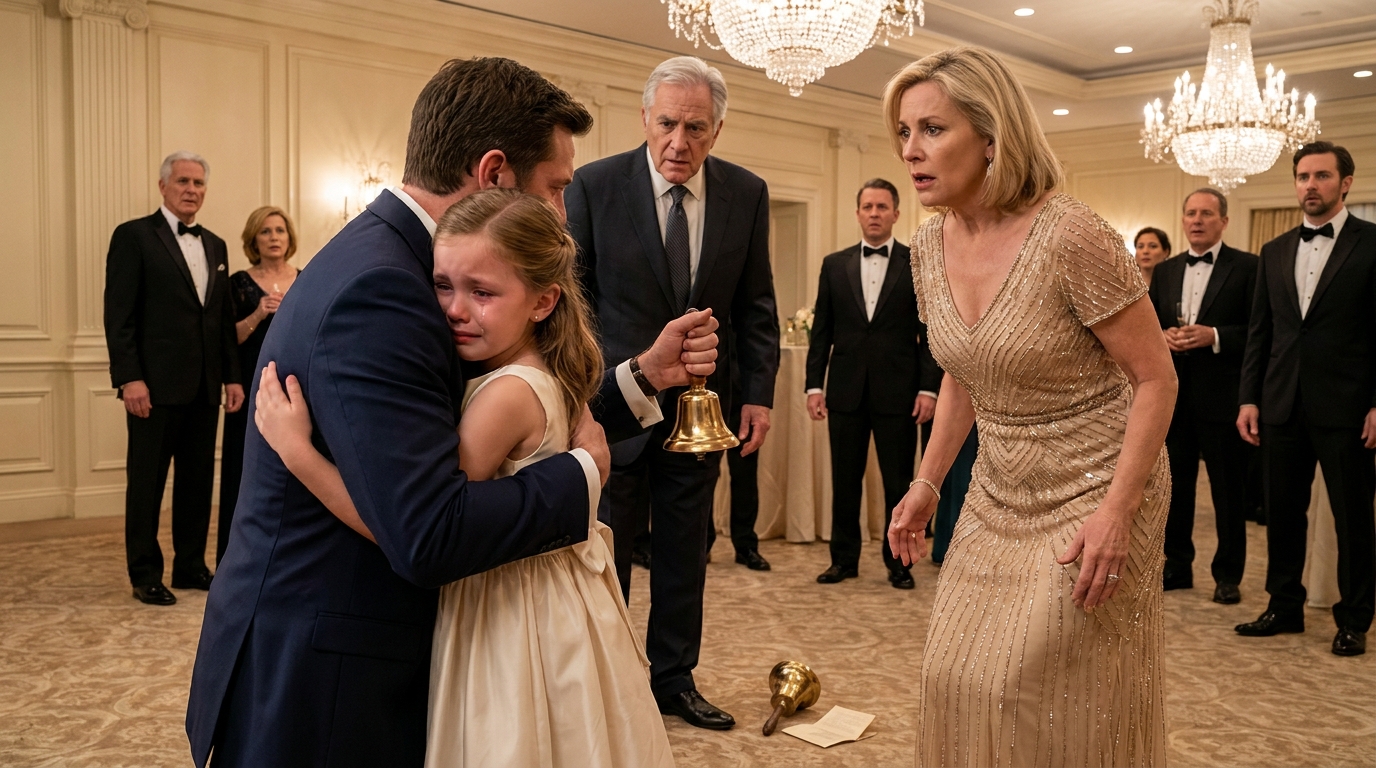
At my father’s black-tie charity gala, my six-year-old daughter stood crying in the middle of the ballroom while clutching an old brass service bell.
Her name is Emma.
She wore a cream party dress.
Her cheeks were wet with tears.
And directly in front of her stood Victoria Hale, one of my father’s oldest family friends.
Victoria wore a shimmering champagne gown.
She looked less angry than frightened.
“Give me the bell,” she said.
Emma shook her head.
“No.”
Victoria reached toward her.
That was when I crossed the ballroom.
I lifted Emma into my arms.
“What happened?”
She wrapped both arms around my neck.
Victoria looked at me.
“She took something that doesn’t belong to her.”
Then my father arrived.
Charles Mercer was seventy-two.
He owned the Mercer Grand Hotel and chaired the family hospitality company.
He rarely reacted strongly in public.
But when he saw the bell, his face changed completely.
“Where did she get that?”
Victoria answered too quickly.
“It was probably part of the historical display.”
My father shook his head.
“No.”
He stepped closer.
“That bell disappeared twenty-eight years ago.”
The room became quiet.
My name is Daniel Mercer.
I grew up in hotels.
The Mercer Grand had been in my family for generations.
The brass bell was one of the first objects ever placed on the hotel’s original front desk.
My grandmother, Eleanor Mercer, used it when she personally greeted guests during the early years.
After she died, the bell vanished.
No one knew where it went.
My father assumed it had been misplaced during a renovation.
He searched storage rooms.
Archives.
Old offices.
Nothing.
Eventually, he stopped looking.
Victoria Hale had been close to my grandmother.
Her family had invested in the hotel decades earlier.
She was always around during family events.
That night, the ballroom included a small historical display featuring old photographs, keys, room ledgers, and antique service items.
Emma loved old objects.
She wandered toward the display while I was speaking with a donor.
That was when she noticed something gold behind a velvet cloth.
The bell.
She picked it up.
Victoria saw her.
She crossed the room immediately.
“Put that down.”
Emma froze.
“I found it.”
“It does not belong to you.”
Emma held it tighter.
Victoria reached for it.
Emma started crying.
That was when I arrived.
My father joined us seconds later.
He took one look at the bell and knew exactly what it was.
Then Emma said something none of us expected.
“I found it in her bag.”
The entire conversation stopped.
Victoria stared at her.
Emma pointed toward a cream evening tote beside the display table.
She explained that the bag had been open.
Part of the bell was visible inside.
Emma thought someone had forgotten to place it with the other antiques.
So she took it out.
My father looked at Victoria.
“Is that your bag?”
She hesitated.
“Yes.”
“Why was the bell inside it?”
“I don’t know.”
He asked her to open the bag.
She refused.
Security moved closer.
Before anyone touched her belongings, Emma shifted in my arms.
The bell slipped from her hand.
It hit the thick ballroom carpet.
The impact was soft.
But the base came loose.
Something folded slid out.
A piece of paper.
My father picked it up.
The paper was yellowed with age.
The handwriting belonged to Eleanor Mercer.
He recognized it immediately.
The note was dated twenty-eight years earlier.
It said:
“If anything happens to me, the signed ownership transfer is hidden with this bell.”
My father read the sentence twice.
Victoria stopped moving.
I asked:
“What ownership transfer?”
My father looked at me.
Then at the bell.
For most of my life, I had believed the Mercer Hotel Group passed from my grandfather to my father.
That was not exactly true.
My grandmother had retained a controlling block of shares through a private holding company.
She intended those shares to pass to her daughter.
My mother, Laura.
But Eleanor died unexpectedly.
The signed transfer could not be found.
Without the original document, the ownership remained under the previous corporate structure.
My mother never challenged it.
She believed Eleanor had changed her mind.
Years later, my mother died.
The issue disappeared with her.
Or so everyone thought.
My father looked at Victoria.
“Did you know about this?”
Victoria said no.
Then security found another document inside her bag.
A photocopy of an old hotel ledger.
Several pages were marked.
One entry referenced a private vault box.
Another referenced Eleanor’s attorney.
My father’s face hardened.
“Why do you have these?”
Victoria finally admitted she had been researching the old ownership records.
She claimed she was doing it for historical reasons.
No one believed that.
My father asked:
“Why take the bell?”
She said nothing.
Then the family attorney arrived.
He examined the note.
He asked for the bell.
The base contained a tiny hollow compartment.
Inside, behind the folded note, was a narrow brass key.
The key number matched an old bank safe-deposit record listed in the ledger.
That changed everything.
The next morning, my father, the attorney, and a bank representative opened the box.
Inside was the original signed stock-transfer agreement.
My grandmother had transferred her controlling shares to my mother before she died.
The signature had been notarized.
The document had never been filed because Eleanor died before her attorney completed the final corporate process.
Legally, it still mattered.
My mother had been the rightful beneficiary.
After her death, her interest passed according to her estate.
To me.
I did not become the owner overnight.
Nothing in business law is that simple.
Lawyers spent months reviewing records.
Corporate filings were corrected.
Old shareholder agreements were examined.
But the document was genuine.
It changed the balance of ownership.
Victoria’s family had also benefited from the missing transfer.
Without Eleanor’s controlling shares being properly recognized, other investors had received larger voting influence for decades.
Victoria knew that reopening the old record could reduce her family’s position.
That was why she had been searching.
She had found references to the bell.
She located it in an old locked cabinet earlier that afternoon.
Then she put it in her bag.
She planned to remove it before anyone realized what it contained.
Emma interrupted that plan.
A six-year-old girl saw something shiny.
That was all.
Victoria did not expect the bell to come loose.
She did not expect the note.
And she definitely did not expect three hundred people to watch the truth fall onto the carpet.
My father did not humiliate her publicly.
He simply asked her to leave.
The legal investigation happened privately.
Her family eventually settled the ownership dispute.
Some voting rights changed.
Several old agreements were rewritten.
The hotel did not collapse.
No one went to prison.
The truth was more complicated than a dramatic crime story.
Victoria had hidden an object tied to a financial dispute.
That alone destroyed trust.
My father ended their business relationship.
He also apologized to me.
That surprised me.
“For what?”
He said:
“For assuming your mother had simply accepted everything.”
He had never investigated deeply because the family was grieving.
He believed the missing paperwork meant the transfer never happened.
He had been wrong.
I did not blame him.
But the discovery changed how we understood my mother.
She had not been excluded.
My grandmother had tried to protect her interest.
The proof had simply disappeared.
Emma became fascinated with the bell.
For several weeks, she asked if she could keep it.
My father said no.
It belonged in the hotel archive.
But he had a replica made for her.
A small polished brass bell.
She kept it on her nightstand.
Whenever she visited Grandpa, she rang it.
He pretended to be annoyed.
“Room service again?”
Emma laughed.
Years later, the original bell sits inside a glass case in the hotel lobby.
Beside it is a simple plaque explaining that it belonged to Eleanor Mercer.
The plaque does not mention Victoria.
It does not mention the ownership dispute.
It simply says:
“Sometimes the smallest objects carry the longest stories.”
I like that.
Because the night itself was not really about money.
It was about memory.
Family.
And the danger of believing old silence means there was never a truth underneath it.
Victoria saw the bell as a threat.
My father saw his mother.
I saw a missing piece of my own family history.
And Emma?
She saw something shiny in an open bag.
That is how three decades of secrecy ended.
Not through an investigation.
Not through a lawsuit.
Through a curious six-year-old girl who picked up a brass bell and refused to let go.