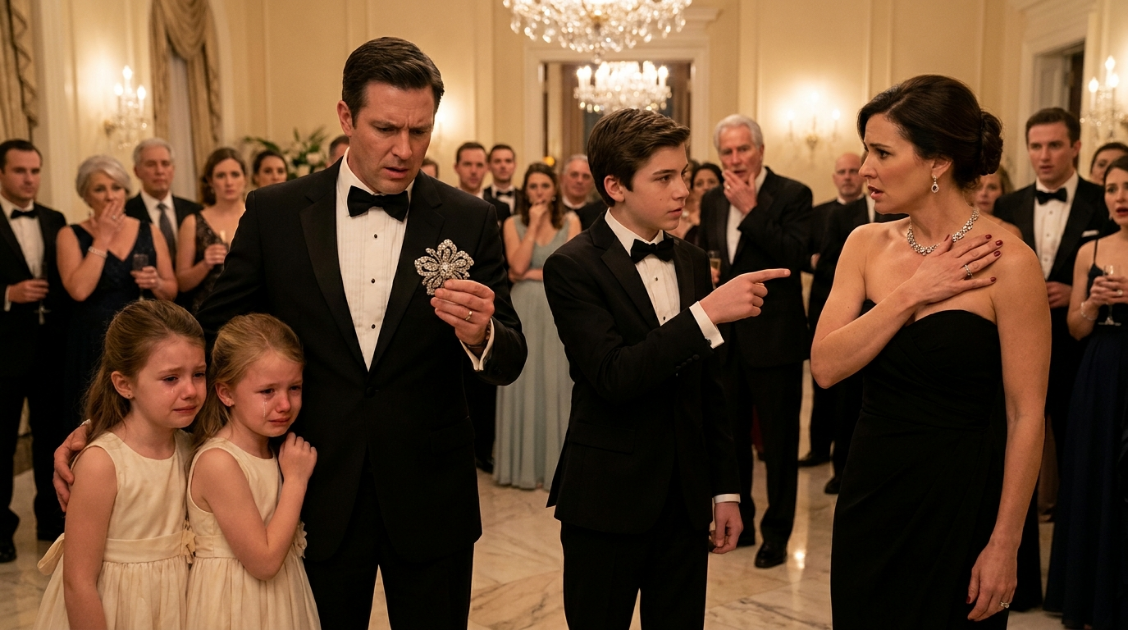
At my father’s black-tie charity gala, my two daughters came running toward me in tears.
Emma was seven.
Sophie was five.
Both wore pale formal dresses.
They had been excited for the event all week.
Now they looked terrified.
Behind them stood my fiancée, Vanessa.
She wore an elegant black evening gown.
Her face was tight with anger.
“They ruined my dress,” she said.
Then she added:
“And they went through my things.”
I looked at the girls.
Emma shook her head.
“We didn’t.”
Sophie was crying too hard to speak.
Before I could ask another question, my seventeen-year-old nephew Luke stepped forward.
“No, they didn’t.”
Vanessa turned toward him.
“Stay out of this.”
Luke pointed toward her shoulder.
“That belongs to Grandma.”
The ballroom went silent.
Pinned to Vanessa’s gown was a large silver floral brooch.
Diamonds surrounded the center.
I had seen it hundreds of times growing up.
My mother wore it to weddings.
Fundraisers.
Anniversaries.
Holiday dinners.
Then she died.
Her name was Caroline Collins.
After her death, several heirlooms were placed in a private family safe.
That brooch was one of them.
Twelve years earlier, it disappeared.
No one knew how.
We blamed moving boxes.
Estate confusion.
Staff changes.
Eventually, the search stopped.
Now it was on Vanessa.
I stared at it.
She immediately placed one hand over the jewelry.
“Andrew, this is mine.”
Emma spoke through tears.
“No.”
Vanessa looked at her.
Emma said:
“You took it from the box.”
I stepped closer.
“What box?”
Vanessa tried to laugh.
“She’s confused.”
Then Luke said:
“She’s not.”
My father joined us.
Charles Collins was seventy-five.
The gala was held in the ballroom of the Collins Grand Hotel.
He had spent decades building the family business.
He rarely showed emotion in public.
But when he saw the brooch, his face changed.
“Take that off.”
Vanessa frowned.
“Charles—”
“Now.”
I removed it carefully.
She did not stop me.
I turned it over.
There were two tiny engraved letters.
C.C.
Caroline Collins.
My mother.
My father closed his eyes for a moment.
Then he asked:
“Where did you get this?”
Vanessa said she had found it in an old box.
“What box?”
“One of the estate boxes.”
My father stared at her.
“You have never had access to the estate storage.”
She looked toward me.
“I was going to tell you.”
That sentence made everything worse.
Luke pulled out his phone.
“I saw her with a key.”
Vanessa turned sharply.
“What?”
Two days earlier, Luke had been in the private library looking for an old family yearbook.
He saw Vanessa near the locked cabinet where spare safe keys were stored.
She was holding a small brass key.
He thought nothing of it at first.
Then he noticed she quickly put it into her purse.
He took a photograph.
Teenagers photograph everything.
That ordinary habit became evidence.
Luke showed us the image.
My father recognized the key.
It had belonged to his younger brother, Robert.
Uncle Robert had been one of the trustees of my mother’s estate.
He died three years earlier.
His personal effects were supposed to have been inventoried.
The key should not have been in circulation.
My father called the family attorney, Martin Hale, who was already attending the gala.
Martin examined the brooch.
Then the photograph.
His expression changed.
He asked:
“Charles, do you remember the missing estate schedule?”
My father looked at him.
“What schedule?”
That was the beginning of a much bigger problem.
According to Martin, several items disappeared during the years after my mother’s death.
Not only the brooch.
A sapphire bracelet.
A pair of antique earrings.
And one sealed document.
The document described a private investment account held through an old family trust.
The account had originally been created by my grandparents.
It contained shares in several companies.
Over time, those shares had become extremely valuable.
After my mother died, the account was supposed to pass into a trust for her children and grandchildren.
But the final supporting schedule disappeared.
Without it, the account remained under older trustee control.
For years, lawyers assumed the document had been lost.
Then Robert died.
That should have triggered another review.
Instead, nothing happened.
My father asked Vanessa:
“What does any of this have to do with you?”
She said:
“Nothing.”
Martin looked at her.
Then asked:
“What was your mother’s maiden name?”
Vanessa froze.
That was the moment I knew something was wrong.
Her mother’s maiden name was Ellis.
Martin searched old trustee correspondence.
Robert had worked closely with a financial administrator named Thomas Ellis.
Vanessa’s uncle.
She had never told me that.
In fact, when Vanessa and I met, she said she knew almost nothing about my family beyond public charity events.
That was not true.
Her uncle had worked with our estate for years.
Then came another revelation.
Thomas Ellis had been dismissed after irregularities were found in several trust records.
No criminal charges were filed.
The problems were handled privately.
But he remained close to Robert.
After Robert died, some of his personal papers went to storage.
Vanessa helped organize them.
That was how she obtained the key.
She admitted that much.
I asked:
“Why didn’t you tell me?”
She said she was afraid I would misunderstand.
That phrase appeared often that night.
Misunderstand.
But the truth was simple.
She knew the key opened a cabinet connected to our family trust.
She used it.
She found the velvet box.
Inside was my mother’s brooch.
She took it.
She said she believed the jewelry had been forgotten.
I asked:
“You wore a missing family heirloom to my father’s gala because you thought nobody remembered it?”
She had no good answer.
Then Emma explained what happened earlier.
She and Sophie wandered into the private library looking for coloring books.
They saw Vanessa opening the velvet box.
Emma recognized the brooch from Grandma’s portrait.
She asked:
“Is that Grandma’s?”
Vanessa told her no.
Emma insisted.
Vanessa became angry.
She told the girls not to touch anything.
They argued.
Then she accused them of going through her belongings.
The girls ran away crying.
That was when they found me.
The missing document was still unresolved.
So my father ordered the private safe opened immediately.
The brooch box had another compartment.
Inside was a folded note.
Not the full trust schedule.
But a handwritten reference number.
Martin recognized it as an old archive code.
The next morning, attorneys searched off-site storage.
They found the sealed trust document in a mislabeled file tied to Robert’s records.
The account existed.
It had never been stolen.
But its administration had been hidden under outdated records for years.
The shares still belonged to the trust.
That was good news.
The bad news was that several people—including Thomas Ellis—had collected fees from managing the account long after they should have lost authority.
Vanessa’s connection did not automatically make her responsible.
The investigation found no evidence that she personally took money.
But she knew far more about the trust than she admitted.
She had been searching for the old records.
The brooch was proof she had accessed restricted family property.
I ended our engagement.
Not because she came from a family connected to old financial problems.
People are not responsible for relatives.
I ended it because she lied.
About the key.
About the estate.
About the brooch.
About knowing my family history.
And worst of all, she frightened my daughters when they recognized the truth.
That was the line I could not cross.
Vanessa left the gala.
There was no dramatic arrest.
The legal review continued for months.
The jewelry was returned.
The trust records were corrected.
Management fees were challenged.
Some money was recovered.
Some disputes were settled privately.
The family learned an uncomfortable lesson.
We had assumed the past was settled because nobody wanted to reopen old boxes.
It was not.
Emma and Sophie recovered quickly.
Children often do when adults finally tell them the truth.
I apologized to them.
I said:
“You did the right thing telling me.”
Emma asked:
“Even though she was going to marry you?”
“Especially then.”
That answer mattered.
Luke became a family legend for the phone photograph.
He hated that.
He said:
“I just thought the key looked suspicious.”
My father laughed for the first time in days.
Years later, the brooch belongs to Emma and Sophie together.
We did not make them decide who gets it.
It stays in the family vault.
When they are older, they can choose.
Sometimes they ask why Grandma’s initials are on the back.
I tell them:
“Because she wanted people to remember where it came from.”
That small engraving solved the first mystery.
C.C.
Two letters.
Enough to break a lie.
When I think about the gala, I remember Vanessa’s face.
Luke pointing.
My father staring at the brooch.
But mostly I remember my daughters running toward me in tears.
They were five and seven.
They had recognized something adults missed.
Not because they understood trusts.
Not because they understood inheritance.
Because they knew their grandmother’s picture.
And they knew the jewelry did not belong on Vanessa’s dress.
Sometimes truth begins that simply.
A child sees something familiar.
And refuses to be told she is wrong.