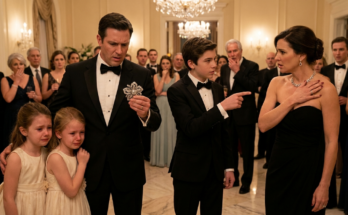
I walked through my front door and found my seventeen-year-old son arguing with my sister.
Ethan was standing near the hallway.
My six-year-old daughter, Lily, was crying beside him.
Claire stood in front of them.
Her face was red with anger.
“He broke into my room.”
Ethan shook his head.
“I opened a drawer.”
“You had no right.”
I stepped between them.
“What happened?”
Then Claire moved too quickly.
Something slipped from her hand.
A ring of keys hit the hardwood floor.
Several keys scattered.
One was brass.
Old.
Small.
Stamped with two letters.
E.M.
My mother’s initials.
I stopped breathing for a second.
That key had disappeared fifteen years ago.
My name is David Mercer.
My mother, Evelyn, died after a short illness when I was in my early thirties.
My sister Claire was older.
More organized.
More involved in Mom’s finances.
When our mother became sick, Claire handled bills, insurance, property records, and meetings with attorneys.
I trusted her.
After Mom died, Claire helped settle the estate.
She told me everything was straightforward.
The family home was sold.
Accounts were divided.
A few valuables went to grandchildren.
Nothing seemed unusual.
One item disappeared during the move.
A small brass key.
Mom had kept it inside a wooden jewelry box.
Nobody knew what it opened.
Claire said it was probably an old cabinet key.
We forgot about it.
Or I did.
Years passed.
Claire remained close to the family.
She visited often.
She helped with the children.
She spent holidays with us.
I never suspected she was hiding anything.
Then Ethan found the photograph.
He had been searching for an old phone charger in the guest room Claire used when she stayed with us.
He opened a drawer.
Inside was a framed picture of Grandma Evelyn.
She was standing in front of a small stone house surrounded by trees.
Ethan had never seen the house before.
Neither had I.
Beside the frame was a ring of keys.
He noticed the old brass one.
He remembered hearing me talk about Grandma’s missing key years earlier.
So he asked Claire.
That was when she exploded.
She told him the drawer was private.
He said:
“Why do you have Grandma’s key?”
Claire tried to grab everything.
Lily heard the shouting and came into the room.
By the time I arrived, everyone was upset.
Then the keys fell.
I picked up the brass one.
“Claire.”
She looked at me.
“Where did this come from?”
She said:
“I found it.”
“When?”
“A long time ago.”
“How long?”
She would not answer.
Ethan handed me his phone.
He had taken a picture of an envelope he saw in Claire’s bag.
The address was outside town.
A rural road.
He searched it online.
A small stone house appeared.
Same front porch.
Same windows.
Same house from the framed photograph.
Claire said:
“It has nothing to do with you.”
That sentence made me angry.
“If Mom owned it, it has everything to do with me.”
Then Lily picked up the frame.
The cardboard backing had come loose when it fell.
A folded paper slid out.
Property-tax receipt.
Owner:
Evelyn Mercer Family Trust.
Recent taxes had been paid.
Someone was still maintaining the property.
I looked at Claire.
“You’ve been paying this?”
She said nothing.
I called our mother’s old estate attorney.
He was retired, but his office still had archived files.
He called back an hour later.
His voice sounded different.
Careful.
“David, there was an early estate schedule that listed a second property.”
I asked:
“What property?”
He gave me the same address.
I felt sick.
“Why didn’t I know?”
He said:
“The final filing did not include it.”
“Who delivered the final documents?”
Long pause.
“Claire.”
That did not automatically prove fraud.
Old estate records can be messy.
Properties can sit in separate trusts.
Documents can be revised.
But it meant we needed answers.
The attorney told us not to enter the property until ownership was clarified.
Claire finally sat down.
She looked exhausted.
Then she said:
“Mom left something there for you.”
I stared at her.
“What?”
“She made me promise not to tell you until you were ready.”
“Ready for what?”
Claire began crying.
Our mother had bought the house secretly years earlier.
Not as an investment.
As a refuge.
Our father had struggled with alcohol when we were children.
Most people never knew.
He was respected publicly.
At home, he could be unpredictable.
Not always violent.
But frightening.
Mom purchased the stone house so she would have somewhere to take us if she ever decided to leave.
She never did.
By the time Dad got sober, the property remained hidden.
Years later, Mom turned it into something else.
A private place where she stored family records, letters, photographs, and journals.
She called it:
“The quiet house.”
Claire knew.
I did not.
Why?
Because after Dad died, Mom feared I would destroy certain letters out of anger.
I had carried resentment toward him for years.
Claire said Mom wanted me to see the truth only after I had children of my own.
That explanation did not make sense to me.
“Then why fifteen years?”
Claire looked ashamed.
“Because I kept waiting.”
Mom’s instructions had not said fifteen years.
Claire had delayed.
At first, she thought I was grieving too much.
Then I got married.
Then Ethan was born.
Then life became busy.
Each year, telling me felt harder.
Meanwhile, Claire maintained the house.
Paid taxes from a small trust account.
Checked the property.
Kept it locked.
Then something changed.
Three months earlier, the trust account began running low.
Claire started preparing to sell the house.
That was why she visited more often.
That was why the records were in her room.
I asked:
“Were you going to sell it without telling me?”
Claire cried harder.
“I didn’t know what else to do.”
That was the betrayal.
Not the original secret.
The continued choice.
She had spent fifteen years deciding for me.
The attorney reviewed everything.
Legally, the stone house belonged to a family trust naming both Claire and me as beneficiaries.
It should have been disclosed.
There was no question.
Claire had breached her duty by keeping it secret.
But the investigation found she had not stolen money.
She had used trust funds only for taxes, repairs, and insurance.
Every payment was documented.
That mattered.
The concealment was still serious.
But the story was not simple theft.
It was control.
Claire believed she knew when I was ready.
She believed protecting Mom’s wishes justified silence.
Then silence became habit.
The attorney arranged for us to visit the house together.
We arrived on a cold morning.
Claire brought the keys.
The brass key opened the front door.
Inside, everything smelled old.
Wood.
Paper.
Dust.
The furniture was covered.
Family photographs lined one wall.
There were pictures I had never seen.
Mom holding me as a baby.
Claire at school.
Dad before drinking became a problem.
Dad after recovery.
There were boxes of letters.
Then we found the final room.
The small silver key opened it.
Inside was a desk.
A tape recorder.
Several journals.
And two envelopes.
One for Claire.
One for me.
My hands shook when I opened mine.
Mom had written:
David,
If you are reading this, then Claire finally brought you here.
Please do not be angry with her for keeping the house.
I asked too much of her.
That sentence changed everything.
Mom knew Claire.
She knew her need to protect people.
She also knew I hated secrets.
The letter continued.
Mom explained the house.
Dad.
The years she almost left.
The years she stayed.
The fear.
The recovery.
The complicated love.
Then she wrote something I never expected.
Your father was not only the worst thing he ever did.
And neither are you.
I read that line several times.
I had spent most of my adult life remembering Dad through anger.
Mom had kept journals showing the full story.
Not to excuse him.
To make the picture complete.
He struggled.
He failed.
He frightened us.
Then he sought treatment.
He remained sober for eighteen years before he died.
I remembered that too.
But anger had simplified him.
The house contained evidence of complexity.
Letters from Dad apologizing.
Receipts from counseling.
Notes he wrote to us but never sent.
Photos of ordinary family days.
Claire cried beside me.
She said:
“I thought if you came here too early, you’d burn everything.”
I almost laughed.
She was probably right when I was thirty.
But not when I was forty-five.
That was the tragedy of waiting.
People change.
Secrets do not update themselves.
The house became ours legally.
We did not sell it.
Not immediately.
Instead, we cataloged everything.
A family historian helped preserve documents.
The trust was restructured.
Claire was no longer sole manager.
Every decision required both of us.
That boundary mattered.
Our relationship took time to repair.
I was angry.
She was defensive.
We argued.
Then apologized.
Then argued again.
Eventually, we reached something honest.
She had not stolen the house.
But she had stolen my chance to know about it sooner.
Both truths mattered.
Ethan apologized for opening the drawer.
Claire apologized for hiding the truth.
Lily only cared that the stone house had a tiny upstairs window she wanted as a reading nook.
Children have a way of shrinking adult drama back to human size.
Years later, we turned the house into a family archive.
Not a museum.
Not public.
Just a place where future generations can read the letters if they want.
The brass key hangs beside the door now.
No longer hidden.
No longer mysterious.
Every time I see it, I remember the day it hit my floor.
One small key.
One old photograph.
Fifteen years of silence.
And one lesson I will never forget:
Sometimes families hide things because they are ashamed.
Sometimes they hide things because they think they are protecting you.
Either way, the person being protected still loses the truth.