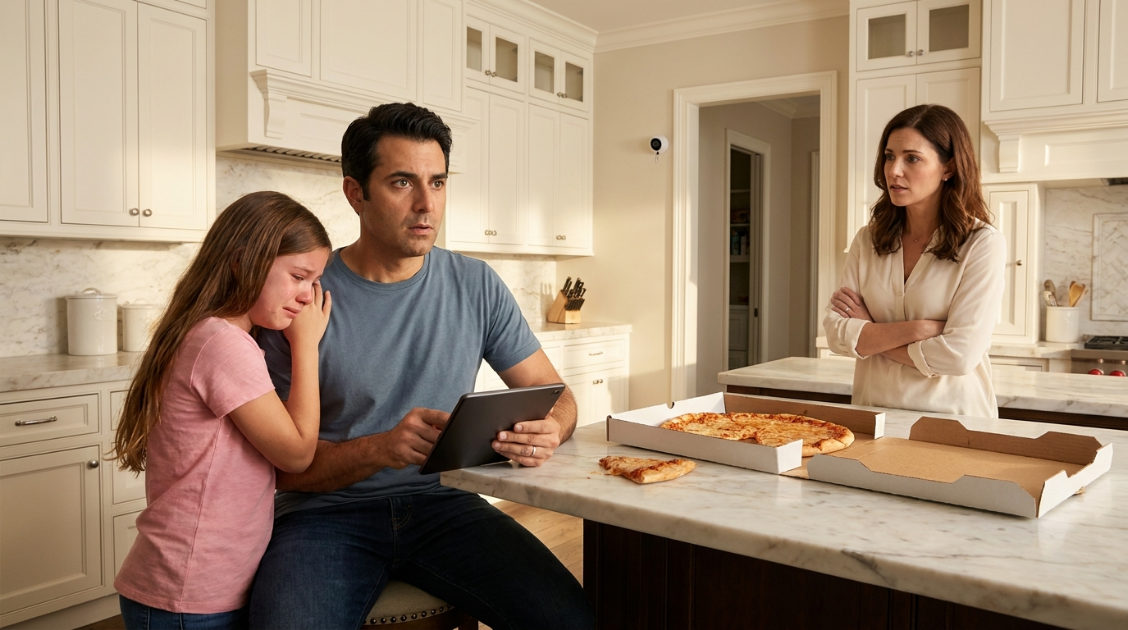
I came home and found my seven-year-old daughter crying beside a pizza on the kitchen island.
Her name is Lily.
She wore a bright pink T-shirt.
Her cheeks were wet with tears.
Across from her stood my fiancée, Claire.
Claire wore a cream blouse.
Her voice was sharp.
“I am tired of your games.”
The moment Lily saw me, she ran across the kitchen.
“Dad.”
She wrapped both arms around me.
I knelt.
“What happened?”
Claire answered before Lily could.
“She threw dinner on the floor and started screaming because I told her she could not have something else.”
Lily shook her head.
“I didn’t.”
Claire sighed dramatically.
“This is exactly what I mean.”
My name is Ryan Bennett.
Lily’s mother died when Lily was three.
For years, it was just the two of us.
Then I met Claire.
She was patient.
Funny.
Good with children.
At least, that was how it seemed.
When I proposed, Lily was cautious but polite.
I never expected her to immediately call Claire Mom.
I only wanted our home to feel safe.
For the first several months, it did.
Claire helped pack lunches.
She attended school events.
She bought Lily books.
She even helped redecorate her room.
Then small complaints started.
“Lily ignored me today.”
“She slammed her door.”
“She says she hates the wedding.”
“She keeps asking when I’m leaving.”
Every time I asked Lily about it, she looked confused.
Sometimes she cried.
“I didn’t say that.”
I assumed the truth was somewhere in the middle.
A child adjusting.
An adult trying too hard.
Normal blended-family stress.
That assumption was my mistake.
The evening everything changed, I worked later than expected.
Claire texted:
Dinner is here.
Pizza.
Lily loves pizza.
When I arrived, I heard crying before I reached the kitchen.
Lily was sitting at the counter.
Claire was standing over her.
One slice of pizza was on the floor.
Claire said:
“She threw it.”
Lily immediately said:
“No.”
I looked at both of them.
Something felt wrong.
Not because of the pizza.
Because Claire looked nervous.
Then I remembered the camera.
Several months earlier, I had installed small indoor cameras after a break-in on our street.
One covered the kitchen and back door.
We almost never watched it.
The live feed connected to a tablet.
I picked it up.
Claire said:
“Ryan, don’t.”
I looked at her.
“Why?”
She did not answer.
I rewound the footage.
There was Lily.
Sitting quietly at the island.
Claire walked in carrying a pizza box.
She opened it.
Lily smiled.
“Thank you.”
Nothing rude.
Nothing hostile.
Then Claire asked:
“Are you going to tell your dad you hate living with me again?”
Lily frowned.
“I never said that.”
Claire stepped closer.
“You say things and then pretend you didn’t.”
Lily replied:
“I didn’t say that.”
Then Claire took one slice of pizza.
She dropped it onto the floor.
Lily stared.
Claire said:
“Now when your father gets home, he’ll see what I deal with.”
I stopped the video.
My hands were shaking.
I looked at Claire.
“What is this?”
She said:
“I was frustrated.”
“You dropped it.”
“I know.”
“Then you told me Lily did it.”
Claire looked away.
Lily pressed against my side.
Then the recording continued.
Claire leaned over the counter.
“If you keep acting like this, maybe your dad will finally agree you should stay with Grandma during the week.”
Lily began crying.
She asked:
“Why?”
Claire replied:
“Because adults need peace too.”
I felt sick.
I paused the video.
“How long has this been happening?”
Claire said:
“Ryan, you’re making this bigger than it is.”
Then Lily whispered:
“She does things and says I did them.”
I looked down at her.
“What things?”
“My backpack.”
“What about it?”
“She hid it.”
Claire interrupted.
“That is ridiculous.”
But now I had a way to check.
I went through older recordings.
The camera did not capture every part of the house.
But it captured enough.
One morning, Claire picked up Lily’s school backpack from its usual hook.
She carried it into the laundry room.
Ten minutes later, she told me Lily had lost it again.
I had scolded Lily that morning.
I remembered.
I told her she needed to be more responsible.
She cried.
Claire stood beside me and said:
“This is what I deal with.”
I felt ashamed.
Another recording showed Claire removing a homework folder from the kitchen counter.
Later that evening, she told me Lily had forgotten to do her work.
Another clip showed her turning off Lily’s night-light.
Then telling me Lily was having tantrums about bedtime.
Individually, the incidents were small.
Together, they were unmistakable.
Claire had been manufacturing problems.
Not every complaint.
Children lose things.
Children argue.
Children have bad days.
But Claire was creating enough incidents that I had started seeing Lily through a false story.
Difficult.
Careless.
Jealous.
Unstable.
I looked at my daughter.
“How many times did you tell me?”
She said:
“A lot.”
That hurt.
Because she had.
And I kept thinking adults were simply misunderstanding each other.
I asked Claire to sit down.
“Why?”
She said:
“I love you.”
“That does not answer the question.”
She started crying.
Then the truth came out.
Claire did not want to live with a child full-time after we married.
She had assumed Lily would spend more time with my mother.
Weekends at first.
Then weekdays too.
I had never agreed to that.
Lily lived with me.
I was her father.
My home was her home.
Claire said she felt like our relationship had no space.
Everything revolved around school.
Meals.
Bedtime.
Parenting.
She wanted us to travel.
She wanted evenings alone.
She wanted what she called “a normal newlywed life.”
I asked:
“Why didn’t you tell me?”
She said:
“Because you would have chosen her.”
I stared at her.
“Of course I would choose my child.”
That was the answer she had feared.
So instead of being honest, she tried to make me believe Lily would be happier living partly somewhere else.
She hoped if Lily seemed difficult enough, I would suggest it myself.
The wedding was six weeks away.
It did not happen.
I ended the engagement that night.
Not because Claire did not want to be a full-time stepmother.
People are allowed to realize a life does not fit them.
I ended it because she manipulated a child to avoid telling me the truth.
She had used my trust against my daughter.
That was different.
Claire packed a bag and stayed with her sister.
The rest of her belongings left over the next week.
There was no dramatic lawsuit.
No police.
No public humiliation.
Just a relationship ending.
But for Lily, the damage was real.
For months, she asked:
“Do you believe me?”
Even about tiny things.
If she spilled water:
“Dad, it was an accident. Do you believe me?”
If homework went missing:
“Do you believe me?”
If a friend upset her:
“Do you believe me?”
I realized trust had become something she thought she had to earn every day.
We started seeing a family counselor.
The counselor helped me understand my part.
I had not caused Claire’s behavior.
But I had repeatedly treated Lily’s truth as one side of an adult disagreement.
That was not fair.
When a child says the same troubling thing repeatedly, adults need to investigate.
Not automatically assume guilt.
Not automatically assume innocence.
Investigate.
Listen.
Look for patterns.
I apologized to Lily.
Not once.
Many times.
She did not need a perfect speech.
She needed different behavior.
So I changed.
If something happened, I asked questions before conclusions.
I stopped letting another adult define Lily’s emotions for her.
I stopped saying:
“She probably didn’t mean it.”
Instead:
“Tell me what happened.”
Months later, Lily asked about Claire.
“Do you miss her?”
I answered honestly.
“Sometimes.”
“Even after what she did?”
“Yes.”
She thought about that.
Then said:
“That’s weird.”
I laughed.
“It is.”
People can hurt you and still be someone you once loved.
Both things can be true.
Claire eventually sent Lily an apology letter.
I read it first.
It was direct.
No excuses.
She wrote:
“I made you look like the problem because I was afraid to tell your dad what I wanted. You did not deserve that.”
Lily did not respond.
That was her choice.
Years later, the kitchen looks different.
New paint.
Different chairs.
The old camera is gone.
But sometimes I remember the tablet in my hands.
One dropped pizza slice.
Such a small thing.
Yet it changed everything.
The pizza was never the problem.
The problem was the story being built around my daughter.
A story designed to make me doubt her.
I almost did.
That is the part I carry.
And the lesson I learned is simple:
When a child keeps telling you something feels wrong, do not wait until you have perfect evidence before you start listening.