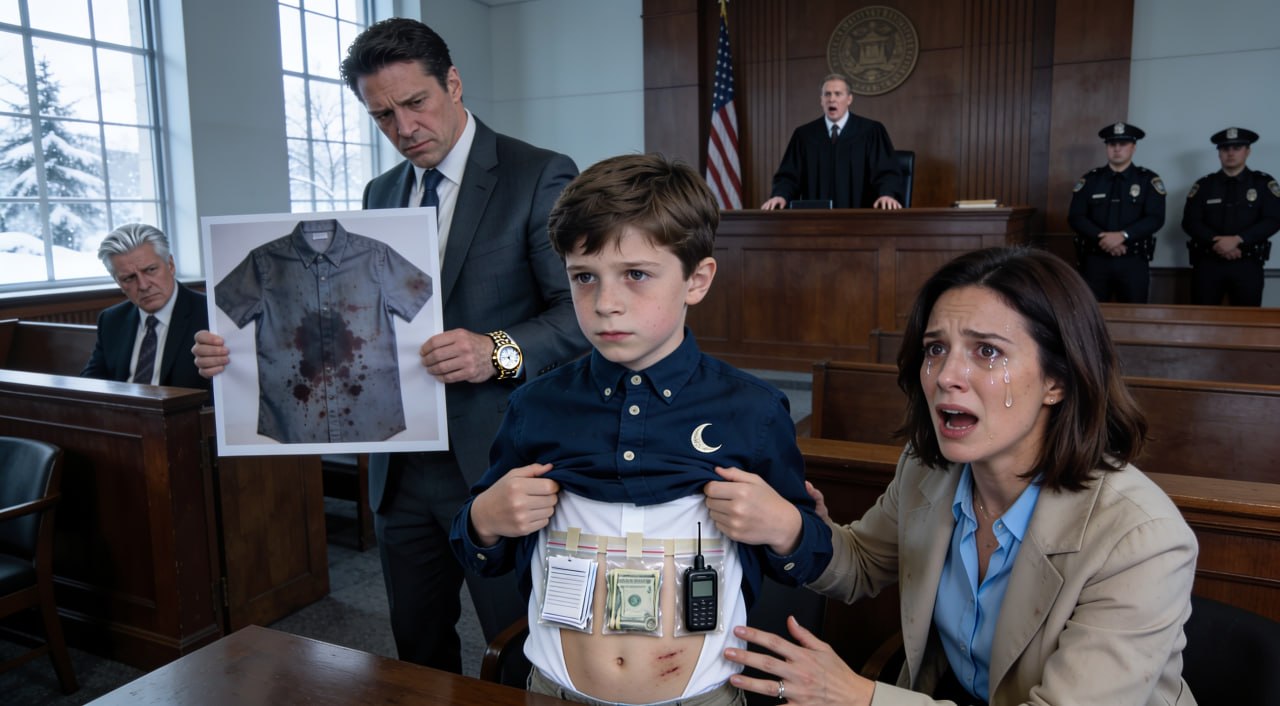
My ex-husband bankrupted me, got me fired, and left our eight-year-old son and me rationing food. Then, in family court, his attorney raised a photograph of Nolan wearing a stained shirt and used it as proof that I was an unfit mother.
“She cannot even keep her child in clean clothes,” Victor Carroway announced. “She has no stable job, no stable home, and no ability to provide basic care.”
Across the Knoxville courtroom, my ex-husband Grant leaned back in a tailored charcoal suit. A luxury watch gleamed on his wrist even though he had spent months telling the court he was too financially strained to pay full child support.
He smiled at me as though he had already won.
The courtroom was colder than the January air outside. I sat with my fingers locked around Nolan’s hand, trying to keep him from seeing how frightened I was.
He wore his favorite navy-blue button-up, the one with a small embroidered moon above the pocket. Four months earlier, I had sold my late grandmother’s vintage locket to buy it for his birthday. It was the last heirloom I owned.
The dark stains across the shirt would not wash out.
I had scrubbed it in motel sinks, laundromat basins, and the bathtub of the one-bedroom apartment we were about to lose. I had soaked it overnight until my hands became raw.
Nothing worked.
I did not know exactly what caused the stains. Nolan only said he had brushed against machinery while hiding in the old garage behind our former house.
Carroway displayed an enlarged photograph of him leaving school with the same stains across his chest.
“This photograph needs no explanation,” he said. “The child is exhausted, improperly dressed, and clearly neglected.”
Grant rewarded himself with a small, satisfied grin.
He had spent two years manufacturing the conditions Carroway now blamed on me.
Before our divorce, I managed payroll for a regional construction company. I earned enough to support Nolan, and I had excellent references.
Three days after I rejected Grant’s demand that I surrender custody, my supervisor called me into his office and fired me for an accounting mistake I had not made.
Two approved apartment applications disappeared after landlords received private warnings that I was unstable and likely to damage their property.
A staffing agency stopped returning my calls after Grant visited its owner at a charity golf event.
Every collapse in my life arrived just after I refused one of his demands.
Grant’s strategy was simple: destroy my ability to provide, then present the destruction as proof that I should lose my child.
I had tried to explain the pattern, but I had no documents, no recordings, and no money for a private investigator.
Carroway knew that.
He turned toward me with theatrical sympathy.
“Ms. Brooks may love her son,” he said, “but love is not enough.”
Grant looked across the room and silently mouthed:
I win.
For one terrible moment, I believed him.
Then Nolan pulled his hand free from mine.
His chair scraped against the floor.
He climbed down and walked toward the judge’s bench. He looked impossibly small beneath the high ceiling, but his shoulders were straight.
“Your Honor,” he said, “my father’s lawyer isn’t telling the truth.”
Carroway froze.
Grant’s smile disappeared.
Nolan grabbed the bottom of his stained shirt.
“This isn’t dirt,” he said. “It’s where I hid the proof.”
He lifted the shirt.
Three flat zip-locked packets were taped against his undershirt. One contained folded cash. Another held grease-marked legal documents. The third contained a digital voice recorder.
Beneath the tape, faint bruises curved around his ribs like fingerprints.
The judge rose from his chair.
“Nolan,” he asked, “who caused those marks?”
Grant stood so violently that his chair struck the wall.
“This is a performance!” he shouted. “She coached him!”
I jumped to my feet.
“Do not call him a liar!”
The judge slammed his gavel and ordered everyone to remain still.
Nolan removed the recorder.
“My dad came to the school gate three weeks ago,” he said. “He didn’t know I had this.”
Grant pointed across the room.
“Put that down!”
Nolan flinched, but he pressed PLAY.
Grant’s recorded voice filled the courtroom.
“Tell your mother that if she doesn’t sign over full custody and drop the alimony request, I’ll make sure she loses her apartment next week.”
A second man asked whether Grant wanted Nolan frightened too.
Grant replied, “Only enough to keep him quiet.”
Then came the sentence that broke the case open:
“I paid her boss to fire her, and I can make sure nobody in this city ever hires her again.”
The recorder clicked off.
Carroway turned slowly toward Grant.
“You told me you had no direct contact with the child outside the visitation schedule.”
Grant’s expression hardened.
“The recording is fabricated.”
Nolan opened the document packet.
“My dad dropped these when he came to our old house,” he said. “He thought I was asleep. He broke Mom’s computer and knocked over his briefcase.”
The papers identified a high-end repair garage called Volunteer Performance Works. Grant owned it through a holding company registered to his childhood friend.
The garage explained the grease on Nolan’s shirt.
Nolan had hidden there after hearing Grant and two men enter the house. He crawled beneath a workbench, collected the papers Grant dropped, and tucked them inside his shirt. The ink and grease soaked through as he ran home.
The documents also listed three undeclared bank accounts.
Grant had sworn that he earned less than $34,000 a year.
The accounts showed more than $1.7 million moving through his companies during the previous eighteen months.
A payment ledger contained names I recognized.
My former supervisor had received $18,000.
Our previous landlord had received $7,500.
A property manager who rejected my application had received $5,000.
Beside the payments was a typed instruction:
Continue custody pressure until she signs.
The cash packet contained $12,000 and a handwritten note promising another payment after I was removed from my apartment and “the boy was secured.”
Grant lunged toward the bench.
Two bailiffs caught him before he reached Nolan.
“You did this!” he screamed at me. “You turned my son against me!”
Nolan stepped in front of me.
“No,” he shouted. “You made me afraid of you.”
The judge ordered an emergency recess, sealed the courtroom, and summoned investigators from the district attorney’s office.
Carroway asked permission to withdraw from representing Grant, explaining that the evidence contradicted material statements his client had made to him. The judge postponed that decision until Grant received independent counsel.
Then the final document was examined.
It was a payment instruction bearing the name of an assistant administrator at Nolan’s school. The memo requested photographs of Nolan “on difficult days,” copies of attendance notes, and advance notice whenever he arrived wearing old clothing.
The administrator had been paid to create a visual record of hardship without documenting its cause.
Investigators later confirmed that the photograph Carroway raised in court had been taken at Grant’s request.
The stains were real.
The story attached to them was not.
That afternoon, the court issued a temporary protective order. Grant’s visitation was suspended. His passport was surrendered, his known accounts were frozen, and he was prohibited from contacting Nolan, me, my former employers, or any housing provider connected to us.
The judge did not decide a criminal case from the family-court bench. Instead, he referred the evidence to prosecutors and ruled on the immediate custody issue before him.
Grant’s petition for full custody was denied.
I received temporary sole legal and physical custody, subject to review after Nolan completed a child-advocacy interview.
The judge looked directly at my son.
“You should never have been required to carry evidence against an adult,” he said. “But telling the truth today protected you and your mother.”
Nolan did not smile.
He simply asked whether we could go home.
For the first time in months, I could tell him yes without wondering where home would be the following week.
The investigation lasted almost a year.
Forensic accountants traced hidden business income, transfers to my former supervisor, payments to housing contacts, and cash withdrawals connected to the men who intimidated Nolan.
The school administrator admitted providing the photograph and information in exchange for money. She lost her job and later pleaded guilty to charges connected to falsifying school records and accepting unlawful payments.
My former supervisor denied knowing why Grant wanted me fired, but emails showed that he had agreed to create a false performance record in exchange for money. The company reinstated the official record of my employment, paid a settlement, and issued a written statement confirming that the alleged accounting error was unsupported.
The two men who confronted Nolan were identified through security footage near the garage. Nolan explained that they had grabbed him while demanding the recorder. The bruises photographed after court matched his account.
Grant was eventually charged with offenses arising from hidden assets, false sworn financial disclosures, witness intimidation, and the scheme to interfere with my employment and housing.
He first claimed that every payment was legitimate business consulting.
Then investigators recovered messages from his phone.
One read:
No job. No lease. No options. She signs by March.
Another read:
Get one good photo of the boy looking neglected. The court will do the rest.
Those messages destroyed his defense.
Grant accepted a plea agreement rather than face trial on every count. The criminal court imposed incarceration followed by supervised release, restitution, and a prohibition on contacting Nolan except through a court-approved therapeutic process.
The family court later converted my temporary custody order into sole custody. Any future contact between Grant and Nolan would require professional supervision and Nolan’s therapist’s approval.
Grant’s hidden assets were included in the divorce accounting. Back child support was paid from frozen funds. A portion of the recovered money reimbursed lost housing deposits, legal fees, and documented wages.
Money did not erase what happened.
Nolan began therapy for nightmares, guilt, and the belief that he had to protect me from every adult in the room. For months, he slept with the voice recorder beneath his pillow even after police returned it.
His therapist helped him understand that gathering evidence had never been his responsibility.
My responsibility was to make sure he never had to do it again.
I found work with a nonprofit housing organization after the settlement corrected my employment record. The salary was modest, but the office was kind, the hours were stable, and no one treated my history like a stain.
We moved into a small two-bedroom apartment near Nolan’s school. It had uneven floors, a narrow kitchen, and a window that looked over a parking lot.
To us, it felt like freedom.
Nolan kept the navy shirt.
I offered to replace it, but he refused.
“It told the truth,” he said.
I washed it one final time and folded it into a storage box with the embroidered moon facing upward. Beside it, I placed a copy of the custody order and the receipt from the pawnshop where I had sold my grandmother’s locket.
A year after the hearing, Nolan asked whether I regretted selling it.
I told him the locket had belonged to someone who loved me. Buying him that shirt was another way of carrying that love forward.
He thought about that, then said, “So it wasn’t really lost.”
“No,” I answered. “It changed shape.”
On the second anniversary of the courtroom hearing, Nolan wore a new navy shirt to school. It had another tiny moon on the pocket, but no stains.
When he came home, he found me holding the old one.
“Are you sad?” he asked.
“A little,” I said. “But mostly I’m proud.”
He leaned against me.
In court, Grant believed the stained shirt proved that he had successfully reduced us to nothing.
He thought poverty would make me look guilty.
He thought fear would keep Nolan silent.
He thought his money could purchase every witness, every door, and every version of the truth.
But the shirt did not prove that I had failed my son.
It proved how hard my son had fought to protect the evidence.
The same marks Grant used to humiliate us led investigators to the hidden garage, the undeclared accounts, and the people he had paid.
Grant entered the courtroom wearing a $10,000 watch and believing time belonged to him.
Fifteen seconds after Nolan lifted his shirt, that time ran out.