Part 1 — The Wedding
When Russell Sterling ended his twelve-year marriage to Mary, he said he had finally found real love.
That love was Valerie.
Their son Caleb was twelve years old.
He never forgave the woman he believed came between his father and their family.
Mary encouraged him to maintain a relationship with Russell, but Caleb always refused if Valerie would be present.
He said he would not stand beside the woman who helped destroy his home.
As the years passed, Caleb grew older, quieter, and more controlled.
His bond with Russell weakened.
Russell stayed married to Valerie.
Then Russell died unexpectedly at fifty-nine.
Valerie said it was a sudden heart attack.
She cried beautifully at the funeral.
Caleb said almost nothing.
After Russell’s death, Caleb changed.
He laughed again.
He spent time with friends.
He stayed out after work.
Mary believed he had finally put the bitterness behind him.
So when Caleb invited her to dinner and announced he was getting married, she allowed herself to hope.
Then Valerie walked in holding his arm.
Mary dropped her glass.
Caleb calmly announced that he loved Valerie and that she understood him better than anyone.
Valerie only smiled.
Three months later, Mary still attended the wedding.
She sat alone in the front row at the reception.
The venue glowed with marble, chandeliers, champagne, and polished elegance.
Caleb behaved like a devoted groom.
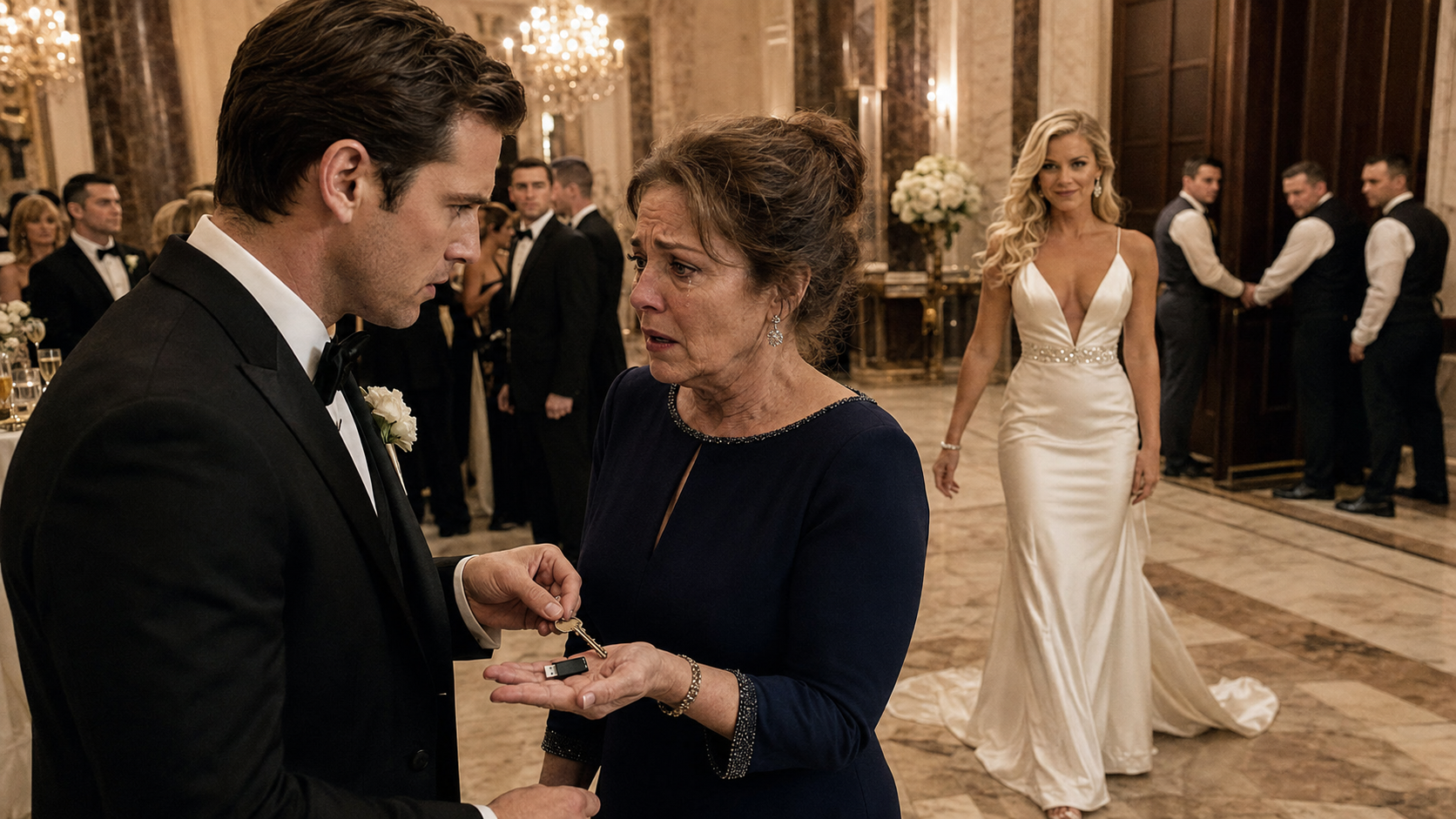
Then, after the ceremony, he crossed the room, took Mary’s shaking hand, and whispered:
“Mom, we have five minutes to set my plan in motion.”
He slipped a brass key and a USB drive into her hand.
He told her Russell had not suffered a simple heart attack.
Caleb believed Valerie slowly poisoned him by tampering with his blood pressure medication.
He believed she isolated Russell, manipulated him into signing the estate over to her, and then got rid of him once he started questioning missing funds.
The police had dismissed Caleb as an estranged son with suspicions and no evidence.
So Caleb gave Valerie exactly what she wanted.
A younger man she believed she could control.
He spent years pretending to love her.
He allowed her to think she had won him completely.
He did it for access.
Valerie kept Russell’s original documents, altered will, financial records, medical receipts, and personal journals locked inside a biometric safe at the estate.
Only a legal resident of the house could give the security system what it needed.
Only a new husband would make Valerie lower her guard.
While Caleb and Valerie stood at the altar, Caleb’s investigator used his new household status to enter the estate and open the vault using Caleb’s stored fingerprint permissions.
Everything was copied and removed.
The USB drive in Mary’s hand contained the evidence.
The brass key opened Russell’s hidden safety deposit box, the one Valerie never knew existed.
Caleb also revealed that the venue’s caterers were not caterers at all.
They were plainclothes detectives positioned to stop Valerie in a public place, surrounded by witnesses, before she could destroy evidence or run.
Mary refused to leave Caleb alone.
He smiled and told her to stand directly behind him.
Valerie approached them in her white silk gown, purring about one big happy family.
Caleb responded loudly enough for the nearby guests to hear.
Then he announced he wanted to give her a wedding gift: a complete merging of assets.
Her eyes lit up with greed.
At that moment, the heavy oak doors opened.
The disguised caterers dropped their trays.
Uniformed officers entered behind them.
Valerie’s smile vanished.
Lead Detective Nora Bennett announced Valerie’s arrest for the murder of Russell Sterling and for multiple counts of fraud and embezzlement.
Valerie lunged at Caleb.
Officers restrained her.
The handcuffs clicked.
Part 2 — The Proof
The USB drive contained more than Caleb had hoped.
Valerie’s safe held Russell’s original will, an altered later will, bank-transfer records, pharmacy receipts, and private journals.
The original will divided Russell’s estate far more fairly.
The altered version gave Valerie near-total control.
The journals were worse.
In them, Valerie recorded changes to Russell’s medication and his physical decline.
One line read:
Lower dose again. He is getting weaker. Good.
Another read:
He keeps asking about the transfers. Must calm him down before he contacts the accountant.
Valerie claimed Caleb planted everything.
Detective Bennett asked if he had also planted the biometric safe, Valerie’s handwritten notebooks, and the receipts stored beneath her bridal jewelry.
Valerie shifted tactics and insisted Russell signed the documents willingly.
More evidence kept appearing.
A guest who had known Russell through business said Russell sounded frightened in the final weeks of his life.
Russell asked whether funds had been moved without authorization.
Valerie tried to call him a liar.
Mary then revealed the brass key.
Russell’s hidden safety deposit box contained letters.
One was addressed to Mary.
One was addressed to Caleb.
One was intended for the police if anything happened to him.
Russell wrote that Valerie controlled his medication.
He wrote that he feared being made sicker on purpose.
He wrote that he believed money was disappearing through accounts he did not recognize.
The bank manager confirmed the letters and financial ledgers were real.
The backup materials also showed shell-account transfers routed through Valerie’s cousin.
As officers secured the scene, more guests came forward.
One remembered Russell looking heavily medicated at a charity event.
Another remembered Valerie joking that older husbands were easier to manage.
What had once sounded cruel now sounded incriminating.
Detective Bennett asked Caleb when he first became suspicious.
He said it began at Russell’s funeral.
Russell’s final months had not looked like natural decline to Caleb.
The longer he investigated, the more Valerie’s story collapsed.
He took the only route left to him.
He got close.
He played wounded.
He made her believe she had complete power.
Valerie responded exactly as he expected.
She did not want love as much as she wanted control.
She mistook obedience for devotion.
That was how Caleb survived beside her long enough to expose her.
As the officers led Valerie away, she screamed that Caleb had wasted years of his life.
He answered:
“No. I got my father back.”
Then Detective Bennett uncovered one more twist.
The journals, letters, and transfer records named an accomplice who helped alter the will and move the money.
That accomplice was present at the wedding.
It was Russell’s longtime accountant, Leonard Pike, one of the reception guests who had been quietly standing near the champagne display all evening.
He had helped Valerie move money through shell companies and disguise it as consulting fees.
When detectives confronted him, Leonard tried to leave through the terrace doors.
Plainclothes officers stopped him.
His phone contained messages from Valerie discussing the forged estate plan and the pressure placed on Russell during his final year.
Leonard was arrested before the reception ended.
Part 3 — The Boy at Twelve and the Man at Thirty-One
Once Valerie and Leonard were taken away, the reception hall fell silent.
Caleb stood perfectly still for a moment.
Then the years finally caught up to him.
His shoulders lowered.
His breath broke.
He turned to Mary and held her tightly.
“It’s over, Mom,” he whispered.
But the ending was not simple.
Russell’s letter to Mary was read the next morning.
In it, he admitted that he had failed her and failed Caleb long before he died.
He said he mistook selfishness for freedom and paid too late for that blindness.
He apologized for leaving Mary to rebuild the family alone.
He asked her not to let Valerie rewrite who he had been before his mistakes.
His letter to Caleb was even more painful.
Russell wrote that he noticed missing funds, changed prescriptions, and growing confusion.
He realized too late that the woman he trusted beside him might be the reason he was falling apart.
He begged Caleb not to sacrifice his life to avenging him.
Caleb had already done exactly that.
The investigation confirmed that Valerie tampered with Russell’s medication over time.
It also confirmed fraud, forged estate documents, and embezzlement with Leonard Pike’s help.
The prosecution built a powerful case.
Valerie was charged with murder, fraud, embezzlement, and conspiracy.
Leonard faced financial-crime charges and conspiracy counts.
Mary testified.
So did Caleb.
The defense tried to paint Caleb as obsessed, manipulative, and emotionally unstable.
But the journals, receipts, letters, and safety-deposit-box records destroyed that strategy.
The jury saw a clear pattern.
Valerie wanted wealth, control, and total access.
Russell became easier to dominate as his health weakened.
When he began asking questions, he became dangerous to her.
Caleb later admitted that the years beside Valerie changed him.
Pretending affection for the woman he believed killed his father was a psychological prison.
He attended events with her.
He listened to her insult Mary.
He smiled through dinners and vacations and public photographs.
He slept lightly and trusted no silence.
He did not call it courage.
He called it endurance.
After the trial, Caleb stepped away from everyone for several months.
He went to therapy.
He stopped trying to act strong every second of the day.
Mary told him she was proud of him, but also angry at how much pain he had carried alone.
He accepted both truths.
Peace did not arrive in one dramatic moment.
It came in ordinary ones.
The first time Caleb slept through the night without checking locks.
The first time Mary laughed with him without hearing Valerie’s voice in the back of her mind.
The first holiday where they did not have to wonder what Russell would have become if he had listened sooner.
Mary eventually opened the safety deposit box herself.
Along with the letters, Russell had left one final instruction.
A portion of his untouched personal funds was to go into a scholarship honoring ethical accounting students—young people trained to protect families from financial abuse and deception.
Mary and Caleb honored that wish.
They also restored what could be recovered from the estate and directed part of it toward a foundation helping families dealing with coercive control and elder financial exploitation.
Caleb never romanticized what he had done.
When one journalist later called it a love story turned revenge story, he corrected her.
“It was never love,” he said. “It was evidence gathering with a wedding ring.”
Mary kept Russell’s letter in a locked drawer for a long time.
Not because it excused him.
Because it proved that in the end, he saw the truth.
And because the little boy who once watched his family break apart had grown into a man willing to break himself open to stop that destruction from happening again.
The guests at the wedding remembered the handcuffs, the screaming, and the white silk dress dragging over marble.
Mary remembered something else.
She remembered the exact moment Caleb slipped the key and the USB into her hand.
The boy whose heart had been shattered at twelve had finally decided that grief would not be the end of his story.
It would be the trap door through which the truth finally came up into the light.


