My Daughter Spilled Wine on Me and Called Me “Just the Waitress”—Then the Manager Asked Me One Question
At my daughter’s engagement dinner in Manhattan, I walked toward her table carrying a small birthday dessert.
Madison sat beside her fiancé, James, in a fitted dark-red designer dress. Her blonde hair had been styled perfectly, diamonds glittered at her ears, and every person at the table looked as though they belonged in a magazine about old money.
I was wearing a white waitress shirt, black vest, black skirt, and the same name badge I had worn on busy nights for years.
I smiled at her.
“Happy birthday, sweetheart.”
Madison’s expression changed instantly.
She looked at James’s parents, then at his aunt, then at the two family friends seated across from her.
Her smile disappeared.
“Don’t call me that,” she said through clenched teeth. “You’re just the waitress.”
For a moment, I thought I had misheard her.
Then she deliberately pushed her wineglass over.
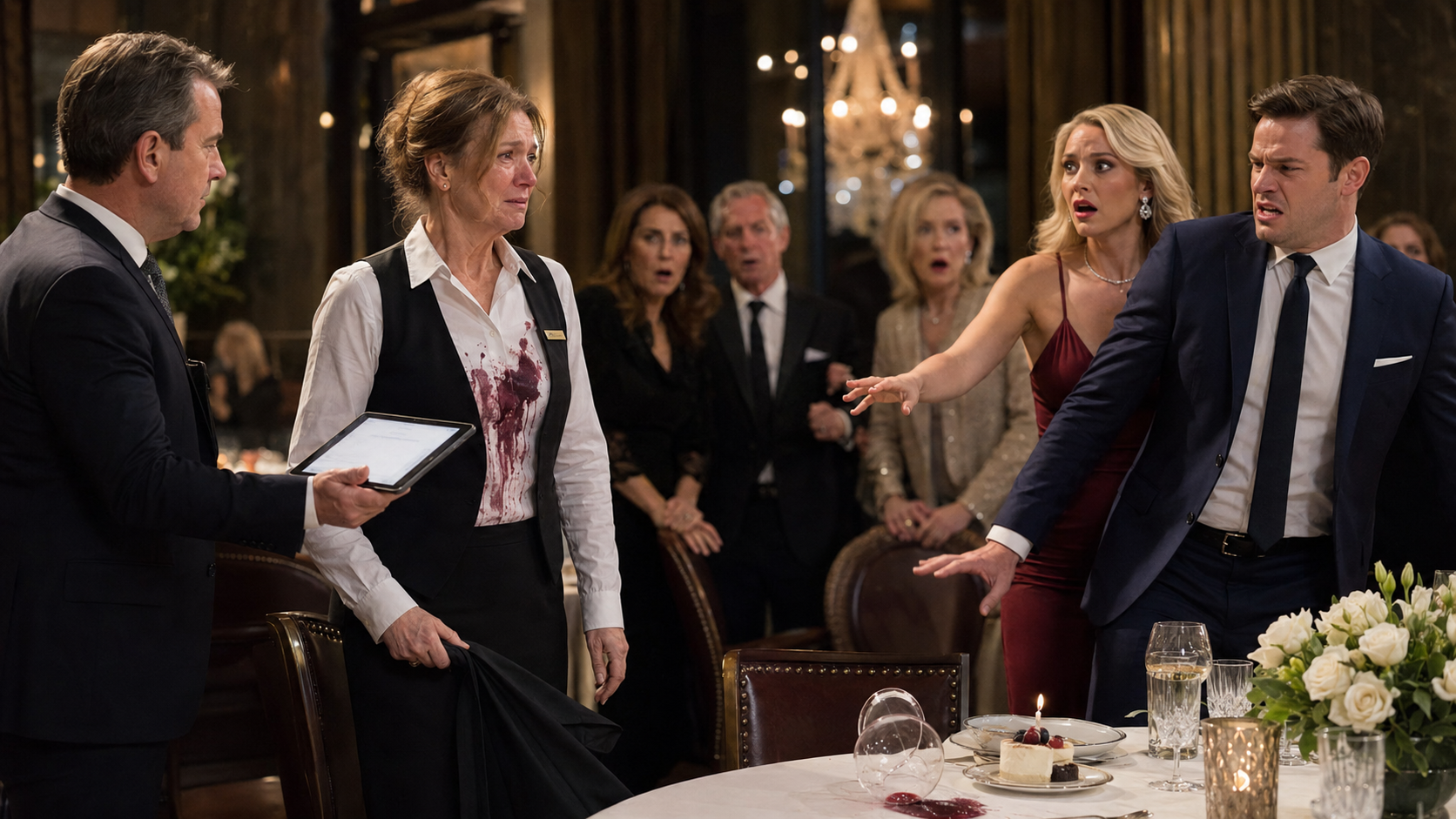
Red wine spilled across the table and down the front of my uniform.
“Then clean this up,” she said loudly. “And stay away from my table.”
Nobody laughed.
James stared at her.
His mother lowered her fork.
His father looked at me with visible discomfort.
I looked down at the stain spreading across the white shirt.
My hands did not shake.
But my chest hurt.
I remembered paying Madison’s first college tuition bill after working sixteen hours straight.
I remembered waiting in a laundromat at two in the morning because our washing machine had broken and I could not afford a new one.
I remembered the year she needed orthodontic work and I quietly canceled a medical procedure I had been saving for.
I remembered every sacrifice I had never mentioned because I thought a mother was supposed to make hardship disappear before her child could see it.
Then our restaurant manager, Thomas, rushed into the room.
Madison leaned back in her chair with a satisfied expression.
She clearly expected him to apologize to the wealthy guests and remove me.
Instead, Thomas stopped beside me.
“Mrs. Bennett,” he said, “should I cancel their wedding reservation?”
Madison’s face lost all color.
James looked at him.
“Mrs. Bennett?”
Madison’s hand tightened around his arm.
“It’s complicated.”
“No,” James said. “It suddenly sounds very simple.”
I slowly removed my stained apron.
Thomas waited.
Madison looked at me.
“Mom, please.”
It was almost impressive how quickly I became her mother again.
James turned toward her.
“Your mother owns this restaurant?”
Madison answered too quickly.
“She owns some of it.”
Thomas looked uncomfortable, but he corrected her.
“Mrs. Bennett owns seventy-eight percent of Bennett House Hospitality.”
James’s father raised his eyebrows.
Thomas continued.
“That includes this restaurant, the private events company, and our expansion properties.”
James looked at me with surprise.
I nodded.
“I started as a waitress here nineteen years ago,” I said. “I still work the floor sometimes because I like knowing what is actually happening in my own restaurant.”
Madison’s jaw tightened.
“You never needed to do that tonight.”
“No,” I said quietly. “I wanted to bring my daughter a birthday dessert.”
James removed Madison’s hand from his arm.
The movement was small.
But everyone saw it.
Madison turned toward him.
“James, she’s making this dramatic.”
“I watched you pour wine on your mother.”
“I was embarrassed.”
“Of what?”
She did not answer.
James looked at my uniform.
“Of her working?”
Still nothing.
“Or of people knowing where you came from?”
Madison stood.
“You don’t understand my family.”
“No,” James said. “I’m starting to.”
Thomas handed me the tablet containing the wedding contract.
Madison and James had requested the restaurant’s entire private event floor, ballroom service, rooftop cocktail hour, imported flowers, custom catering, and a late-night reception.
The estimated total was more than most people earned in several years.
The booking required my final approval because Madison had requested a family-rate package far below our normal price.
James looked at the screen.
“You told me this was already confirmed.”
Madison swallowed.
“It basically was.”
“No,” I said. “It was waiting for my signature.”
James looked at her slowly.
“So you needed your mother’s restaurant.”
Madison crossed her arms.
“We were giving her business.”
Thomas actually looked away.
I almost laughed.
Instead, I asked him to bring me the blue folder from my office.
Madison’s expression changed.
“No.”
James noticed.
“What’s in the folder?”
“Nothing.”
I looked at my daughter.
“You signed it, Madison.”
Her voice dropped.
“Mom, not here.”
“Why not? You were comfortable speaking publicly when you thought I had less power than you.”
Thomas returned with the folder.
Inside was an agreement Madison had signed three months earlier.
She had approached me privately after James proposed.
She said his family expected a certain type of wedding.
She said she could not afford it.
Then she asked me for help.
I agreed to subsidize the event under one condition: there would be no lying about who was paying for it.
Madison signed the agreement.
But she had apparently told James and his parents a very different story.
James read the first page.
His expression hardened.
“You told us your investment account was covering this.”
Madison looked around the table.
“I was going to explain.”
“When?” James asked. “After the wedding?”
She reached for his hand.
He stepped back again.
I turned to the second page.
It listed deposits I had already paid to outside vendors at Madison’s request.
Flowers.
Photography.
A custom cake.
A designer planner.
A hotel block for James’s relatives.
Madison had thanked me privately for every payment.
Then, in front of the same people benefiting from them, she had called me “just the waitress.”
James’s mother looked at Madison with deep disappointment.
“Why would you hide this?”
Madison’s eyes filled with panic.
“Because you don’t know what it’s like to enter a family like yours.”
James’s father shook his head.
“Do not blame us for what you just did.”
Madison turned on me.
“You wanted this.”
“No.”
“You wanted to humiliate me.”
I looked at the wine stain on my shirt.
“I walked in carrying cake.”
That silenced the room.
Madison’s eyes filled with angry tears.
“You always do this. You act humble so everyone thinks you’re better than me.”
For the first time that night, I understood something I had refused to see for years.
Madison was not ashamed because I had failed.
She was ashamed because my history contradicted the version of herself she had created.
She wanted people to believe she had grown up around money.
She had told James she attended private schools her entire childhood.
She had not.
She had told his family her parents were entrepreneurs.
Her father had disappeared when she was eight, and I had scrubbed restaurant floors before I ever owned a company.
She had turned my sacrifices into details she needed erased.
I looked at Thomas.
“Cancel everything.”
Madison froze.
“Mom.”
“She is no longer using my restaurant.”
Thomas nodded once.
“I’ll handle it.”
Madison rushed toward me.
“You can’t do this. The wedding is in five months.”
“I can return the refundable deposits and pay the cancellation penalties on the vendors I contracted personally.”
Her breathing became fast.
“What about the ballroom?”
“You can find another one.”
“You know Manhattan is booked.”
“I do.”
She stared at me in disbelief.
James took a slow breath.
“Stop talking about the venue.”
Madison turned toward him.
“What?”
He removed the engagement announcement card from his jacket pocket and placed it on the table.
“I just watched you humiliate the woman who raised you, paid for your education, helped finance our wedding, and apparently owns the restaurant you pretended was beneath you.”
“James—”
“I need time away from you.”
She grabbed his sleeve.
“Please don’t do this in front of everyone.”
He looked at the red wine dripping from the edge of the table.
“You started doing things in front of everyone.”
Then he walked out.
Madison stood frozen.
The wealthy guests she had tried so hard to impress would barely look at her.
James’s mother approached me before leaving.
“I am sorry,” she said. “No one deserves what happened here.”
I thanked her.
Then the room emptied.
Madison remained behind.
For several minutes, neither of us spoke.
Finally, she whispered, “Are you happy now?”
“No.”
“You ruined my engagement.”
“No, Madison. I canceled a reservation.”
Her eyes filled with tears.
“You know what I mean.”
“I do. And that is why you need to hear this clearly. I did not make James step away from you. I did not make you lie about the wedding. I did not make you pour wine on me. Those choices were yours.”
She wiped her face angrily.
“I was scared they would judge me.”
“So you judged me first.”
She had no answer.
I picked up the stained apron from the chair.
Before leaving, I turned back toward her.
“When you were little, I wanted you to have every opportunity I never had. Somewhere along the way, you learned to believe having more made you worth more.”
Madison looked down.
“I should have taught you better.”
That was the last thing I said that night.
James did not return to the apartment he shared with Madison.
Three days later, he asked for the engagement ring back.
He told her he was not ending the relationship because her mother was wealthy or because the wedding venue had disappeared.
He ended it because he had seen how quickly Madison could become cruel when she believed someone had lower status than her.
The wedding was canceled.
The deposits were settled.
The restaurant continued operating.
And I continued working occasional dinner shifts.
Some people asked why I would still carry plates when I could sit upstairs in an office.
The answer was simple.
There is dignity in honest work.
The shame belongs to people who cannot recognize it.
Madison and I did not speak for nearly two months.
Then one rainy afternoon, she arrived at the restaurant without makeup, without diamonds, and without the polished confidence she usually wore like armor.
She sat at a corner table until my shift ended.
When I approached, she stood.
“I’m sorry,” she said.
I waited.
She looked at my uniform.
Then at the floor.
“I was ashamed of the wrong person.”
I did not hug her immediately.
Forgiveness is not the same as pretending something never happened.
But I sat down.
And for the first time in years, my daughter told me the truth.
She admitted she had spent so long trying to look successful that she had begun treating anyone connected to her old life as a threat.
She admitted she had lied to James.
She admitted she had used my generosity while resenting the fact that she needed it.
And she admitted the cruelest part of all.
When I walked toward her with that birthday dessert, she had seen her mother.
But she chose to call me the waitress because she thought the people around her would respect her more.
She was wrong.
It cost her the man she planned to marry.
It cost her the wedding she wanted.
And for a while, it nearly cost her me.
Six months later, Madison began working with a therapist and took a job with a nonprofit hospitality program that trained low-income women for restaurant careers.
I did not arrange the position.
I did not donate money to get her in.
I told her that if she wanted to rebuild her life, she needed to do some things without my name, my money, or my restaurant protecting her.
She agreed.
On my sixtieth birthday, Madison came to Bennett House after closing.
She carried a small dessert with one candle.
She placed it in front of me and smiled nervously.
“Happy birthday, Mom.”
I looked at her for a long moment.
Then I smiled.
“Thank you, sweetheart.”
This time, she did not look around to see who was watching.