My father built Bennett Manufacturing from a rented warehouse and one secondhand machine.
By the time I was thirty-six, the company employed more than four hundred people across Illinois and Indiana.
To the outside world, it was a family success story.
Inside the family, things were more complicated.
My father, William Bennett, had two children.
Jason was five years older than me.
He had always assumed one fact was inevitable:
One day, the company would be his.
Nobody had officially promised him that.
But nobody had stopped him from believing it either.
Jason joined Bennett Manufacturing immediately after college.
He liked titles.
Vice President of Development.
Executive Strategy Director.
Senior Managing Partner.
Every few years, he created a new position for himself.
I joined later.
I started in operations.
No corner office.
No executive assistant.
My father made me spend six months working on the manufacturing floor before I was allowed into management.
At the time, I resented him.
Years later, I understood.
I learned what the company actually did.
I knew which machines constantly failed.
Which supervisors could solve problems before senior management even knew they existed.
Which customers paid late.
Which contracts looked profitable but weren’t.
Jason knew golf courses.
I knew production.
For years, that difference didn’t matter.
Dad remained firmly in charge.
Then he got sick.
Not terminally.
But seriously enough that he underwent heart surgery and spent months recovering.
That was when things changed.
I became acting operations president.
Jason handled more of Dad’s financial and administrative responsibilities.
At least, that was what I thought.
Dad recovered.
The company stabilized.
Then, shortly before his sixty-eighth birthday, he announced his retirement.
“I’m done,” he told us.
Jason laughed.
“You’ve said that three times.”
“This time I bought a boat.”
Dad hated boats.
That was how we knew he was serious.
He planned a private retirement dinner at an upscale Chicago steakhouse.
Family.
Senior executives.
Several longtime clients.
Around thirty people.
Dad didn’t want a ballroom.
He didn’t want speeches.
He wanted a steak and a glass of bourbon.
For the first hour, everything was pleasant.
Sarah Mitchell, our CFO, gave a short toast.
Dad embarrassed me by telling everyone about the first time I accidentally shut down an entire production line.
Jason told stories about traveling with Dad for business.
Then dessert arrived.
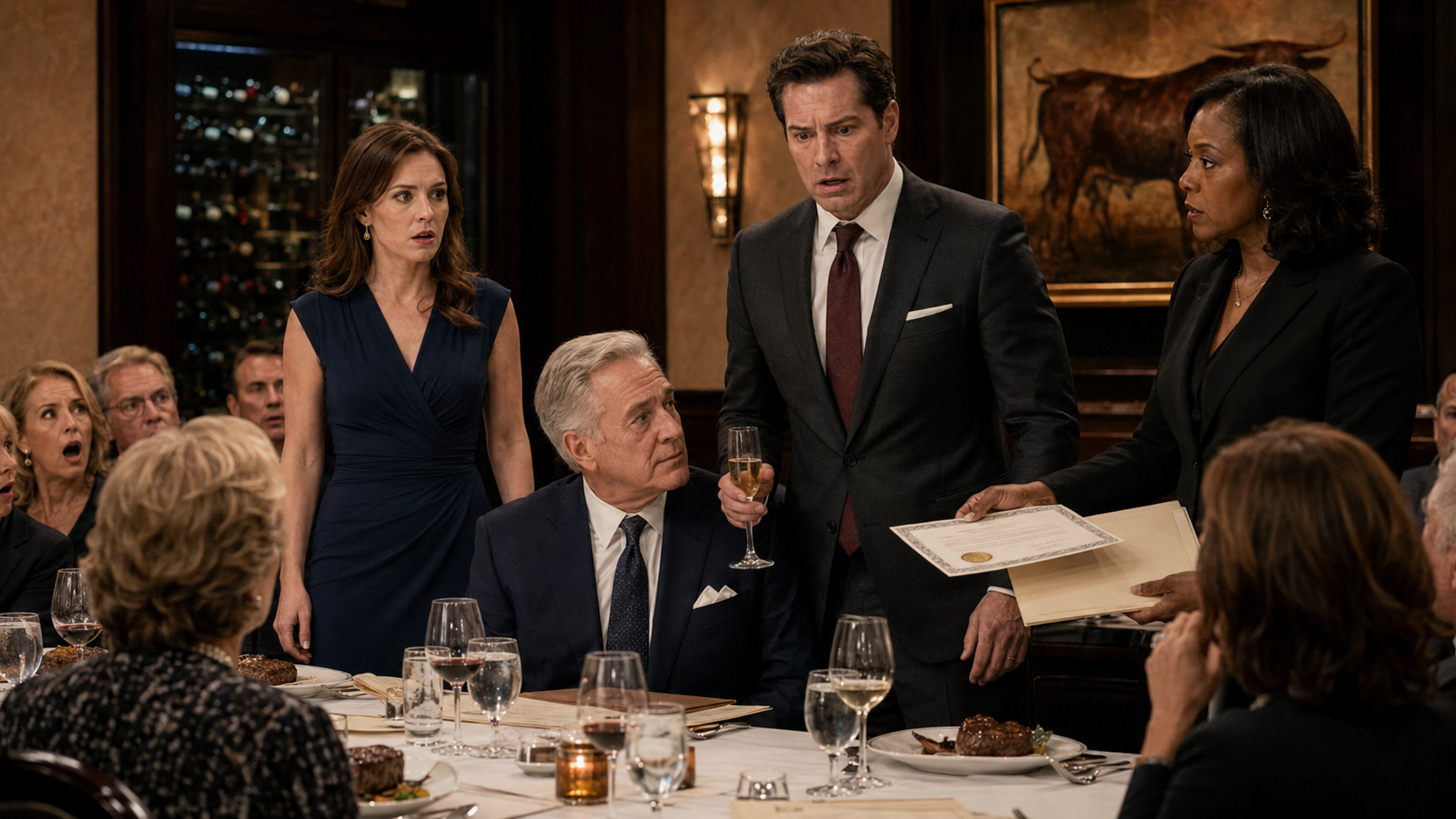
Jason stood.
He raised his champagne glass.
“Before Dad officially retires, there’s one more announcement.”
Dad looked at him.
“What announcement?”
Jason smiled.
“You’ll see.”
Something in my stomach tightened.
My brother enjoyed surprises only when someone else was uncomfortable.
He turned toward me.
“Laura.”
“Yes?”
“You should probably pack your office tomorrow.”
People laughed nervously.
I stared at him.
“What?”
Jason smiled wider.
“You’re fired.”
Nobody laughed anymore.
Dad’s face changed.
I looked around the table.
Several executives stared at their plates.
Others looked directly at Jason.
I slowly stood.
“Explain.”
“You’ve done good work.”
I almost laughed.
“Thank you.”
“But the company is moving in a different direction.”
“What direction?”
“Mine.”
He adjusted his jacket.
“Dad is retiring. I’m taking over.”
My father hadn’t spoken.
That worried me.
Jason continued.
“Operations needs new leadership.”
I folded my arms.
“And you decided to announce this during Dad’s dinner?”
“I thought everyone deserved clarity.”
I looked at Dad.
“Did you approve this?”
Jason answered for him.
“He doesn’t need to.”
That was the first mistake.
Dad slowly put his fork down.
Jason continued.
“I control the company now.”
Dad finally spoke.
“No.”
My brother turned.
“What?”
Dad wiped his mouth with his napkin.
“You don’t.”
Jason laughed.
“Dad, we’ve already discussed succession.”
“We discussed responsibilities.”
“Same thing.”
“No.”
Dad looked at him for several seconds.
“You own ten percent.”
Jason’s expression changed.
I thought I had misheard.
So did everyone else.
“What?” Jason asked.
Dad repeated it.
“You own ten percent of Bennett Manufacturing.”
Jason stared at him.
“That isn’t possible.”
“Why?”
“Because you transferred the shares.”
“Yes.”
“To me.”
“No.”
Dad turned toward me.
“To Laura.”
I stopped breathing.
Jason laughed.
Not because it was funny.
Because he genuinely believed Dad was confused.
“Dad, Laura doesn’t own the company.”
Dad smiled slightly.
“She owns fifty-one percent.”
Every person at the table became silent.
I looked at him.
“Fifty-one?”
Dad nodded.
“You’ve been effectively running it for three years.”
Jason’s face reddened.
“You can’t do that.”
Dad raised an eyebrow.
“I founded it.”
“You promised me control.”
“I never promised you ownership.”
“You told me I would run the company.”
“I told you both of you would have roles.”
Jason pointed toward me.
“She doesn’t even know she owns it!”
Dad looked amused.
“She knows now.”
I almost wanted to disappear.
Not because I was embarrassed.
Because I suddenly understood why Dad had asked me to sign several documents months earlier.
I thought they were part of a routine restructuring plan.
Our attorney had explained voting rights.
Share classes.
Estate taxes.
I had signed where instructed.
Apparently I had not understood the scale of the transfer.
Jason looked furious.
“This is insane.”
Dad leaned back.
“Sit down.”
“No.”
“Jason.”
“You gave her control because she played nurse while you were sick?”
My stomach turned.
I stepped toward him.
“Be careful.”
He looked at me.
“You’ve wanted this your whole life.”
“No.”
“Yes.”
“You’re projecting.”
He laughed.
Then the dining-room doors opened.
Sarah Mitchell walked in.
She had left twenty minutes earlier after receiving a call.
Now she carried a thick cream folder.
Jason saw her.
His anger became irritation.
“Why are you coming back in?”
Sarah ignored him.
She walked directly to Dad.
“Everything is confirmed.”
Dad nodded.
“Thank you.”
Jason looked between them.
“What is confirmed?”
Sarah placed the folder on the table.
Dad gestured toward an empty chair.
“Sit down.”
Jason remained standing.
“What is going on?”
Sarah opened the first section.
Share certificates.
Amended ownership agreements.
Board resolutions.
Corporate records.
She placed one document in front of Jason.
He looked at it.
Then looked again.
His ten percent was clearly recorded.
Mine was fifty-one.
Dad retained twenty-four.
The rest had been distributed through employee ownership and a family trust.
Jason stared at the paper.
“This isn’t valid.”
Sarah said calmly:
“It was reviewed by outside counsel.”
“You work for Dad.”
“I work for the company.”
That distinction mattered now.
Jason turned toward me.
“So what? You’re going to fire me?”
I hadn’t even processed owning fifty-one percent.
“I haven’t decided anything.”
He smiled bitterly.
“Of course.”
Dad sighed.
“Jason, this evening could have ended with a conversation about your future role.”
My brother laughed.
“My future role?”
“Yes.”
Then Dad looked toward Sarah.
“But you decided to make other things relevant.”
Sarah opened the second section of the folder.
That was when Jason’s expression changed again.
This time, fear replaced anger.
I noticed.
Dad noticed.
“What’s in there?” I asked.
Sarah looked at Jason before answering.
“Financial irregularities.”
My brother immediately scoffed.
“Seriously?”
Sarah continued.
“During the ownership restructuring, we conducted a full review of executive-authorized payments.”
Jason folded his arms.
“And?”
“We identified consulting expenses that did not correspond with operating projects.”
“How much?”
Sarah looked at me.
“Six hundred forty thousand dollars.”
I thought she meant a budgeting discrepancy.
Jason knew she didn’t.
His face had gone pale.
Dad asked:
“Do you want to explain?”
Jason looked around the room.
“This isn’t the place.”
I almost laughed.
“You just fired me here.”
He glared at me.
“Stay out of this.”
Sarah corrected him.
“She owns fifty-one percent. She cannot stay out of it.”
That sentence landed hard.
Jason looked at Sarah.
“Those were legitimate consulting payments.”
“To whom?”
“Various vendors.”
Sarah removed several invoices.
“North Star Advisory.”
Jason said nothing.
“Lakefront Strategic Partners.”
Still nothing.
“And Holloway Development Consulting.”
Dad leaned forward.
“Do you recognize them?”
Jason looked annoyed.
“Of course.”
“What did they do?”
“Business development.”
Sarah asked:
“Specifically?”
Jason looked at her.
“You’re the CFO. You have the contracts.”
Sarah nodded.
“I do.”
She opened another section.
“The contracts describe market analysis, supplier restructuring, and acquisition strategy.”
“So?”
“We asked the relevant departments.”
Jason’s jaw tightened.
Sarah continued.
“No one received any of those services.”
People around the table shifted uncomfortably.
Jason finally said:
“Not every executive consultation involves operations.”
“Correct.”
Sarah nodded.
“Which is why we traced ownership.”
She placed another page down.
“North Star uses the same registered office as Lakefront Properties LLC.”
Jason looked away.
Sarah continued.
“Lakefront Properties belongs to Amanda Bennett.”
Jason’s wife.
Amanda was sitting three seats away.
Her face went white.
She whispered:
“What?”
Jason turned toward her.
“Don’t.”
Amanda looked at Sarah.
“I don’t own a consulting company.”
Sarah said:
“You own the LLC receiving payments.”
Amanda’s hands began trembling.
“I don’t know what she’s talking about.”
Jason interrupted.
“You signed formation papers.”
“For the lake house!”
He said nothing.
Amanda’s eyes widened.
“What did you do?”
Jason looked at Dad.
“This has nothing to do with her.”
Dad answered:
“You used her company.”
“I used an existing entity.”
“To send Bennett Manufacturing money to yourself?”
“It wasn’t to myself.”
Sarah opened the bank tracing summary.
Payments from Bennett Manufacturing went to the LLC.
From there, money paid for:
A luxury SUV.
Private club memberships.
Credit card balances.
Renovations to Jason and Amanda’s Wisconsin lake property.
And several personal investment losses.
Amanda stared at her husband.
“You told me your bonus paid for the renovations.”
Jason whispered:
“Not now.”
“When?”
“Later.”
“Later?”
Her voice rose.
“You used my name?”
Jason slammed his hand on the table.
“I was fixing a cash-flow problem!”
Dad’s voice became quiet.
“What cash-flow problem?”
Jason looked at him.
“My investments.”
Dad stared.
“So company money fixed your investments?”
“I was going to repay it.”
Dad closed his eyes.
There it was again.
The phrase people use after taking money they had no right to take.
I was going to repay it.
Sarah wasn’t finished.
“Some authorizations occurred while William was hospitalized.”
Dad looked at her.
“I signed nothing during that period.”
Sarah nodded.
“We know.”
Jason’s eyes moved toward the door.
I noticed.
“Were Dad’s signatures forged?”
He immediately answered:
“No.”
Too fast.
Sarah opened another file.
Several electronic approvals carried Dad’s credentials.
Dad looked at Jason.
“You changed my passwords.”
Jason said nothing.
I remembered.
After surgery, Dad complained he couldn’t access several systems.
Jason said cyber security had forced password resets.
He personally “helped” restore access.
Dad stared at him.
“You changed my passwords.”
Jason finally said:
“You couldn’t remember them.”
“I was sedated after open-heart surgery.”
“You needed help.”
“So you helped yourself?”
Jason’s jaw tightened.
“I had authority.”
“No.”
Sarah corrected him.
“You had administrative access. Not authority to move money.”
My brother looked around the table.
“This is a family business. Everyone here acts like I stole from strangers.”
That sentence changed Dad’s face.
He stood.
Jason became quiet.
My father rarely raised his voice.
He didn’t need to.
“You think stealing from family is less serious?”
Jason looked away.
Dad continued.
“I trusted you with access because you were my son.”
“I was trying to protect the company.”
“From what?”
“My mistakes?”
Jason said nothing.
Dad shook his head.
“No. You were protecting yourself from your mistakes using the company.”
Amanda began crying.
Jason looked at her.
“Stop.”
She stood.
“You don’t get to tell me to stop.”
She removed her wedding ring.
Not dramatically.
She simply put it beside her plate.
Jason stared at it.
“Amanda.”
“You put my name on companies I didn’t understand.”
“I explained everything.”
“You told me they were for property management.”
“They were.”
Sarah said gently:
“Some were.”
Amanda looked at Jason.
“What else don’t I know?”
He couldn’t answer.
Dad sat back down.
For the first time that night, Jason looked defeated.
Then Sarah said:
“There is one more thing.”
My brother looked at her.
“What?”
“A recording.”
His expression changed instantly.
“What recording?”
Sarah opened her tablet.
Three weeks earlier, Jason had met with our procurement director, Frank Mason.
Jason wanted Frank to approve another consulting contract worth $250,000.
Frank thought the arrangement was suspicious.
He refused.
Jason became angry.
The meeting took place in one of our conference rooms.
The room’s video system automatically recorded because an external vendor was originally scheduled to join remotely.
The vendor canceled.
Nobody disabled the recording.
Jason apparently forgot it existed.
Sarah pressed play.
Jason’s voice filled the private dining room.
“Once Dad retires, Laura is gone.”
I stopped breathing.
Frank asked:
“Does William know?”
Jason:
“He won’t care once I control voting rights.”
Frank:
“And Sarah?”
Jason laughed.
“She works for whoever owns the company.”
Sarah raised an eyebrow.
The recording continued.
Frank asked about the consulting payments.
Jason’s voice became lower.
“After the transition, I can clean up the ledger.”
Frank:
“What does that mean?”
Jason:
“Move things where nobody asks questions.”
Sarah stopped playback.
Nobody spoke.
Jason stared at the table.
Dad looked older.
Not physically.
Emotionally.
My father had built Bennett Manufacturing for forty-three years.
He had survived recessions.
Factory fires.
Lawsuits.
Customers going bankrupt.
He had nearly died during surgery.
But sitting at that table, the thing that seemed to hurt him most was his son.
Jason finally said:
“I wasn’t going to steal forever.”
Dad looked at him.
“That’s your defense?”
“No.”
Jason’s voice broke.
“I got in over my head.”
“Then why didn’t you ask me?”
“You always thought Laura was better.”
I stared at him.
Dad didn’t answer immediately.
Jason continued.
“She was always the responsible one.”
“That isn’t true.”
“Yes, it is.”
“You had every opportunity she had.”
“No.”
“You had more.”
Jason looked up.
Dad’s voice softened.
“I spent years making excuses for you because you were my first son.”
Jason started crying.
“I wanted you to trust me.”
Dad nodded toward the folder.
“I did.”
That ended the argument.
The retirement dinner stopped being a celebration.
Our outside attorneys arrived later that night.
Nobody called police from the restaurant.
The financial review needed to be completed first.
But by the following week, Jason had been suspended from all company duties.
His system access was revoked.
Corporate cards frozen.
Board authority removed.
I became interim chair.
Not because I wanted revenge.
Because somebody had to keep four hundred employees from wondering whether the company was collapsing.
The audit took three months.
The final amount exceeded the original $640,000.
Additional questionable transactions brought the total closer to $790,000.
Some could be legitimately explained.
Much could not.
Jason eventually admitted using company funds without authorization.
He sold the lake property.
The luxury SUV.
Several investments.
Restitution covered a significant portion of the loss.
The legal consequences were complicated and took more than a year.
Civil claims.
Tax corrections.
Corporate settlements.
A criminal investigation.
Jason eventually entered a plea agreement involving financial offenses and restitution.
He avoided the worst possible sentence partly because money was repaid and because Dad refused to exaggerate anything investigators could not prove.
That surprised me.
“You’re still protecting him,” I told Dad.
He shook his head.
“No.”
“Then why?”
“Truth should be enough.”
He looked at me.
“I don’t need revenge added to it.”
Dad’s retirement continued.
He bought the boat.
He hated it.
He sold it four months later.
Then he started volunteering with a technical-school program.
I remained CEO.
That part terrified me.
For years, I thought my value came from being useful behind the scenes.
Owning fifty-one percent changed nothing about who I was.
It simply made the responsibility impossible to avoid.
Sarah stayed CFO.
She became the person I trusted most at work.
Amanda filed for divorce.
She cooperated with the financial investigation and was not accused of knowingly participating in the transfers.
Her name had been used.
Like Dad’s.
Like the company.
Jason lost more than money.
He lost credibility.
That took longer to rebuild.
For almost a year, Dad refused to discuss business with him.
They met for breakfast sometimes.
Talked about sports.
Family.
Weather.
Anything except Bennett Manufacturing.
Then one morning, Jason asked Dad:
“Do you hate me?”
Dad told me about the conversation later.
His answer was simple.
“No.”
Jason apparently cried.
Then Dad added:
“But loving you doesn’t require trusting you.”
That distinction became important in our family.
We stopped treating forgiveness as restoration.
Forgiveness could happen emotionally.
Trust required evidence.
Time.
Consistency.
Two years after the retirement dinner, Jason came to our annual company picnic.
Not as an executive.
As Dad’s guest.
Several employees avoided him.
He understood.
One older machinist named Ray eventually walked over.
Ray had worked for Dad for thirty years.
Jason held out his hand.
Ray didn’t take it.
He said:
“You know what bothered us?”
Jason nodded.
“The money.”
Ray shook his head.
“No.”
Jason looked confused.
Ray pointed toward the factory.
“Those accounts paid people’s wages.”
Jason became quiet.
Ray continued.
“When executives steal from a company, they like to think they’re stealing from a building.”
He pointed toward employees eating with their families.
“They’re stealing certainty from people.”
Jason lowered his eyes.
“I know.”
Ray finally shook his hand.
“Good.”
That was the beginning of something.
Not redemption.
Not yet.
Recognition.
My relationship with Jason remains complicated.
We talk.
We have dinner occasionally.
He has never returned to Bennett Manufacturing.
I don’t believe he should.
Neither does Dad.
The company eventually created stronger financial controls.
No executive can approve large vendor contracts alone.
Ownership connections are independently checked.
Password access is separated from financial authority.
And every year, Sarah jokes during the audit:
“Remember when we trusted people?”
I laugh.
Then immediately feel guilty.
Because trust wasn’t the mistake.
Blind trust was.
Dad taught me that later.
We were sitting together on his back porch.
I asked whether he regretted transferring control to me.
“No.”
“Not even after everything it did to the family?”
He looked surprised.
“Laura, the transfer didn’t do anything.”
“What do you mean?”
“Jason’s choices did.”
I thought about that.
For a long time, I believed Dad giving me fifty-one percent had somehow caused the conflict.
Maybe if ownership had been equal…
Maybe if Dad had prepared Jason better…
Maybe if I had known earlier…
Dad stopped that thinking.
“People blame the truth because lies were comfortable.”
He looked at me.
“Don’t do that.”
I never forgot it.
At the retirement dinner, Jason thought he was making a power move.
He stood in front of our family, our executives, and the founder of the company and told me:
“You’re fired.”
For several seconds, he believed everyone at that table was watching my career end.
Then Dad said:
“You might want to check who owns the company.”
The room changed.
But ownership wasn’t what ultimately destroyed Jason’s plan.
Evidence did.
The missing money.
The fake vendors.
The passwords.
The recorded meeting.
Jason had spent months preparing to remove me because he believed I was the person standing between him and control.
He misunderstood.
I wasn’t standing between him and the company.
His own choices were.
And once the truth reached that dinner table, there was no one left for him to fire.