My father was still alive when my brother told the hospital staff I was no longer allowed in his room.

At first, I thought there had been a mistake.

I had spent almost every evening beside Dad since his surgery.

His name was Richard Bennett.

He was seventy-one years old, stubborn, funny, and the kind of man who still balanced his checkbook with a pen even though his bank had an app.

Three weeks earlier, he had gone into the hospital for what doctors expected to be a straightforward procedure.

Complications followed.

An infection.

Low blood pressure.

Several days in intensive care.

Then gradual improvement.

By the second week, Dad was speaking clearly again.

He asked about his dog.

He complained about hospital coffee.

He reminded me that his property-tax payment was due on Friday.

That was my father.

So when I arrived on a Wednesday morning and found my brother Michael standing outside Dad’s room with his wife Vanessa, I expected them to tell me Dad was sleeping.

Instead, Michael held up a legal folder.

“You can’t go in.”

I stared at him.

“What?”

“Dad signed a medical power of attorney.”

He tapped the folder.

“I make the decisions now.”

I thought he was joking.

Our father had already completed healthcare paperwork two years earlier.

I was listed as his primary medical agent.

Michael was listed as alternate.

Dad had chosen that order for one reason.

I lived fifteen minutes away.

Michael lived nearly an hour away.

Dad had explained it to both of us.

No drama.

No favoritism.

Just logistics.

I looked at the folder.

“When did he change it?”

Vanessa answered before Michael could.

“This week.”

I reached for the papers.

Michael pulled them back.

“You don’t need to see them.”

“Apparently I do.”

He lowered his voice.

“Claire, stop making everything a fight.”

I almost laughed.

“I came here to visit Dad.”

“He doesn’t want to see you.”

That sentence stopped me.

Then, from inside the room, I heard a weak voice.

“Claire?”

My father.

I looked at Michael.

“You said he doesn’t want me here.”

Michael’s face tightened.

“He’s confused.”

Dad called again.

“Claire?”

I stepped toward the door.

Michael blocked me.

“Give him space.”

I felt anger rise so fast it scared me.

“Move.”

Vanessa stepped closer.

“Security can remove you if necessary.”

That was when Nurse Elena came out of Dad’s room.

She had cared for him for several days.

She knew me.

She knew Michael.

She looked at the three of us.

“What’s happening?”

Michael immediately spoke in a calm voice.

“My father is asking for quiet. Claire is upsetting him.”

I stared at him.

Elena looked through the doorway.

Dad called my name again.

She looked back at Michael.

“He’s asking for her.”

Michael held up the folder.

“I’m his medical power of attorney.”

Elena did not react.

“Let me see the document.”

He handed it to her.

She read the first page.

Then the signature page.

Her expression changed slightly.

“Who witnessed this?”

Vanessa said:
“A mobile notary.”

“When?”

“Monday morning.”

Elena looked at the date.

Then she looked at me.

Something was wrong.

I asked:
“What time was it signed?”

Michael said:
“Why does that matter?”

Elena answered:
“Because medication timing matters.”

She checked Dad’s electronic chart.

The document was dated 7:05 a.m.

At 6:24, Dad had been given a sedative after becoming agitated during a painful dressing change.

At 7:12, the nursing record described him as disoriented.

At 7:18, he tried to remove his IV because he believed he was in his own bedroom.

I looked at Michael.

“He couldn’t give legal consent.”

Michael snapped:
“You’re not qualified to say that.”

I said:
“Neither are you.”

Vanessa folded her arms.

“You always do this.”

“Do what?”

“Act like you’re the only person who cares about him.”

I stared at her.

“This is not about who cares more.”

Michael raised the folder.

“It’s about what Dad signed.”

Then Elena spoke quietly.

“There may be something else.”

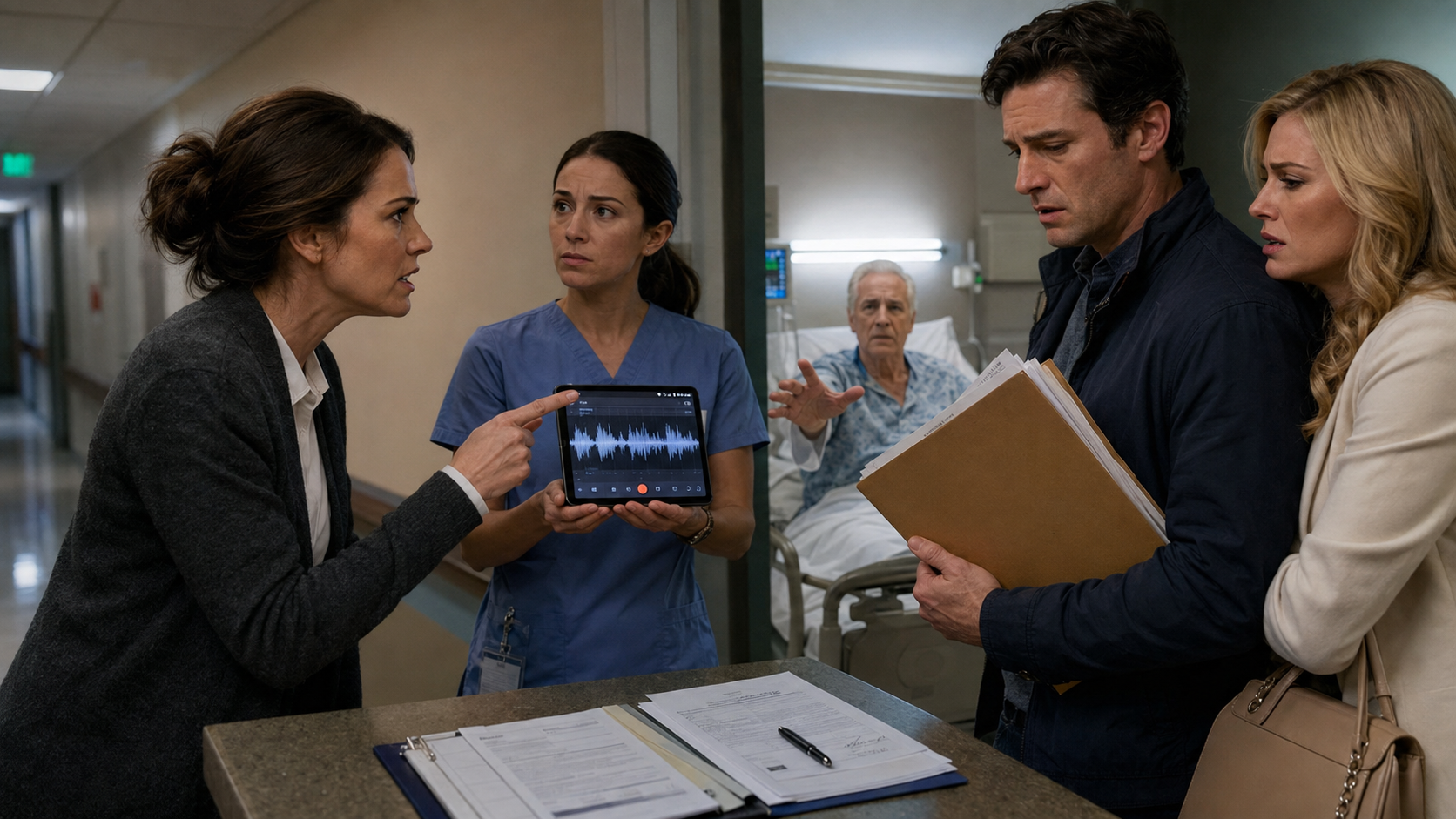
She walked to the nursing station.

A minute later, she returned holding a hospital tablet.

Michael looked irritated.

“What is that?”

“A safety recording.”

Vanessa’s face changed.

“What recording?”

Elena explained that Dad’s room had a digital call system.

When a patient activated the call button, the system captured a short audio log connected to the request.

Most recordings were mundane.

Water.

Pain medication.

Help getting out of bed.

But early Monday morning, Dad had pressed the call button while Michael and Vanessa were inside the room.

A code emergency elsewhere on the floor delayed the nurse response.

The recording continued.

Elena pressed play.

We heard the room.

Machines.

Dad breathing.

Paper moving.

Then Vanessa’s voice.

“Just sign where Michael marked it.”

Dad answered.

“What is it?”

“A hospital form.”

Michael spoke.

“It lets me talk to the doctors for you.”

Dad said:
“I already told Claire she handles my medical papers.”

My brother went completely still.

On the recording, Vanessa answered:

“Claire isn’t here.”

Dad said:

“Then wait until she is.”

I looked at Michael.

He reached for the tablet.

“Turn that off.”

Elena stepped back.

“No.”

He lowered his voice.

“You are violating his privacy.”

“The hospital will review access and disclosure,” she said. “But right now this recording concerns patient safety.”

The audio continued.

Michael said:
“Dad, this is temporary.”

Dad answered:
“I don’t want to sign anything.”

Then Vanessa:

“You’re making this harder than it needs to be.”

Paper moved again.

Dad asked:
“Where are my glasses?”

Michael said:
“You don’t need them.”

I felt sick.

My father needed reading glasses for everything.

Menus.

Medication labels.

His phone.

He could not have read the legal document in front of him.

Then Dad said:

“I’m tired.”

Michael answered:
“Just sign and we’ll let you sleep.”

The recording ended when a nurse entered.

No one in the hallway spoke.

Finally, Michael said:
“He knew what he was signing.”

I pointed at the medication record.

“He didn’t even know where he was fifteen minutes later.”

“He had moments of clarity.”

Vanessa jumped in.

“Exactly.”

Then Elena said:
“There is another recording.”

Michael’s face changed again.

The second file began after they had left Dad’s room.

Dad’s voice was barely above a whisper.

“Please call Claire.”

A nurse answered:
“Your daughter?”

“Yes.”

“Is something wrong?”

A long pause.

Then Dad said:

“They’re trying to make me sign things.”

I closed my eyes.

For the first time that morning, Michael had nothing to say.

The hospital contacted its legal and ethics teams.

Until they reviewed the situation, Michael’s claimed authority was treated as disputed.

I was allowed into Dad’s room.

He looked exhausted.

When he saw me, he reached for my hand.

“I thought you weren’t coming.”

“I’m here.”

He looked toward the door.

“Michael said you were too busy.”

That hurt.

“I wasn’t.”

Dad looked confused.

Then embarrassed.

“I signed something.”

“I know.”

“I couldn’t read it.”

“I know.”

He squeezed my fingers.

“Don’t let them move me.”

That sentence made me pause.

“Move you where?”

Dad looked at me.

“I don’t know. Somewhere far.”

I went back into the hallway.

The social worker checked the discharge-planning system.

A transfer request had already been filed.

Silver Pines Recovery Center.

Two hours away.

Dad had always said he wanted rehabilitation close to home.

There were three facilities within twenty minutes that accepted his insurance.

Why Silver Pines?

Then I recognized the name.

Vanessa’s older brother, Eric, was part of an investment group that owned a percentage of Silver Pines.

I asked the social worker for the private-pay estimate.

Nearly $1,100 per day.

Insurance would cover some of the cost.

Not all.

Michael had signed forms authorizing payment from Dad’s personal accounts.

The same accounts he could access through the new power of attorney.

I walked back to him.

“Why Silver Pines?”

He looked annoyed.

“It’s a good facility.”

“There are three closer.”

“They’re not as good.”

“Your brother-in-law owns part of it.”

Vanessa snapped:
“He is an investor. He doesn’t run admissions.”

“That’s not what I asked.”

Michael stepped between us.

“Dad needs rehabilitation.”

“Dad just told me he doesn’t want to go there.”

“He’s confused.”

Again.

That word.

Confused.

Every disagreement became confusion.

Every objection became incapacity.

Every time Dad resisted, Michael used his illness to erase what he said.

The hospital attorney arrived before noon.

Her name was Priya Shah.

She reviewed the original healthcare directive naming me.

Then the new power of attorney.

Then the audio recordings.

Then the medication chart.

She asked Michael who had arranged the mobile notary.

Vanessa answered:
“I did.”

“Who explained the document to Richard?”

“Michael.”

“Was independent counsel present?”

“No.”

“Was the notary told Mr. Bennett had received sedating medication?”

Neither answered.

Priya looked at the transfer request.

Then she looked at the financial authorization.

Finally she said:

“Until capacity and validity are reviewed, the hospital will not rely on this new document for discharge placement.”

Michael exploded.

“You can’t do that!”

Priya remained calm.

“We can decline to rely on disputed authority where patient safety is involved.”

He pointed at me.

“She put you up to this.”

I said:
“I didn’t know the document existed until this morning.”

Michael shouted:
“You’ve controlled Dad for years!”

Dad’s door opened slightly.

He had heard him.

I turned.

Dad looked at Michael.

“Stop.”

Michael froze.

Dad’s voice was weak.

But clear.

“I asked Claire to help me because she listens.”

My brother’s face changed.

That was the real wound.

Not paperwork.

Not rehabilitation.

Not even money.

He had spent years believing Dad trusted me more.

Instead of asking why, he decided to take control.

But we still did not know how far he had gone.

That changed when Dad’s bank called.

Two days earlier, someone had attempted to add Michael as an authorized signer on two investment accounts.

The request included the same power-of-attorney document.

The accounts held a little over $840,000.

The bank’s fraud team had delayed approval because the signature on the new authority did not match the signature profile they had on file.

Michael said the change was only for convenience.

Dad said he had never requested it.

Then the bank representative mentioned another request.

A $95,000 transfer.

Destination: Bennett Family Consulting LLC.

I had never heard of the company.

Michael had created it six weeks earlier.

He claimed it was intended to manage Dad’s future care expenses.

The company had one owner.

Michael.

Vanessa was listed as authorized manager.

Dad stared at him.

“You opened a company with my name?”

Michael answered:
“For your care.”

Dad said:
“Then why didn’t you tell me?”

Michael had no answer.

The transfer never cleared.

The bank froze all new authority requests.

Dad’s existing accounts remained under his control while the hospital arranged an independent capacity assessment.

The next day, a geriatric psychiatrist evaluated him.

Dad was tired.

He sometimes needed questions repeated.

But he understood where he was.

He understood what property he owned.

He understood the purpose of a power of attorney.

And when asked whether he wanted Michael to control his finances, Dad answered:

“No.”

When asked whom he wanted helping him, he said:

“Claire, with independent review.”

That ended the hospital dispute.

But it did not end the family crisis.

Dad revoked the new document formally through an attorney brought to the hospital.

He also revoked every financial authorization Michael had attempted to create.

The hospital canceled the Silver Pines transfer.

Dad eventually moved to a rehabilitation center twelve minutes from my house.

He improved slowly.

Within six weeks, he was walking with a cane.

Within three months, he was back home.

The legal investigation continued in the background.

The mobile notary admitted Vanessa had told him Dad was fully alert.

He said he had been rushed and had not independently questioned Dad about the document.

His conduct was reviewed by the state.

The attempted $95,000 transfer became the most serious financial issue.

Michael insisted it had been intended for legitimate care expenses.

But investigators found an internal email from Vanessa to Michael.

It said:

“Once it lands in the LLC, Claire can’t question every dollar.”

Another message said:

“Silver Pines will solve two problems. He’ll be away from her, and Eric can make sure he stays long enough to stabilize the account.”

That message destroyed any claim that the rehabilitation placement was purely medical.

Eric denied participating in the plan and said he had never agreed to influence Dad’s length of stay.

Investigators found no evidence that he knew about the disputed authority.

The focus remained on Michael and Vanessa.

The final legal outcome took more than a year.

Michael entered an agreement requiring restitution for legal and investigative costs and accepted penalties related to the attempted unauthorized financial transfer.

Vanessa faced separate consequences connected to the document preparation and false representations surrounding the notary process.

Neither went to prison for decades.

Real life was less dramatic than that.

But both lost access to Dad’s finances permanently.

Dad also changed his estate documents.

Not to punish Michael.

To protect himself.

He appointed a professional fiduciary as financial agent if he ever lost capacity.

I remained his healthcare agent.

Every major financial action would require independent documentation.

For almost eight months, Dad refused to speak to Michael.

I never pressured him.

Neither did the therapist who worked with our family.

Then one afternoon, Michael wrote Dad a letter.

It was not an excuse.

That surprised me.

He admitted he had spent years resenting the fact that Dad trusted me with practical matters.

He said he began interpreting every decision as proof that he mattered less.

When Dad became sick, that resentment turned into panic.

Michael convinced himself that if he controlled the paperwork, he would finally control his place in the family.

Dad read the letter twice.

Then he put it in a drawer.

He did not call Michael immediately.

Forgiveness, if it came, would not be automatic.

Vanessa never wrote a real apology.

She sent one message through her attorney saying she had only wanted to “protect family assets from mismanagement.”

Dad laughed when he read it.

Then he deleted it.

A year after the hospital confrontation, Dad invited me to lunch.

He brought the old medical folder.

The disputed power of attorney was inside.

He placed it on the table.

“I keep thinking about this.”

I asked:
“Why?”

“Because my signature looks real.”

It did.

That was what made the situation frightening.

The page looked official.

The stamp looked official.

The wording looked professional.

Without the hospital recording, Michael might have convinced people Dad knowingly signed it.

Dad tapped the page.

“People think losing control happens all at once.”

I listened.

He continued.

“It doesn’t.”

“Sometimes it’s one signature you can’t read.”

“One person saying you’re confused.”

“One decision made while you’re too tired to argue.”

Then he looked at me.

“That nurse saved me.”

I shook my head.

“She helped.”

Dad smiled.

“You always correct the dramatic version.”

I laughed.

He was right.

The nurse helped.

The hospital attorney helped.

The bank helped.

The psychiatrist helped.

But Dad had done something important too.

While weak, sedated, and frightened, he pressed a button.

He asked for help.

That small action created the recording Michael never knew existed.

Two years later, Dad turned seventy-three.

We celebrated at his house.

No hospital.

No lawyers.

No folders.

Just dinner.

Michael was not there.

Dad was not ready.

After dessert, Dad took out his phone.

He had finally learned to use the banking app he once hated.

He showed me the screen proudly.

“I can see every transaction myself now.”

I smiled.

“Look at you.”

He pointed at me.

“Don’t get sarcastic.”

Then he became quiet.

“Claire?”

“Yes?”

“If I ever really become confused…”

I waited.

“Don’t let anyone use that word to erase me.”

I understood exactly what he meant.

“I won’t.”

He nodded.

That was the lesson our family carried forward.

Illness can make someone vulnerable.

Medication can make someone tired.

Age can slow a person down.

None of those things give another person permission to take their voice.

Michael walked into that hospital believing a signed page would end the argument.

He believed authority could be created by putting Dad’s name on the bottom of a document.

He thought the hospital staff would see the paper and stop asking questions.

He thought Dad was too weak to explain.

He thought I would arrive too late.

He was wrong.

Because before anyone told me what had happened, my father had already pressed the nurse button.

And the hospital had heard everything.