For the first hour of my wedding day, I believed everything had finally fallen into place.
My name is Daniel Mercer.
I was thirty-six years old, a widower, and the father of a seven-year-old daughter named Sophie.
My first wife, Rebecca, died four years earlier after a sudden illness.
Sophie was three.
For a long time, I had no interest in dating again.
My daughter needed stability.
So did I.
Then I met Lauren.
She seemed patient with Sophie.
She never demanded to be called Mom.
She remembered school performances.
She bought Sophie art supplies.
When I proposed, Sophie even helped me choose the ring.
That was why what happened on our wedding day felt impossible.
The ceremony took place inside a luxury hotel outside Washington, D.C.
Nearly two hundred guests attended.
My mother Margaret sat in the front row.
Sophie served as our flower girl.
After the ceremony, Lauren went upstairs to change her veil and prepare for photographs.
Sophie was supposed to remain with my sister near the ballroom.
About twenty minutes later, someone from hotel security approached me.
“Mr. Mercer?”
I turned.
The man’s expression immediately frightened me.
“We found your daughter in a restricted service hallway.”
I didn’t wait for another sentence.
I ran.
Sophie was sitting beside a hotel employee near the elevators.
Her flower-girl dress was dirty.
Her cheeks were wet.
There were several minor scratches near her face and arm.
Nothing serious.
But she was terrified.
“Daddy!”
She ran into me.
I lifted her.
“What happened?”
She wouldn’t answer.
“Did you fall?”
She shook her head.
“Did somebody hurt you?”
Another head shake.
Then she whispered:
“Take me downstairs.”
“To the reception?”
She nodded.
“I need Grandma.”
That sentence confused me.
But I carried her back.
When the ballroom doors opened, guests immediately noticed us.
The music stopped.
My mother stood.
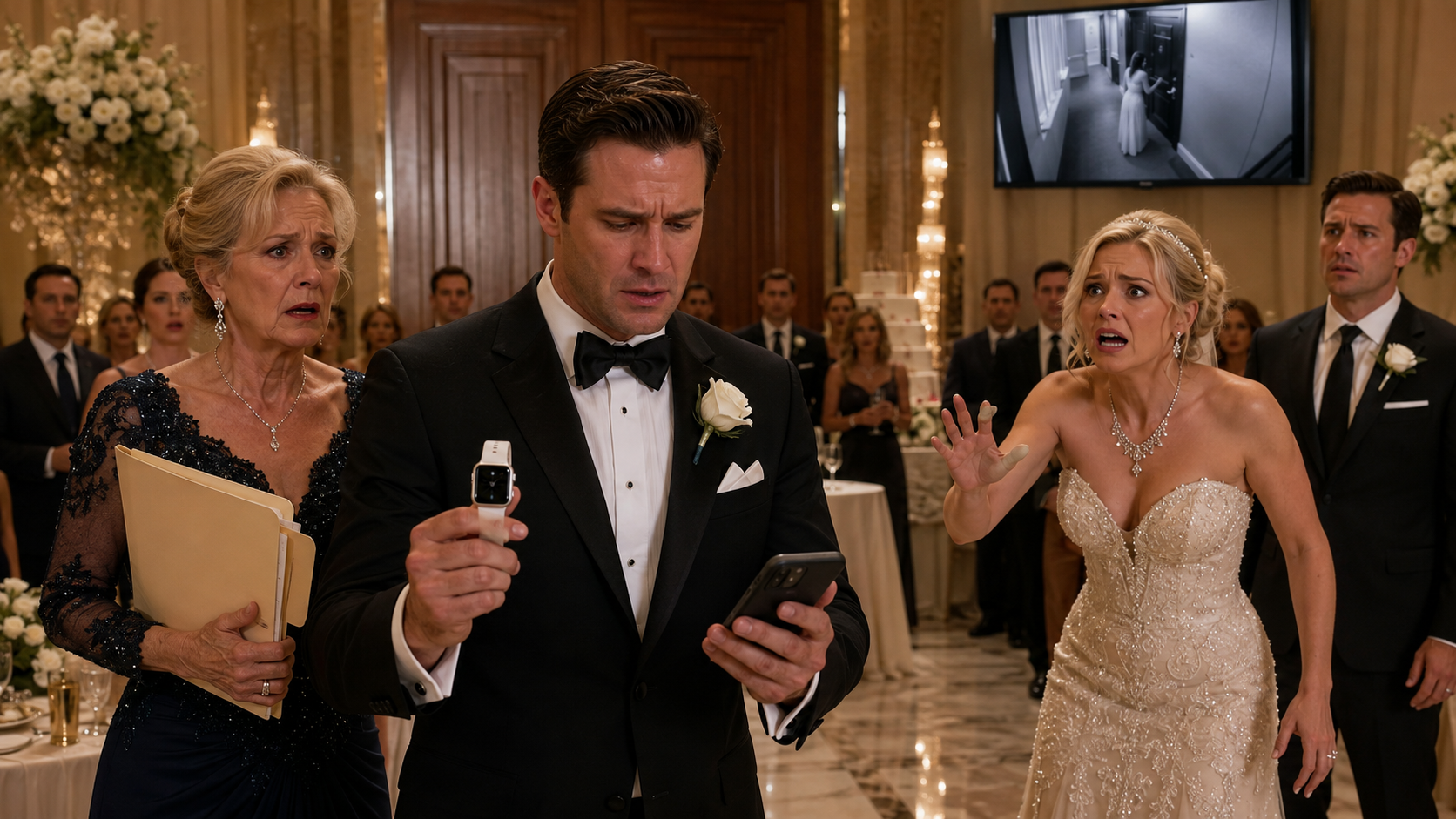
Lauren was near the wedding cake.
The moment she saw Sophie, her expression changed.
Not concern.
Anger.
She marched across the room.
“What is she doing here?”
I stared at her.
“What?”
“She was supposed to stay upstairs until she calmed down.”
My stomach tightened.
“You knew where she was?”
Lauren hesitated.
“She was having another tantrum.”
Sophie clung tighter to me.
“I wasn’t.”
Lauren rolled her eyes.
“Daniel, please. Not today.”
My mother stepped closer.
“Sophie, sweetheart, what happened?”
Sophie looked directly at Lauren.
Then pointed.
“She locked me in.”
The ballroom went silent.
Lauren laughed nervously.
“That is ridiculous.”
Sophie started crying again.
“You did.”
Lauren’s voice sharpened.
“STOP LYING.”
I stepped between them.
“Don’t yell at her.”
Lauren looked at me as if I had betrayed her.
“You’re seriously going to let a seven-year-old destroy our wedding?”
I couldn’t believe what I was hearing.
“My daughter came back crying from a locked hallway.”
“She ran away!”
“No.”
Sophie shook her head.
“She put me there.”
I lowered my voice.
“Why?”
Sophie looked toward my mother.
Then back at me.
“She said after you signed, I had to leave.”
My mother’s expression changed.
“Signed what?”
Lauren immediately answered.
“Nothing.”
Sophie opened her hand.
She was wearing the small smartwatch I’d given her the year before.
It had basic location tracking, emergency calling, and audio recording.
Rebecca had once owned a similar device for running.
After her death, I had become overly cautious about losing track of Sophie.
Sophie touched the screen.
“I recorded them.”
Lauren went completely still.
“Recorded who?”
“You and Uncle Eric.”
Lauren wasn’t Sophie’s biological aunt.
Sophie simply called Lauren’s brother Eric “Uncle” because we were becoming family.
I looked toward Eric’s table.
He was no longer smiling.
Hotel security moved us into a conference room away from the guests.
My mother came with us.
So did Lauren and Eric.
Sophie sat beside me while a female security supervisor helped access the recording.
At first there was only background noise.
A door closing.
Sophie breathing.
Then Lauren’s voice.
“Daniel will sign after the reception.”
Eric responded.
“And the trust?”
Lauren:
“The attorney says the restructuring gives us enough control.”
I looked at her.
“What restructuring?”
Lauren shook her head.
“This conversation is being taken out of context.”
The recording continued.
Eric said:
“What happens with Sophie?”
Lauren’s answer made my stomach turn.
“Once everything is settled, Daniel will agree to boarding school. He just needs to stop making every decision around that child.”
I looked down at Sophie.
Her eyes filled again.
Lauren spoke quickly.
“Daniel, I didn’t mean—”
“Quiet.”
It was the first time I had ever spoken to her that way.
The audio continued.
Eric mentioned a company called Westbrook Development Group.
The name meant nothing to me.
But my mother reacted immediately.
“I’ve seen that name.”
Everyone turned toward her.
Margaret explained that several weeks earlier Lauren had given me paperwork supposedly connected to refinancing the family property.
My family owned an old estate outside Alexandria.
The property had belonged to Rebecca’s family before her death.
Under Rebecca’s will, ownership was complicated.
I held a lifetime interest in portions of the property.
But Sophie was the primary future beneficiary.
Lauren knew that.
At least, I thought she did.
The recording continued.
Eric said:
“What if Daniel realizes the house ultimately belongs to Sophie?”
Lauren replied:
“By then he’ll already have signed.”
I felt physically sick.
I looked at my new wife.
“What exactly were you planning for me to sign?”
Lauren stood.
“I am not discussing private finances in front of hotel employees.”
My mother laughed once.
“Interesting time to discover privacy.”
Eric told Lauren to stop talking.
Security informed us that police had been contacted because a child had allegedly been confined in a restricted area.
Lauren exploded.
“Nobody kidnapped anyone!”
Nobody had used that word.
That made the room even quieter.
Hotel investigators reviewed the surveillance footage.
The cameras did not show what happened inside the bridal suite.
But they showed enough.
Sophie walking toward the room.
Lauren discovering her.
Lauren guiding her into a service corridor.
Then Lauren returning alone.
Several minutes later, Lauren was recorded speaking to hotel staff.
She told them Sophie was upset and should be left alone.
Another camera showed Sophie later emerging through a housekeeping doorway.
Lauren stopped denying that she had placed her there.
Instead, she changed her explanation.
“I needed ten minutes.”
I stared at her.
“You locked my daughter away because she overheard you?”
“No!”
“Then why?”
“She was screaming.”
Sophie whispered:
“I wasn’t screaming until you locked the door.”
Lauren looked at her.
I immediately stepped closer.
“Don’t.”
My mother took Sophie outside.
That was when the conversation became uglier.
Lauren insisted everything she had done financially was intended to “protect our future.”
I asked to see every document she planned for me to sign.
She resisted.
Police arrived.
Eventually Eric handed over a folder.
The paperwork proposed moving several property interests into a newly formed holding company.
That company would then enter into a development agreement with Westbrook Development Group.
I asked who owned Westbrook.
Eric wouldn’t answer.
My mother already knew.
She had searched public business records from her phone.
Westbrook belonged to Eric.
Indirectly.
The registered owner was another LLC.
But the mailing address matched his office.
The plan suddenly became obvious.
If I transferred control of the property into the new structure, Eric’s company would receive development rights.
Lauren and Eric would financially benefit.
Sophie’s future inheritance could have been dramatically affected.
Lauren insisted:
“It would’ve increased the property’s value.”
“Then why didn’t you tell me Eric owned the company?”
Silence.
“And why were you talking about sending Sophie away?”
“She needs structure.”
“She is seven.”
“You build your entire life around her!”
I stared at the woman I had married that afternoon.
“Yes.”
Lauren seemed genuinely surprised.
I continued.
“She’s my daughter.”
Lauren shook her head.
“And I’m supposed to be your wife.”
“Those aren’t competing positions.”
My mother had once said something similar.
Lauren apparently believed otherwise.
Then hotel security arrived with another piece of information.
Someone had delivered the paperwork to Lauren’s bridal suite that morning.
The person appeared on surveillance.
My attorney.
Thomas Wade.
I couldn’t understand it.
Thomas had represented me for nearly five years.
He knew Rebecca’s estate structure.
He knew Sophie’s trust better than Lauren did.
Police contacted him.
At first he claimed the documents were preliminary drafts.
Then investigators found emails.
Thomas had been communicating privately with Eric.
He stood to earn an advisory fee if the redevelopment occurred.
That explained why he had repeatedly told me the restructuring was “standard estate planning after remarriage.”
It wasn’t.
It was self-dealing disguised as convenience.
I had nearly signed because I trusted him.
The ceremony papers were legally valid.
My marriage existed.
But it did not last.
I retained another attorney the next morning.
Within days, we began annulment proceedings based on fraud and misrepresentation, with divorce as an alternative.
Lauren fought it at first.
Then the financial investigation expanded.
She stopped fighting.
Thomas lost his ability to represent me and later faced professional disciplinary proceedings.
Eric’s development deal collapsed.
The property remained protected.
More importantly, Sophie remained protected.
For months afterward, she asked one question repeatedly.
“Were you going to send me away?”
Every time, I answered the same way.
“Never.”
“But Lauren said—”
“Lauren didn’t get to decide.”
Sophie eventually stopped asking.
The scratches disappeared quickly.
The fear didn’t.
For several weeks she refused to sleep with her bedroom door closed.
We found a therapist.
I went too.
There were things I needed to understand.
How I had missed Lauren’s resentment.
How often I had dismissed strange comments because I wanted the relationship to work.
How easily adults can interpret a child’s discomfort as jealousy.
My mother admitted something too.
She had never fully trusted Lauren.
“Why didn’t you tell me?”
“I did.”
I remembered.
Margaret had once said:
“She treats Sophie like competition when she thinks nobody is watching.”
I became defensive.
I accused my mother of refusing to accept that I was moving on from Rebecca.
She stopped bringing it up.
I had heard her warning.
I simply didn’t listen.
Almost a year later, Sophie and I returned to the hotel.
Not for a wedding.
For my mother’s retirement dinner.
When the elevator doors opened near the ballroom, Sophie stopped.
I looked at her.
“You okay?”
She thought about it.
Then nodded.
Inside the ballroom, she stayed close for the first few minutes.
Then she saw her cousins and ran toward them.
I watched her disappear into the crowd.
My mother stood beside me.
“You’re staring.”
“I know.”
“She’ll be okay.”
“I know.”
This time, I actually believed it.
The wedding photographs stayed in storage.
I never destroyed them.
The day happened.
Pretending otherwise wouldn’t change anything.
But there is one image I remember more clearly than every photograph.
The ballroom doors opening.
My daughter in my arms.
My bride walking toward us furious instead of concerned.
And Sophie pointing at the woman I had just married.
Lauren believed Sophie was an obstacle.
A child who could be removed from the room until adults finished their plans.
She underestimated something very simple.
Children may not understand trusts.
They may not understand holding companies.
They may not understand financial fraud.
But they understand when someone scares them.
And sometimes the smallest person in the room is the first one willing to say:
“Something is wrong.”