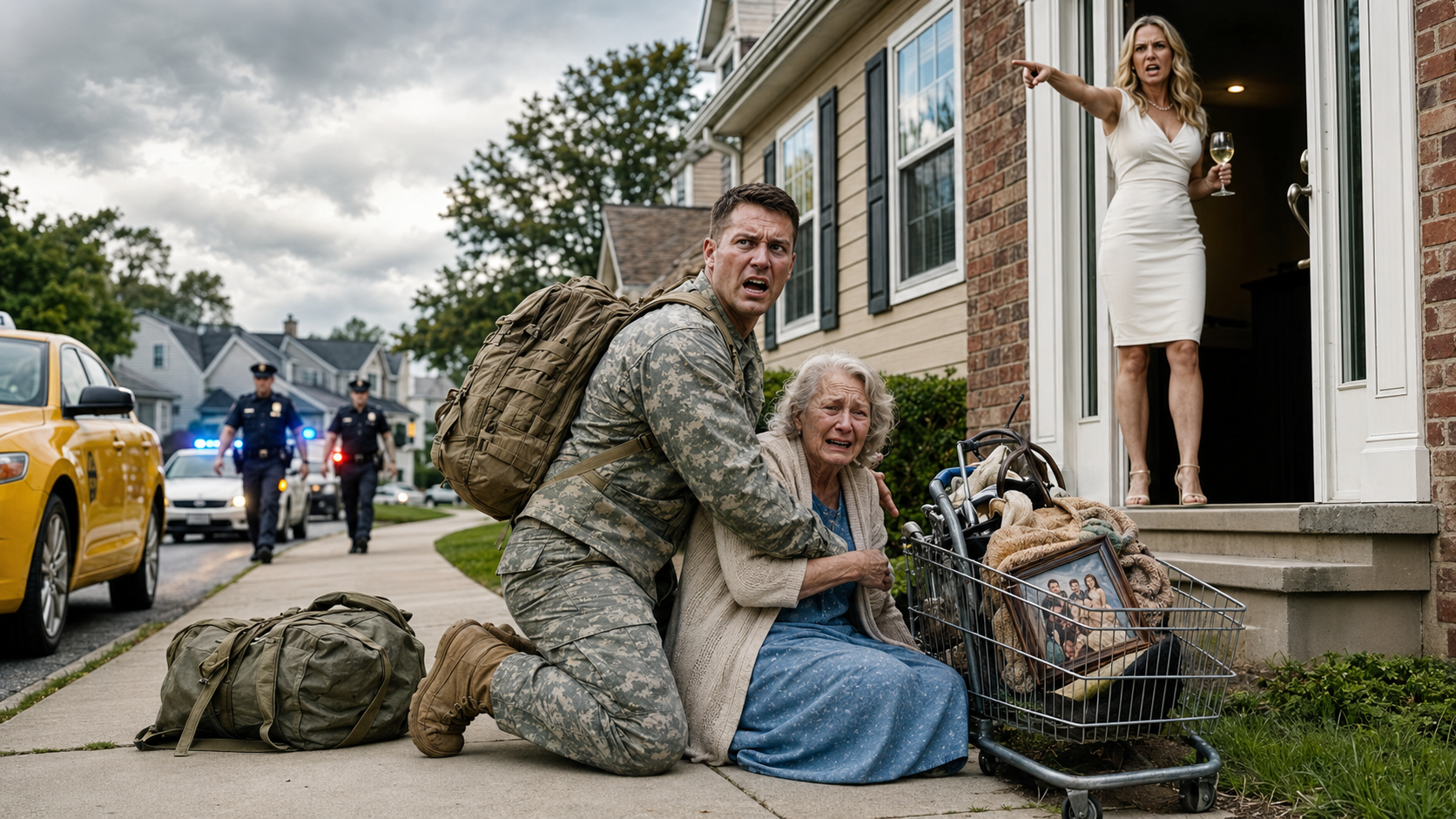
My wife stood in my mother’s doorway holding a glass of wine and screamed, “GET THAT OLD WOMAN OFF MY PROPERTY!”

I had been home from deployment for less than five minutes.

What Ashley did not know was that the house had never belonged to her.

And the police car turning onto our street was not there by accident.

My name is Ethan Walker. I was thirty-three years old and had spent eleven months overseas with the Army. For weeks, I had imagined coming home to the same ordinary scene: a taxi at the curb, my mother Ruth on the porch, my wife Ashley waiting in the doorway, and one quiet evening where I would not need to listen for radios, alarms, or boots outside my room.

I came back one day earlier than expected.

I had told Ashley my flight had been delayed.

That was not completely true.

A military legal-assistance officer had advised me not to discuss the strange bank alerts I had been receiving until I could see the accounts in person.

Three withdrawals had appeared in our joint account during the previous month.

$8,000.

$12,500.

$15,000.

Every time I asked Ashley about them, she said the money had gone toward repairs on my mother’s house.

I asked for invoices.

She became angry.

“You’re overseas and I’m handling everything,” she told me. “Either trust your wife or come home and do it yourself.”

Something in her voice stayed with me.

So when a seat opened on an earlier military flight, I took it.

The yellow taxi stopped in front of number 365 shortly after three in the afternoon.

I stepped out carrying my duffel and smiled when I saw the house.

“Mom! I’m home!”

Then I noticed a metal shopping cart at the edge of the driveway.

It was packed with two folded blankets, a grocery bag, an old pair of shoes, a small lamp, and the framed photograph of my father that had sat on my mother’s dresser for years.

Beside the cart sat Ruth.

My mother was seventy-four.

Her gray hair was messy. She wore a faded blue dress under a beige cardigan, and both hands were pressed together in her lap.

She looked tired.

More than tired.

She looked defeated.

I dropped my duffel on the sidewalk and ran.

“Mom?”

She looked up slowly.

For half a second she did not move.

Then her mouth opened.

“You came home.”

“Of course I came home.”

I knelt beside her.

“Why are you sitting out here?”

She grabbed my sleeve.

“Ashley changed the locks.”

I thought I had misheard her.

“What?”

“She said I don’t live here anymore.”

The front door opened.

Ashley stepped outside in a fitted white dress holding a glass of wine.

She looked like she was about to leave for dinner.

No panic.

No shame.

No apology.

Only irritation.

“Ethan,” she said. “You weren’t supposed to be back until tomorrow.”

I stood.

“Why is my mother sitting on the sidewalk with her belongings in a shopping cart?”

Ashley sighed.

“Because this arrangement was destroying our marriage.”

“Our marriage?”

“She has been living with us for years.”

My mother spoke quietly behind me.

“This is my house.”

Ashley heard her.

Her expression hardened.

“Not anymore.”

I looked at Ashley.

“What did you just say?”

She came down the porch steps.

“I handled the paperwork. Ruth transferred the property.”

My mother shook her head immediately.

“No.”

Ashley snapped at her.

“You signed it.”

“I signed nothing.”

“Oh, please. You don’t even remember half the things you do.”

My mother flinched.

That was the moment I stopped trying to stay calm.

“Do not talk to her like that.”

Ashley lifted her chin.

“Then get her off the property.”

I stared at her.

“What?”

Her voice became louder.

“I said get that old woman off my property!”

The street seemed to go silent.

I pointed toward the house.

“This is HER house!”

Ashley stepped closer to me.

“She transferred it.”

“You threw a seventy-four-year-old woman out of her own home?”

“I did what you were too weak to do!”

I could feel blood pounding in my ears.

“What paperwork, Ashley?”

She laughed once.

“Prove it isn’t mine.”

Then red and blue light flashed across the front windows.

Ashley turned toward the street.

A police cruiser stopped behind the taxi.

Two officers got out.

One was Officer Daniel Ruiz, a patrol supervisor. The second was Officer Maya Chen.

Ruiz walked toward us carrying a black document folder.

“Mrs. Walker,” he said, “step away from Ruth.”

Ashley stared at me.

“You called them?”

“No.”

Our next-door neighbor, Mr. Collins, stepped out of his driveway.

“I did.”

Ashley glared at him.

Ruiz opened the folder.

The first page was a quitclaim deed recorded six weeks earlier.

According to that document, Ruth Walker had voluntarily transferred 365 Briarwood Lane to Ashley Walker for one dollar.

My mother’s name appeared at the bottom.

So did a notary seal.

Ruth looked at the signature.

“That isn’t mine.”

Ashley shouted immediately.

“She forgets things!”

Ruiz turned to the next page.

“The notary whose stamp appears on this deed says she never met Ruth Walker.”

Ashley stopped moving.

Ruiz continued.

“She reported her seal missing last month.”

I stared at Ashley.

“You forged my mother’s deed?”

Ashley pointed at Ruth.

“She was going to lose the house!”

“No, she wasn’t.”

“You don’t know what I had to deal with while you were gone!”

“Then explain it.”

Ashley shouted.

“She was confused! She couldn’t manage bills. She needed help.”

My mother shook her head.

“I paid every bill.”

She had.

My father paid off the mortgage years before he died. Ruth’s pension covered taxes, insurance, utilities, and food. I also sent money home every month because I wanted her to be comfortable.

That reminded me of the withdrawals.

I looked at Ashley.

“Where did my deployment pay go?”

She did not answer.

Officer Chen asked Ashley for permission to enter the house.

Ashley refused.

Ruiz told her they would secure the scene while a detective contacted the prosecutor.

Ashley screamed that the police were interfering in a family dispute.

Then Mr. Collins held up his phone.

“I have video.”

The recording was from that morning.

It showed Ashley dragging Ruth’s suitcase onto the porch.

Then she carried out a cardboard box and dumped photographs and papers into the shopping cart.

My mother stood beside her crying.

Ashley said clearly:

“If Ethan comes home, I’ll tell him you chose to leave.”

I watched the clip twice.

Ashley tried to reach for the phone.

Ruiz blocked her.

“Do not touch the evidence.”

My mother whispered my name.

I went back to her.

“Why didn’t you call me?”

She looked embarrassed.

“I tried.”

“What happened?”

“Ashley took my phone.”

I slowly looked toward my wife.

“You took her phone?”

Ashley crossed her arms.

“She kept calling you at bad hours.”

Ruth reached into her cardigan and pulled out a folded piece of paper.

She had written down the dates of every attempted call.

Eleven dates.

None had reached me.

Ashley had blocked my number on Ruth’s phone.

For weeks, every time I asked to speak to my mother, Ashley had given me an excuse.

“She’s asleep.”

“She’s at church.”

“She has a headache.”

“She doesn’t want to talk.”

I believed my wife because I thought marriage required trust.

Ashley had used that trust as cover.

Detective Lena Brooks arrived about twenty minutes later.

She separated everyone and began taking statements.

My mother told her that the pressure started three months earlier.

At first, Ashley offered to “help” with the mail.

Then she asked Ruth to transfer utility accounts into Ashley’s name.

Then she brought Ruth several papers and claimed they were insurance forms.

Ruth refused to sign because the documents looked wrong.

After that, Ashley began telling neighbors that Ruth was becoming forgetful.

She moved Ruth’s medication from the kitchen.

She took over online accounts.

She told Ruth that I was frustrated by her constant calls.

Worst of all, she repeatedly said that I would be angry if my mother caused problems while I was deployed.

Ruth believed her.

Not because I had ever threatened my mother.

Because Ashley said it often enough that an older woman who already worried about being a burden started to doubt herself.

Detective Brooks asked whether Ruth had ever been diagnosed with dementia.

“No,” I said.

Her physician confirmed that the next morning.

Ruth had arthritis, high blood pressure, and hearing loss.

She did not have dementia.

The “confusion” Ashley described existed primarily in paperwork Ashley had created.

By early evening, investigators obtained an emergency search warrant for the home office.

I stayed outside with my mother while officers entered the house.

The first evidence bag came out twenty minutes later.

It contained copies of Ruth’s driver’s license, Social Security card, pension statements, tax bills, and bank records.

The second bag contained a notary seal.

The same notary seal reported missing.

The third contained draft deeds.

Three versions.

Each showed a slightly different attempt at imitating my mother’s signature.

Then Detective Brooks brought out a real-estate contract.

Closing was scheduled for Monday.

Four days away.

The buyer was an LLC called North Ridge Property Group.

I had never heard of it.

The detective had.

The company had been created by Ashley’s older brother, Kyle, only two months earlier.

The contract price was $218,000.

Similar homes on that street were selling for around $420,000.

The plan became obvious.

Ashley would use the forged deed to place the house in her name.

Then she would sell it cheaply to a company controlled by her brother.

After enough time passed, the company could resell it near market value.

The profit would stay inside their family.

By the time anyone challenged the deed, Ashley expected my mother to be living somewhere else.

She also expected me to still be overseas.

My early return destroyed the schedule.

But the house was only part of it.

The joint bank account showed $63,400 in transfers to an account I did not recognize.

The receiving account belonged only to Ashley.

When I asked where the money went, she screamed, “I’m your wife! Half of everything is mine!”

Detective Brooks replied, “Marriage does not make fraudulent transfers legal.”

Ashley stared at me.

“You’re choosing her over me?”

I looked at my mother sitting beside a shopping cart.

“I’m choosing the truth.”

Ashley’s face twisted.

“She was ruining our life!”

I finally shouted back.

“No. She was standing in the way of your plan.”

Ashley fell silent.

That was when police opened her laptop.

A folder sat on the desktop.

AFTER ETHAN.

Inside were scanned passports, hotel bookings, bank-transfer instructions, and a one-way flight itinerary for Ashley and her brother.

The flight was scheduled for Monday night.

Hours after the planned closing on my mother’s house.

But another document drew the detective’s attention.

It was a petition for emergency guardianship over Ruth.

The petition claimed Ruth was cognitively impaired and financially incapable.

That alone was disturbing.

Then I saw the signature line.

My name was on it.

“Ethan Walker.”

I had never seen the form.

My signature was forged.

Ashley had planned to file the guardianship petition if Ruth challenged the deed.

On paper, it would appear that both Ruth’s daughter-in-law and her deployed son believed Ruth was incompetent.

The plan was designed to make my mother look unreliable before she could even tell anyone what happened.

I felt sick.

Ashley tried to explain.

“I was protecting us.”

“By forging my name?”

“You would have agreed if you were here!”

“No.”

“You don’t know that!”

“I know it now.”

Police arrested Ashley that evening on initial allegations related to forgery, identity theft, financial exploitation of an elderly adult, and theft.

The exact charges changed as the investigation developed.

My mother did not watch them put Ashley in the patrol car.

She was too busy holding my hand.

“I’m sorry,” Ruth said.

I looked at her.

“For what?”

“For causing trouble between you and your wife.”

Those words hurt more than anything Ashley had shouted.

I crouched beside my mother.

“You did not cause this.”

“She said you would hate me.”

“I don’t.”

“She said you wanted the house.”

“I don’t want the house.”

Ruth looked confused.

“Then why are you angry?”

“Because I almost lost you while I was worrying about money.”

That night, my mother did not sleep in the house.

Neither did I.

We stayed with Mr. Collins and his wife because the police still needed access to the property and because I did not want Ruth walking back into rooms that had just been searched.

The next morning, military legal assistance helped me contact a civilian attorney who specialized in elder financial exploitation.

The forged deed was challenged immediately.

Because the underlying signature was fraudulent and the transaction had not yet proceeded to the planned resale, the court issued an order preventing any transfer of the property.

The scheduled Monday closing was canceled.

North Ridge Property Group was investigated.

Ashley’s brother Kyle initially claimed he knew nothing about the forged deed.

Emails later showed otherwise.

He had discussed the resale value of the property with Ashley weeks before the deed was filed.

One message from Kyle said:

“Once it is in your name, move fast before the old lady changes her mind.”

Another said:

“Ethan is out of the country. Best window we are going to get.”

Kyle eventually accepted a plea agreement related to the attempted property fraud and conspiracy.

Ashley faced the more serious case because she had direct access to Ruth, used the stolen notary seal, forged two signatures, controlled the bank transfers, and physically removed Ruth’s belongings from the house.

Investigators also discovered what happened to the $63,400.

Some paid Ashley’s private credit-card debt.

Some went toward the creation of North Ridge Property Group.

Almost $20,000 had been moved into an account intended for travel and temporary housing after the planned sale.

The money was largely recovered or repaid through court orders, asset sales, and restitution.

The criminal case took more than a year.

During that time, Ashley’s attorney tried to describe the situation as a marriage collapsing under the pressure of caring for an older relative.

The evidence made that argument difficult.

There was the forged deed.

The stolen notary seal.

The draft signatures.

The guardianship petition bearing my forged name.

The bank transfers.

The flight reservation.

The messages with Kyle.

And Mr. Collins’s video of my mother being put outside with her belongings.

Ashley eventually pleaded guilty to multiple offenses involving forgery, theft, and elder financial exploitation.

The judge also issued orders preventing her from contacting Ruth.

The property remained in my mother’s name.

My divorce from Ashley was finalized months later.

I did not fight over furniture.

I did not fight over the car.

I fought only to make sure no joint debt created through the fraud was assigned to me or my mother.

The court record made that possible.

The hardest part was not the legal case.

It was helping Ruth believe that she had not destroyed my marriage.

For months she apologized whenever I looked tired.

She apologized when I had to attend a hearing.

She apologized when reporters called.

She apologized when my attorney came to the house.

Finally, one evening, I took the shopping cart out of the garage.

Ashley had packed my mother’s belongings into it on the morning I came home.

Ruth had insisted we keep it because she said it was “still useful.”

I wheeled it into the backyard.

“What are you doing?” she asked.

“Ending something.”

We removed every item one by one.

The blankets went to the laundry.

The photographs went back on the shelves.

My father’s framed picture returned to my mother’s dresser.

The grocery bags went into the kitchen.

The old shoes went by the back door.

Then I rolled the empty cart to Mr. Collins.

He returned it to the store.

That simple act affected my mother more than the court case.

For the first time since I came home, she cried from relief instead of fear.

A year later, I was no longer living in the house full-time.

I had rented a small place ten minutes away.

Not because I wanted distance from my mother.

Because Ruth wanted her independence back.

She hired a part-time helper twice a week for heavy chores.

I installed cameras outside and a doorbell she could operate easily.

Her attorney placed the home into a properly managed trust with clear protections against unauthorized transfer.

Ruth chose all of it herself.

Nobody took control from her.

On the anniversary of my return, she asked me to sit on the porch.

The same porch Ashley had walked down holding a wine glass.

The same driveway where I had dropped my duffel.

The same curb where my mother had sat beside a shopping cart believing her own son might be angry with her.

Ruth handed me a small envelope.

Inside was a new key to the house.

“I already have a key,” I said.

“I know.”

“Then what is this?”

“A reminder.”

“Of what?”

She smiled.

“That you knock.”

I laughed.

My mother had survived something designed to make her feel powerless.

The best way I could love her afterward was not by taking over her life.

It was by making sure she had the power to run it herself.

Ashley had looked me in the face that afternoon and screamed that the property was hers.

She believed a forged signature, a stolen seal, and my absence had made that true.

But property records can be corrected.

Money can sometimes be recovered.

Locks can be replaced.

The harder damage is what happens when someone convinces an older person that they are unwanted in their own family.

That is why the image I remember most is not Ashley being taken toward a police car.

It is my mother gripping my sleeve and asking whether I was angry at her.

I came home expecting a celebration.

Instead, I found my mother outside her own house with her life packed into a shopping cart.

And in less than fifteen minutes, the woman I trusted most revealed exactly what she had been doing while I was gone.

Ashley thought my deployment gave her time.

She was right.

She just did not know I was coming home one day early.