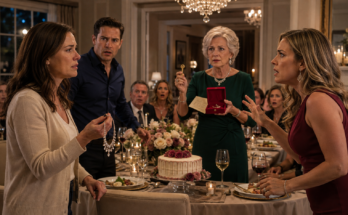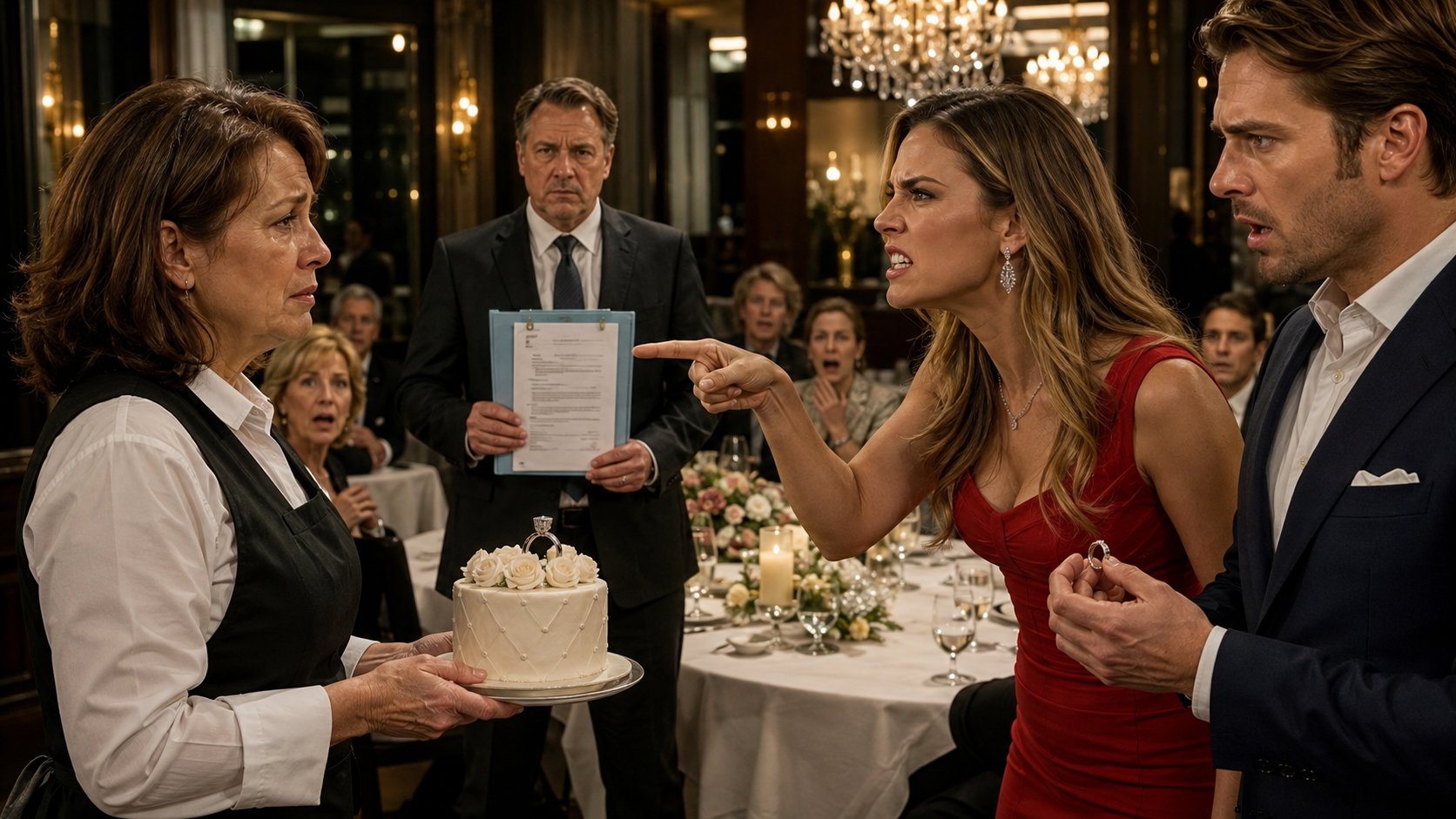
My daughter pointed at my uniform in front of her fiancé’s wealthy family and screamed, “She’s nobody. She’s just a waitress.”
Then the restaurant manager walked over and asked me one question.
“Linda, do you want me to remove her from your restaurant?”
The entire room went silent.
But the humiliation was only the beginning.
My name is Linda Hayes.
For most of my adult life, I worked in restaurants.
I started washing dishes at nineteen.
At twenty-three, I became a server.
At twenty-six, I was managing shifts.
At thirty, my husband Robert and I opened our first small restaurant with twelve tables, mismatched chairs, and an ice machine that broke every Thursday.
We named it Hayes & Oak.
Robert cooked.
I managed the dining room, payroll, suppliers, reservations, hiring, complaints, and everything else that kept the doors open.
We worked constantly.
There were years when we could not afford a vacation.
There were nights when Robert slept on flour sacks in the office because a delivery was arriving before sunrise.
There were Christmas mornings when we opened presents with our daughter Madison in the restaurant kitchen because we were preparing a holiday lunch.
Madison grew up around Hayes & Oak.
As a child, she loved it.
She drew pictures for the walls.
She sat at table seven doing homework.
She learned to fold napkins before she learned long division.
When she turned thirteen, something changed.
She became embarrassed by the restaurant.
At first, it was small.
“Mom, don’t pick me up wearing your apron.”
Then:
“Can you not tell my friends you wait tables?”
Then:
“Dad should say he owns a hospitality company, not a restaurant.”
I thought it was a teenager trying to impress people.
Robert laughed it off.
“She’ll grow out of it.”
She did not.
She grew into it.
By college, Madison had learned how to describe our life without ever technically saying she came from restaurant workers.
She told people her parents were in “private hospitality investments.”
She described Hayes & Oak as “one of the family’s properties.”
When friends visited, she never introduced me as the owner.
She simply said, “My mom works here.”
I noticed.
I said nothing.
Robert always told me not to turn every hurt feeling into a confrontation.
“She knows who we are,” he said. “One day she’ll understand what it took.”
Then Robert died of a heart attack at fifty-eight.
He collapsed in the kitchen after lunch service.
Madison was twenty-two.
For a while, grief brought us together.
She came home.
She slept in her childhood room.
She sat beside me while I sorted through Robert’s clothes.
Then the funeral ended.
Her friends left.
Her job offers began.
And slowly, she pulled away again.
Robert’s ownership interest in the restaurant transferred to me under our operating agreement and estate plan.
Madison was not left with nothing.
Robert had created an investment account for her.
It contained enough money to give her a strong start.
I also paid the rest of her university tuition.
When she graduated, I paid the security deposit on her first apartment.
When her first job disappeared during a restructuring, I covered eight months of rent.
I helped with her car.
I paid off one emergency medical bill she was afraid to tell anyone about.
I did these things because she was my daughter.
I never considered them investments that required gratitude.
Still, I hoped kindness would eventually become respect.
Then Madison met James Whitmore.
James came from a wealthy family.
His father owned several commercial properties.
His mother chaired a nonprofit foundation.
Madison told me they were “old money.”
I remember asking why that mattered.
She stared at me.
“You wouldn’t understand.”
Maybe I did understand.
I simply did not care.
The first time I saw a photo of James, I told Madison he looked kind.
She immediately said, “Please don’t message him.”
I laughed because I thought she was joking.
“I wasn’t planning to.”
“I’m serious, Mom.”
“Why?”
“I want one part of my life that isn’t connected to the restaurant.”
That sentence stayed with me.
I asked whether she was ashamed of me.
She became angry.
“Why do you make everything about you?”
So I stopped asking.
Three months later, Madison became engaged.
I learned from social media.
There was a photograph of James kneeling in front of her on a hotel terrace.
Madison wore a white dress.
The caption said:
“The beginning of forever.”
I stared at that post for almost five minutes.
Then I typed:
Congratulations. I love you.
She liked the comment.
She did not call.
Two weeks before the engagement dinner, a printed invitation arrived at my house.
Friday.
7:00 p.m.
Hayes & Oak.
Private Room A.
I smiled when I saw it.
I thought Madison had finally changed her mind.
I thought maybe she wanted to introduce me properly.
I even bought a simple navy dress for the evening.
Then Friday came.
At five o’clock, one of our servers called in sick.
At six, another had to leave because her child was ill.
Private Room A had a large party.
The main dining room was full.
I had spent years telling my employees that there was no job in the restaurant I would ask them to do that I would not do myself.
So I changed plans.
I put on black pants, a white shirt, and my server apron.
I told Mr. Parker I would help until the rush slowed down.
At 7:30, I walked past Private Room A.
Madison was there.
She looked stunning in a fitted red dress.
James sat beside her.
His parents were across the table.
There were flowers, champagne glasses, and a small gold sign congratulating the couple.
For a few seconds, I stood outside the room wondering whether I should go home, change, and come back.
Then our pastry chef, Maria, touched my arm.
“I made Madison’s cake.”
It was the same chocolate-hazelnut recipe Robert had made every year when Madison was a child.
Maria had decorated it with white flowers.
I stared at it and felt my throat tighten.
“Take it in,” Maria said.
So I did.
I carried the cake into Private Room A.
“Congratulations, sweetheart. I made your favorite—”
Madison turned.
Her smile vanished.
“Who let her in here?”
The room went quiet.
I stopped.
“What?”
“Put that down.”
I thought she was nervous.
“Madison?”
“I said put it down and get out.”
James stood.
“Madison, what’s happening?”
She pointed at me.
“She’s nobody. She’s just a waitress.”
For a moment, I forgot how to breathe.
James looked at her.
Then at me.
“A waitress?”
“Yes.”
His expression changed.
“You told me your mother was dead.”
That hurt more than being called a waitress.
I looked at my daughter.
“You told him I was dead?”
Madison’s jaw tightened.
“This is not the place.”
I said, “You invited me.”
“I didn’t invite you.”
She glanced around the room, embarrassed.
“That card was for the venue file. You were never supposed to come.”
I realized then that the invitation had probably been mailed automatically by someone coordinating the event.
Madison had not sent it.
She had booked her engagement dinner in my restaurant and expected me to stay invisible.
James said, “Madison, answer her.”
Instead, Madison stepped toward me.
“You always do this.”
“Do what?”
“Make everything about the restaurant.”
“I carried you a cake.”
“You came in dressed like that.”
I looked down at my uniform.
Like that.
A clean white shirt.
A black apron.
The clothes I had worn while earning the money that paid for her education.
I felt something inside me settle.
Not anger yet.
Clarity.
Then Mr. Parker entered.
He had heard the shouting.
“Linda, is everything all right?”
Madison pointed at me.
“Please tell your employee to leave.”
Mr. Parker stared.
“My employee?”
Madison’s expression flickered.
Mr. Parker turned to me.
“Linda, do you want me to remove your daughter from your restaurant?”
No one spoke.
James looked at me.
“Your restaurant?”
I nodded.
Madison immediately said, “It’s a family business.”
I corrected her.
“It is my business.”
She glared at me.
“Dad built it.”
“Yes.”
“And I’m his daughter.”
“Yes.”
“So stop acting like I’m some stranger.”
Before I could answer, Mr. Parker noticed a blue legal folder partly hidden under Madison’s handbag.
He picked it up.
“Is this from our attorney?”
Madison lunged toward him.
“Give me that.”
James stepped between them.
“What is it?”
Mr. Parker opened the folder.
His face changed.
“Linda, did you sign an ownership transfer?”
“No.”
He handed me the first page.
It claimed that I had agreed to transfer 65 percent of Hayes & Oak Hospitality LLC to Madison immediately following her engagement.
My name appeared on the last line.
The signature looked similar to mine.
But it was not mine.
I had signed thousands of checks, contracts, tax forms, licenses, and employee records over the years.
I knew every curve of my own handwriting.
“This is forged.”
Madison shouted, “It’s a draft!”
Mr. Parker replied, “The bank received a copy this morning.”
I looked at my daughter.
“Why?”
She folded her arms.
“Dad always said this place would be mine.”
“No. Your father said you would always have a place here.”
“What is the difference?”
“One is love. The other is ownership.”
She rolled her eyes.
“I’m your only child.”
“And that does not make forgery legal.”
James’s father stood.
“Perhaps we should leave.”
Madison spun toward him.
“No! Nobody is leaving.”
James looked at her.
“Why did you tell me your mother was dead?”
Madison’s eyes moved around the room.
She had been caught between two stories and could not maintain both.
Finally she said:
“Because she embarrasses me.”
Nobody reacted.
Madison continued.
“She waits tables. She talks to everyone. She tells embarrassing stories. She acts like this place is some heroic achievement.”
I almost laughed.
“This place paid your tuition.”
James turned to me.
“You paid her tuition?”
“Yes.”
Madison shouted, “So what?”
“Did you pay for her apartment?”
“Yes.”
“Her car?”
“I helped.”
James looked at Madison.
“You told me your father’s estate paid for everything.”
Madison said, “It basically did.”
“No,” I replied. “His estate left you an investment account. I paid the rest.”
James went pale.
“You told me both your parents were dead.”
I stared at my daughter.
Parents.
Plural.
Madison had not simply erased me from one dinner.
She had erased me from her life story.
Mr. Parker opened the rest of the blue folder.
There were corporate resolutions.
Banking forms.
A lease amendment.
An authorization naming Madison as the controlling member of the company.
There was also an email.
The sender was Diane Keller.
Our former bookkeeper.
Diane had worked for Hayes & Oak for almost six years.
I fired her after finding vendor payments that did not match invoices.
At the time, Madison told me I was being paranoid.
Now Diane was helping her.
The email read:
“Once Linda signs the wedding packet, I can attach the signature page to the transfer set. She never reads event forms.”
I remembered the wedding packet immediately.
Two weeks earlier, Madison came to my office with a stack of catering forms.
She said James’s mother wanted everything finalized quickly.
I signed a menu approval.
A deposit authorization.
A guest estimate.
Then I reached a mostly blank page with only a signature line.
I refused.
Madison became irritated.
“It’s standard.”
“I don’t sign blank forms.”
“Mom, why do you make everything difficult?”
I pushed the page back.
Now I knew why she wanted it.
She needed a fresh signature sample.
James read the email.
“You were trying to trick your mother?”
Madison screamed, “It was supposed to be mine eventually!”
I said, “Eventually is not today.”
“You never believed in me!”
“I offered you a management job twice.”
“You made me work weekends!”
“You were twenty-four.”
“You treated me like staff.”
“You were staff.”
That made her furious.
She pointed at me.
“There! That is exactly what I mean! I am your daughter!”
“And I never wanted you to believe that being my daughter meant the rules did not apply to you.”
James slowly removed his engagement ring.
Madison froze.
“What are you doing?”
He put it on the table.
“I don’t know who you are.”
She laughed nervously.
“James, stop.”
“You told me your mother died.”
“I can explain.”
“You called her a waitress like it was an insult.”
“I panicked.”
“You filed forged ownership documents.”
“They’re drafts!”
“The bank received them.”
Madison looked at me.
Then she screamed the sentence that finally ended any doubt about what she wanted.
“IT WAS SUPPOSED TO BE MINE!”
The guests flinched.
I stared at her.
“No, Madison. You were supposed to learn how to take care of something before asking to inherit it.”
Mr. Parker’s phone rang.
It was our attorney, Susan Calder.
Susan was already downstairs.
The bank had contacted her after flagging the ownership change.
Mr. Parker looked at me.
“There’s another filing.”
“What filing?”
He showed me his phone.
This one involved my house.
A home-equity authorization had been submitted using my electronic signature.
The money requested was $175,000.
The destination account belonged to a company called M&H Bridal Holdings.
I had never heard of it.
Susan arrived ten minutes later and recognized the company name from the paperwork.
Madison and Diane had formed M&H Bridal Holdings three months earlier.
The company had no real employees.
No office.
No active business.
But it had a bank account.
Susan explained that if the home-equity transaction cleared, the funds could be moved into that account and then used as “capital” to support Madison’s supposed ownership stake in Hayes & Oak.
In simple terms, my daughter was trying to borrow against my house and then use my own money to help take my restaurant.
James sat down slowly.
His mother covered her mouth.
Madison tried to say I had promised to help pay for the wedding.
I had.
I had offered $25,000.
Not $175,000.
And certainly not through forged documents.
Susan asked Mr. Parker to call the police.
Madison shouted that we were destroying her life.
I looked at her.
“No. We are stopping you from destroying mine.”
Police arrived.
The engagement dinner ended.
The cake remained untouched.
Diane was arrested two days later after investigators found copies of my electronic signature, corporate login credentials, and internal banking forms on her laptop.
The investigation revealed that Madison had been planning the transfer for almost five months.
She believed that once she became engaged to James, I would feel pressure to “secure her future.”
She expected to present the ownership change as an engagement gift after the paperwork was already filed.
If I objected, she planned to tell relatives that grief after Robert’s death had made me irrational about the restaurant.
That part hurt almost as much as the fraud.
She intended to use my love for her father against me.
The home-equity transaction was stopped before any funds were released.
The ownership filing was rejected.
No control of Hayes & Oak ever transferred.
The restaurant remained mine.
Madison was eventually charged with offenses connected to attempted fraud, forgery, and identity misuse.
Diane faced related charges.
The criminal case lasted almost a year.
I will not pretend I enjoyed watching my daughter face consequences.
I did not.
There were nights I sat alone in Robert’s old office and cried until I could barely breathe.
I wondered whether I had worked too much.
I wondered whether paying for everything had taught Madison that effort was optional.
I wondered whether Robert would have blamed me.
Then Susan said something I needed to hear.
“Regret can help you understand the past. It cannot turn fraud into a parenting mistake.”
Madison eventually accepted a plea agreement.
She was ordered to repay legal expenses tied to the fraudulent filings, complete community service, and remain under court supervision.
She was also prohibited from accessing Hayes & Oak financial systems or representing herself as an owner.
James ended the engagement permanently.
He returned every expensive gift Madison had given him.
Several months later, he sent me a short letter.
He apologized for believing the story she told about her family.
I wrote back that he had nothing to apologize for.
Madison had lied carefully.
She knew exactly what version of herself she wanted him to see.
I did not speak to Madison for almost six months.
Not because I hated her.
Because every conversation became an argument about what she “deserved.”
Then one afternoon, she asked to meet.
Not at the restaurant.
At a coffee shop.
She looked different.
No designer dress.
No dramatic entrance.
She sat across from me and said:
“I was ashamed of you.”
I already knew that.
Still, hearing it directly hurt.
She continued.
“I thought if people knew you waited tables, they would think I came from nothing.”
I looked at her.
“You did not come from nothing.”
She started crying.
“I know.”
“No, Madison. Listen to me.”
She looked up.
“You came from two people who worked until their hands hurt so you would have choices.”
She covered her face.
I let her cry.
I did not tell her everything was okay.
It was not.
I did not tell her she was forgiven.
I was not ready.
Instead, I said:
“If you ever want a relationship with me again, it cannot be built on what you think you are entitled to.”
She nodded.
That was the beginning.
Not of a perfect reconciliation.
Of a slow one.
Madison found a job at a marketing firm unrelated to me.
She rented a smaller apartment.
For the first time in years, I did not pay her bills.
She occasionally texted.
Sometimes I answered.
Sometimes I waited.
Trust returned in inches.
Two years after the engagement dinner, Hayes & Oak celebrated its thirtieth anniversary.
We held a small event after closing.
Employees brought their families.
Maria made Robert’s chocolate-hazelnut cake.
At the end of the night, Madison appeared at the front door.
She did not walk in.
She knocked.
I opened it.
She held a small gift bag.
“Can I come in?”
I moved aside.
Inside the bag was a framed photograph.
It showed Robert and me outside Hayes & Oak on opening day.
I was wearing an apron.
Robert had flour on his shirt.
We were exhausted.
And happy.
Below the photograph, Madison had placed a small engraved plate.
It read:
BUILT, NOT GIVEN.
I stared at it for a long time.
Then I looked at her.
She said, “I think I finally understand.”
Maybe she did.
Maybe she was still learning.
So was I.
I never transferred the restaurant to Madison.
Years later, I created a succession plan with my attorney.
Ownership would not pass automatically because of blood.
Any future transfer would depend on experience, responsibility, and the ability to protect the people who worked there.
That decision made some relatives angry.
I did not care.
Hayes & Oak was not just an asset.
It represented thousands of mornings before sunrise.
It represented Robert’s hands.
My back pain.
Our employees.
Our customers.
And a little girl who once did homework at table seven before growing up and forgetting what that table cost.
The night of her engagement dinner, Madison thought my uniform made me small.
She thought calling me “just a waitress” would make everyone else see me the way she did.
Instead, the uniform told the truth.
I was willing to do the work.
She wanted the reward without it.
And when James learned that the “waitress” she was ashamed of owned the restaurant she was trying to steal, the life Madison had invented for herself collapsed in less than fifteen minutes.