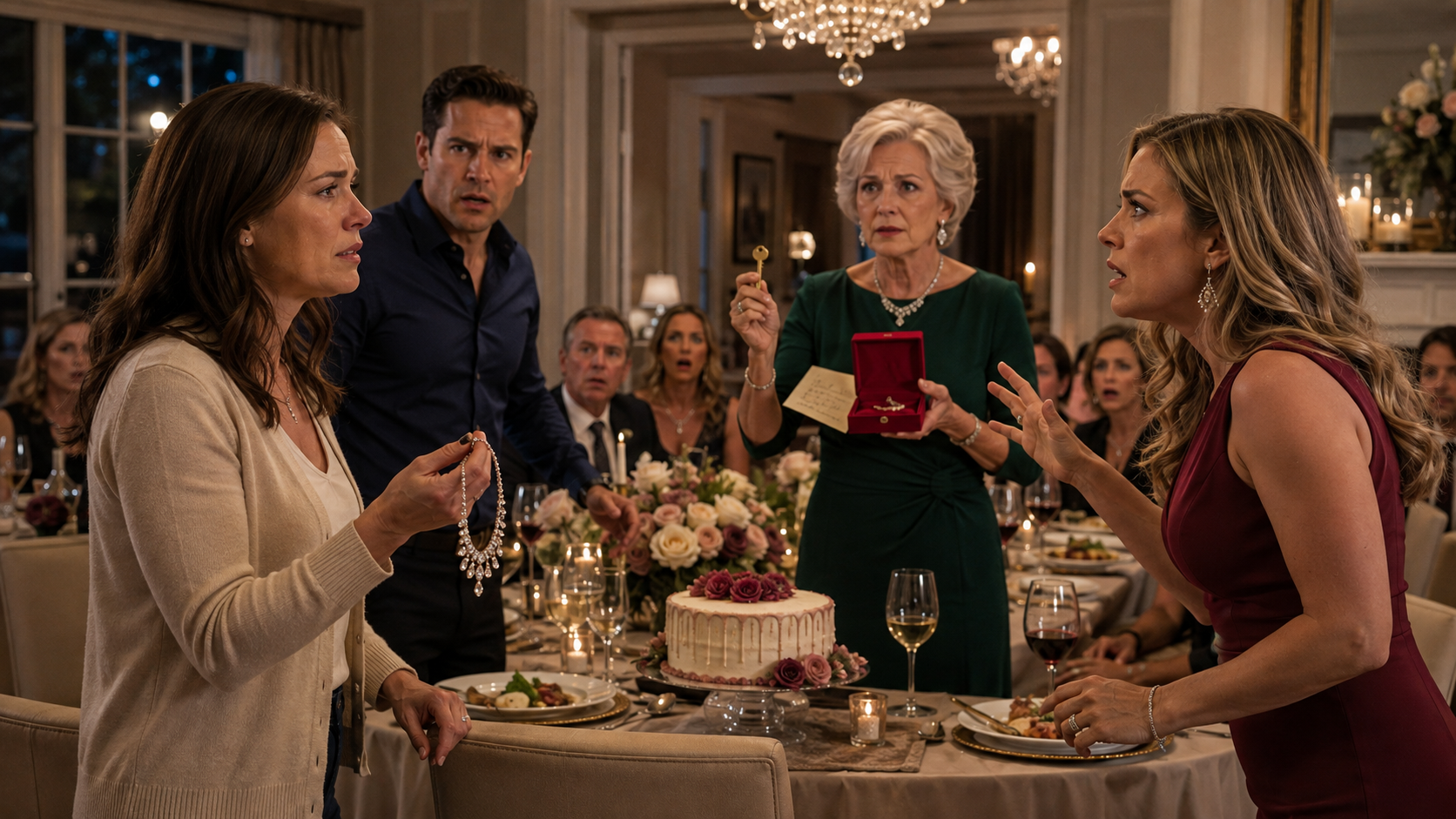
At my mother-in-law Helen’s 70th birthday dinner, my sister-in-law Lauren grabbed a red velvet jewelry box from the dining table and screamed at my eight-year-old daughter.
“OPEN YOUR HAND! WHAT DID YOU TAKE?”
Every conversation stopped.
Emma backed away from her chair.
She was wearing the pale-blue dress Helen had bought for her birthday dinner, and tears appeared almost instantly in her eyes.
Inside Emma’s trembling hand was an antique diamond necklace.
“Grandma gave it to me,” she said.
Lauren leaned toward her.
“LIAR! THAT NECKLACE IS MINE!”
I crossed the space between them in two steps.
I pulled Emma behind me.
“Back away from my daughter.”
Lauren pointed past my shoulder.
“Your daughter is a thief.”
My husband Mark stood so quickly that his chair hit the wall.
“Lauren, stop.”
She turned toward him.
“You always choose them over your real family.”
Mark’s face changed.
Emma heard the words too.
She had been adopted when she was five.
She understood exactly what Lauren meant.
Before Mark could answer, Helen slowly stood from the head of the table.
My mother-in-law rarely raised her voice.
She did not need to.
“I gave Emma the necklace.”
Lauren froze.
Helen picked up the red velvet box.
“And I know why you want it.”
Lauren’s eyes moved toward the box.
Helen removed a folded card.
“Your father left a message inside this box before he died.”
Lauren stepped forward.
“Don’t read that.”
Helen unfolded it.
Then she read aloud.
“If Lauren ever claims this necklace, check the safe records.”
The room went silent.
Mark stared at his sister.
“What safe records?”
Helen lifted the velvet lining.
Taped underneath it was a tiny brass key.
Lauren’s face went completely pale.
“Give me that key.”
Helen closed her hand around it.
“No.”
Lauren moved closer.
I stepped between her and Emma again.
“Do not touch my child.”
Lauren glared at me.
“This has nothing to do with you.”
“You screamed in my daughter’s face. Now it does.”
Emma was crying quietly behind me.
Mark looked at his mother.
“What does the key open?”
Helen took a slow breath.
“Your father’s private safe.”
Thomas Bennett, my father-in-law, had died eleven months earlier.
For more than forty years, he had owned Bennett Commercial Construction, a successful regional company outside Chicago.
He was disciplined, cautious, and almost painfully organized.
When his health declined, Lauren became the family member who helped him most.
She scheduled appointments.
She paid bills.
She collected mail.
She sat in meetings with accountants.
Everyone praised her.
Mark praised her.
I did too.
We thought she had sacrificed nearly a year of her life to care for her father.
What none of us knew was that Thomas had begun to fear her.
Three months before his death, Thomas asked Helen to move several personal documents out of his office.
He told her that money was leaving his accounts without his permission.
Helen thought medication and exhaustion were making him suspicious.
Thomas did not argue.
Instead, he gave her the red velvet jewelry box.
It contained the diamond necklace he had bought her on their 25th wedding anniversary.
He told Helen not to open the box until she felt ready.
She assumed he was being sentimental.
After Thomas died, the box remained in a locked drawer in Helen’s bedroom.
Then Helen’s 70th birthday approached.
She decided to give the necklace to Emma.
It was not because Emma was the only grandchild.
It was because Thomas and Emma had formed an extraordinary bond during his final year.
Emma would sit beside him after school and read children’s books aloud.
Sometimes Thomas fell asleep halfway through a chapter.
Emma would place a bookmark between the pages and whisper, “We’ll finish tomorrow.”
She drew pictures for his hospital room.
She learned how to make his tea exactly the way he liked it.
On the final afternoon Emma saw him, Thomas gave her a small wooden bird he had carved when Mark was a child.
“Families keep stories alive,” he told her.
Emma never forgot it.
Lauren knew Helen planned to give Emma the necklace.
From the moment she heard about it, she objected.
“That necklace belongs in the bloodline,” she said.
Helen answered, “Emma is my granddaughter.”
Lauren tried again.
“I mean eventually. For my daughter.”
Lauren did not have children.
She was not even married.
But she had always spoken as though future biological children should outrank Emma.
Mark told her to stop.
Lauren claimed everyone was being oversensitive.
At the birthday dinner, she finally stopped pretending.
The moment Helen placed the necklace in Emma’s hand, Lauren snapped.
She accused an eight-year-old child of stealing something that had been handed to her seconds earlier.
But the necklace was only the surface of the conflict.
The brass key underneath the velvet lining led to the real story.
After the guests left, Mark drove us to Thomas’s old office building.
Helen still had legal access because the family had not yet sold the property.
Thomas’s private office remained almost exactly as he had left it.
His desk calendar was still open to the month he died.
His old reading glasses sat beside a stack of construction bids.
Behind a shelf of accounting binders was a small steel safe.
The brass key fit perfectly.
Inside were five envelopes.
A handwritten ledger.
Copies of bank statements.
A USB drive.
And a letter addressed to Helen and Mark.
Mark opened the bank statements first.
The earliest suspicious transfer was $9,800.
Then $14,000.
Then $22,500.
Then $31,000.
Over eight months, more than $186,000 had moved out of Thomas’s personal and business accounts.
Most of the money went to a consulting company called LWB Holdings.
Mark stared at the page.
Lauren Whitney Bennett.
His sister.
Helen sat down.
“No.”
Mark kept reading.
Some payments were labeled “project consulting.”
Others were marked “vendor management.”
Thomas had written notes in the margins.
Not authorized.
Ask Lauren.
No contract.
Check signature.
The handwritten ledger was worse.
Thomas had listed every transfer he questioned.
Beside one payment, he wrote:
Lauren says I approved this while medicated. I did not.
Beside another:
Signature does not look like mine.
The final page contained a message.
“If I am gone before this is resolved, protect Helen and the child. Lauren thinks family means ownership.”
Mark read the sentence twice.
Emma was not with us.
She had gone home with my sister because we refused to drag her into another adult confrontation.
Still, Thomas had written “the child.”
He had known Lauren resented Emma.
Helen opened the letter addressed to her.
Thomas apologized for hiding the investigation.
He wrote that he had been afraid Helen would confront Lauren before he understood the full situation.
He also explained the necklace.
“I want Emma to have it one day,” he wrote. “Not because of its value. Because she sat with me when she had nothing to gain.”
Helen began crying.
Mark inserted the USB drive into Thomas’s old laptop.
There were three folders.
BANK.
LAUREN.
VIDEO.
Inside the video folder was one file.
Thomas appeared on the screen.
He looked thin.
His voice was weak.
But his eyes were clear.
“If you are watching this,” he said, “Lauren probably told you that I promised her the company, the house, or Helen’s jewelry.”
He paused.
“I promised her none of those things.”
Then Thomas described the missing transfers.
He said he believed Lauren had used his declining health to create false consulting invoices.
He had contacted the bank.
He had also hired a forensic accountant.
Then he said the name none of us expected.
“Lauren could not have moved the larger payments alone. I believe my operations manager, Peter Sloan, helped her.”
Mark leaned back.
Peter had worked for Thomas for twenty-two years.
He had spoken at Thomas’s funeral.
He had hugged Helen beside the grave.
The following morning, Mark called the family attorney.
The attorney contacted the forensic accountant Thomas had hired before his death.
That accountant still had copies of several records Thomas had sent him.
Together, they reconstructed the missing transactions.
Peter had approved fake vendor invoices inside the company.
Lauren had created LWB Holdings six months before the first transfer.
Money moved from Bennett Commercial Construction to fake vendors.
From those vendors, part of it moved to Lauren’s company.
The rest went to an account controlled by Peter.
The total was much larger than the money we first saw in Thomas’s safe.
Over fourteen months, investigators eventually traced more than $412,000 in unauthorized payments.
Lauren denied everything.
She said Thomas had promised to compensate her for caring for him.
No written agreement supported that claim.
She said the company owed her consulting fees.
There was no consulting contract.
She said Thomas gave her permission verbally.
But Thomas’s video directly contradicted her.
Peter initially claimed the invoices were legitimate.
Then investigators found emails between him and Lauren.
One message read:
Your dad won’t remember which projects are real.
Another said:
Keep Helen out of the office until quarter-end.
The case lasted more than a year.
Peter pleaded guilty first.
His cooperation exposed the full scheme.
Lauren eventually entered a plea involving fraud, forged business records, and unauthorized transfers.
She was ordered to repay a substantial amount.
She sold her luxury SUV.
She sold an investment property.
She lost every role connected to the family company.
The company itself survived because Mark and an outside management team took control.
But the financial case was only part of what changed.
Lauren had screamed at Emma because she believed the necklace symbolized something larger.
She thought giving Emma the necklace meant Thomas and Helen had chosen an adopted granddaughter over her.
The truth was more painful.
Thomas had chosen Emma because Emma had shown him kindness when he was sick.
Lauren had been thinking about assets.
Emma had been thinking about whether Grandpa wanted another chapter of his book.
Helen kept the red velvet box.
But she refused to take the necklace back.
When Emma finally asked what had happened at the birthday dinner, we gave her an age-appropriate explanation.
We told her Aunt Lauren had been angry about money.
We told her adults had discovered that Lauren had lied.
We told her none of it was Emma’s responsibility.
Emma looked at the necklace.
“Did Grandpa really want me to have it?”
Helen answered.
“Yes.”
“Even though I’m adopted?”
Helen’s face tightened.
She took Emma’s hands.
“Listen to me. Nobody adopts a child halfway.”
Emma looked confused.
Helen continued.
“You are not partly my granddaughter. You are my granddaughter.”
That became one of Emma’s favorite stories about Helen.
Not the stolen money.
Not the court case.
Not Lauren.
The sentence.
You are my granddaughter.
Two years later, Helen turned seventy-two.
We held another dinner in the same house.
Emma wore the necklace for the first time.
She was ten.
Before dessert, she placed the old red velvet box beside Helen’s plate.
Inside was a new handwritten note.
Helen opened it.
Emma had written:
“Grandma, families keep stories alive. Grandpa told me.”
Helen cried before she reached the second line.
Mark looked toward me.
Neither of us mentioned Lauren.
We did not need to.
The empty chair at the table said enough.
Lauren once believed blood entitled her to everything Thomas had built.
She believed an adopted child should stand behind her.
She believed the diamond necklace belonged to her because she had been born into the family.
But Thomas had hidden the truth underneath that necklace.
A brass key.
A handwritten warning.
Bank records.
And one final video.
Lauren grabbed the red velvet box because she thought it contained an inheritance.
What it really contained was evidence.
And when she called my eight-year-old daughter a thief, she had no idea she was standing inches away from the object that would expose who had actually been stealing from the family.