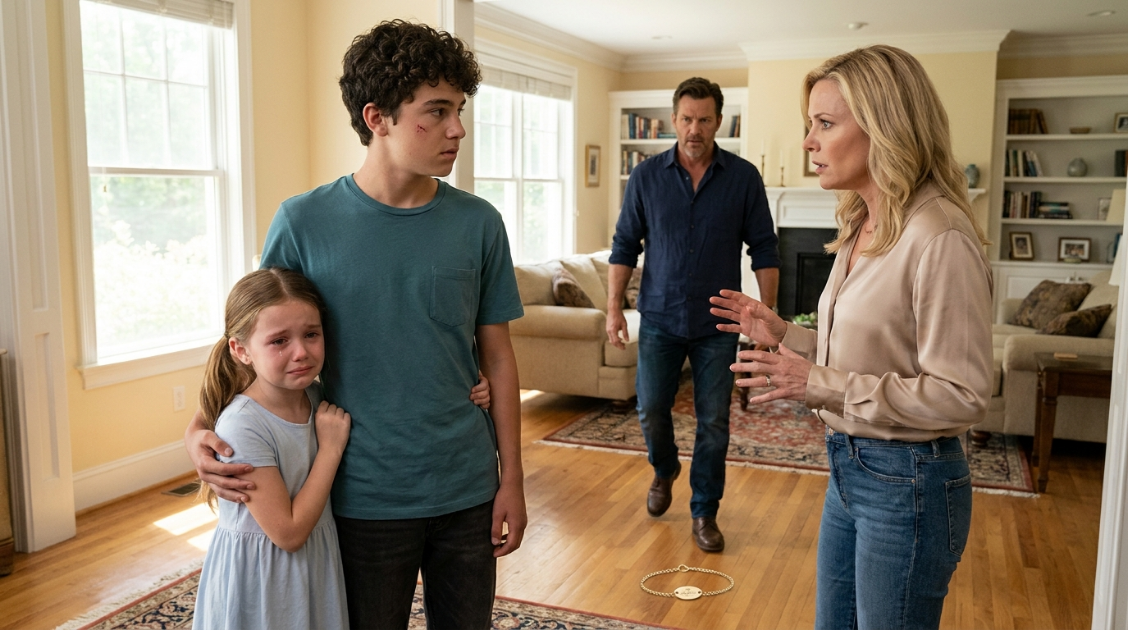
My wife grabbed my eight-year-old daughter by the wrist and demanded that she confess to stealing a gold bracelet.
Lily was crying.
“I didn’t take it.”
My fifteen-year-old son, Jake, heard the shouting from upstairs.
By the time he reached the hallway, Melissa was still holding Lily’s wrist.
“Let her go,” he said.
Melissa told him to stay out of it.
He stepped between them anyway.
A few seconds later, Jake had a red scratch across his cheek.
That was the scene I walked into when I came home.
My name is David Parker.
Lily is eight.
Jake is fifteen.
Their biological mother, Sarah, died six years earlier.
For a long time after Sarah’s death, our house felt empty.
Jake became quiet.
Lily started sleeping with the light on.
I spent most of my energy trying to keep everything together.
Three years later, I met Melissa.
She seemed patient.
Kind.
Organized.
She helped Lily with school projects and drove Jake to soccer practice.
For the first year, I believed we were becoming a family again.
Then small things changed.
Melissa complained that Lily was too sensitive.
She said I comforted her too quickly.
She thought Lily used tears to avoid consequences.
Whenever something went wrong in the house, Melissa seemed to suspect Lily first.
At first, I did not see a pattern.
A perfume bottle broke in the bathroom.
Melissa said Lily had knocked it over.
Lily denied it.
I told Lily to apologize anyway.
A twenty-dollar bill disappeared from the kitchen counter.
Melissa said Lily had been near it.
Lily cried and said she never touched the money.
Two days later, Melissa said she had found it in another purse.
She never apologized.
A silver necklace went missing.
Again, Lily was blamed.
Again, it turned up later.
I kept telling myself these were misunderstandings.
I wanted peace.
That became my excuse.
Then came the bracelet.
It had belonged to Melissa’s late mother.
A thin gold chain with a small oval charm.
She wore it often.
That afternoon, Melissa said she could not find it.
Lily had gone upstairs to get a sweater.
Melissa decided that was enough.
She called Lily into the hallway.
“Where is my bracelet?”
“I don’t know.”
“You were in my room.”
“No, I wasn’t.”
“You walked past it.”
“I only got my sweater.”
Melissa became angrier.
She grabbed Lily’s wrist.
“Tell me where you put it.”
Lily started crying.
That was when Jake came downstairs.
He had heard his sister.
“Let her go.”
Melissa turned toward him.
“This does not involve you.”
“She’s crying.”
“She needs to learn not to steal.”
“She didn’t steal anything.”
Melissa stepped closer.
“You always defend her.”
Jake moved between them.
During the argument, Melissa’s hand caught his cheek.
It left a red mark.
Nothing serious.
But enough for me to notice when I walked in.
I opened the front door.
Everyone stopped.
Lily was covering her ears.
Jake stood beside her.
Melissa looked furious.
“What happened?”
She pointed at Lily.
“She stole my mother’s bracelet.”
Lily immediately shook her head.
“I didn’t.”
Jake said:
“She didn’t.”
Melissa looked at me.
“David, you need to stop letting them gang up on me.”
Then something hit the floor.
A faint metallic sound.
We all looked down.
The bracelet was lying on the hardwood.
It had slipped from Melissa’s pocket.
For several seconds, no one spoke.
Melissa stared at it.
Then she said:
“I must have put it there without realizing.”
Jake looked at her.
“No.”
She turned.
“What?”
“You found it before Dad came home.”
My stomach tightened.
Melissa said he was lying.
Jake pulled out his phone.
“I recorded it.”
He had started recording when he heard Lily screaming.
The video began from the upstairs landing.
Melissa was in her bedroom.
She moved a chair.
The bracelet was underneath.
She picked it up.
Then she looked toward the hallway.
Instead of calling Lily back and apologizing, Melissa slipped the bracelet into her jeans pocket.
Then she returned downstairs.
The recording continued.
Melissa confronted Lily again.
“Tell me the truth.”
“I am.”
“If you admit you took it, maybe your father will finally see what kind of child you really are.”
I stopped the video.
I looked at Melissa.
“What does that mean?”
She crossed her arms.
“She lies.”
“When?”
“All the time.”
“Give me an example.”
She named the perfume bottle.
The missing money.
The necklace.
Jake interrupted.
“The perfume bottle was already cracked.”
Melissa glared at him.
He continued.
“The money was in your other purse.”
She said nothing.
“And the necklace?”
Jake looked at me.
“I found it in Melissa’s jewelry box.”
I felt sick.
I had made Lily apologize for things she had not done.
Not once.
Several times.
I looked at my daughter.
She was standing silently.
Not crying anymore.
That somehow felt worse.
I asked:
“Why didn’t you tell me?”
She whispered:
“I did.”
That sentence hit harder than anything else.
She had told me.
I had chosen not to hear her.
Because hearing her would have meant confronting Melissa.
And confronting Melissa would have threatened the peace I was trying so hard to preserve.
Except there had never been peace.
There had only been silence.
Jake then said:
“There’s another video.”
Melissa’s face changed.
“Jake.”
He ignored her.
A week earlier, he had been recording a video call with a friend when Melissa entered the kitchen.
She did not know his phone was still recording audio.
The conversation was short.
Melissa was speaking to her sister.
She said:
“David always chooses those kids first.”
Her sister asked:
“What do you expect? They’re his children.”
Melissa answered:
“I just need him to see Lily isn’t as innocent as he thinks.”
Then she laughed.
“Once he stops trusting her, everything gets easier.”
I listened twice.
There was nothing to misunderstand.
I looked at Melissa.
“What gets easier?”
She said she was frustrated.
She said blended families were difficult.
She said I had never made her feel like the priority.
I answered:
“You were trying to make me distrust an eight-year-old.”
“No.”
“Yes.”
She began crying.
She said she loved me.
She said she had only wanted boundaries.
I told her boundaries did not require inventing guilt.
I asked her to pack a bag.
She stared at me.
“You’re kicking me out because of a bracelet?”
“No.”
“I’m asking you to leave because you found the bracelet and kept accusing my daughter anyway.”
Melissa left that evening and stayed with her sister.
The next morning, I called an attorney.
I also called a family therapist.
Not for Melissa.
For me and my children.
I needed to understand what I had allowed to happen.
The therapist asked Lily a simple question during our first session.
“When you told Dad you didn’t do something, what did you think would happen?”
Lily looked at me.
Then she said:
“He would tell me to apologize.”
I had to look away.
That had become her expectation.
Not that I would listen.
Not that I would investigate.
That I would make her apologize so the house would become quiet again.
The therapist later told me:
“A child who is repeatedly asked to apologize for things she did not do may begin to believe that truth matters less than keeping adults comfortable.”
I never forgot that.
Jake felt guilty too.
He thought he should have protected Lily earlier.
I told him that burden was not his.
He was her brother.
Not her parent.
The responsibility had been mine.
Melissa and I separated permanently.
The divorce did not become dramatic.
There were no shared children.
Our finances were mostly separate.
She apologized several times.
Some apologies sounded sincere.
Others blamed stress.
I eventually stopped trying to decide which version was true.
The relationship was over because trust was gone.
More important, my children needed to see that I was willing to act.
Not just apologize.
I changed things at home.
No forced apologies.
If something went missing, we looked for facts.
If someone made an accusation, the accusation had to be supported.
Lily began speaking more confidently.
Jake stopped hovering around her every time an adult corrected her.
That took longer.
He had become used to protecting her.
One afternoon, about six months later, Lily accidentally knocked over a glass of juice.
She immediately said:
“Sorry.”
Then she froze.
I handed her a towel.
“It was an accident.”
She looked surprised.
“That’s it?”
“That’s it.”
She smiled.
It was such a small moment.
But I realized how tense she had been living.
A year later, Jake showed me the old video of the bracelet incident.
I asked why he still had it.
He said:
“Because that’s the day you believed us.”
I corrected him.
“That’s the day I finally believed you.”
There was a difference.
And I had to own it.
The gold bracelet was returned to Melissa after the divorce.
It was hers.
I did not want it.
Lily never wanted to see it again.
People might think the bracelet was the important object in this story.
It was not.
The important thing was the sound it made when it hit the floor.
That tiny metallic click ended months of doubt.
The bracelet proved Melissa had lied.
But Jake’s recording proved why.
And Lily’s quiet sentence—“I did tell you”—proved what my failure had cost.
I cannot undo the times I asked my daughter to apologize for things she did not do.
I cannot erase the fear she felt when an adult decided she was guilty.
But I can make sure she never again has to wonder whether her father will listen.
That afternoon, I thought I came home to an argument about a missing bracelet.
Instead, I came home to the moment my family finally stopped pretending everything was fine.
The bracelet fell from Melissa’s pocket.
And with it, every excuse I had been making fell too.