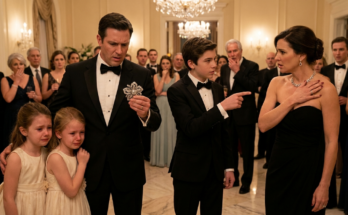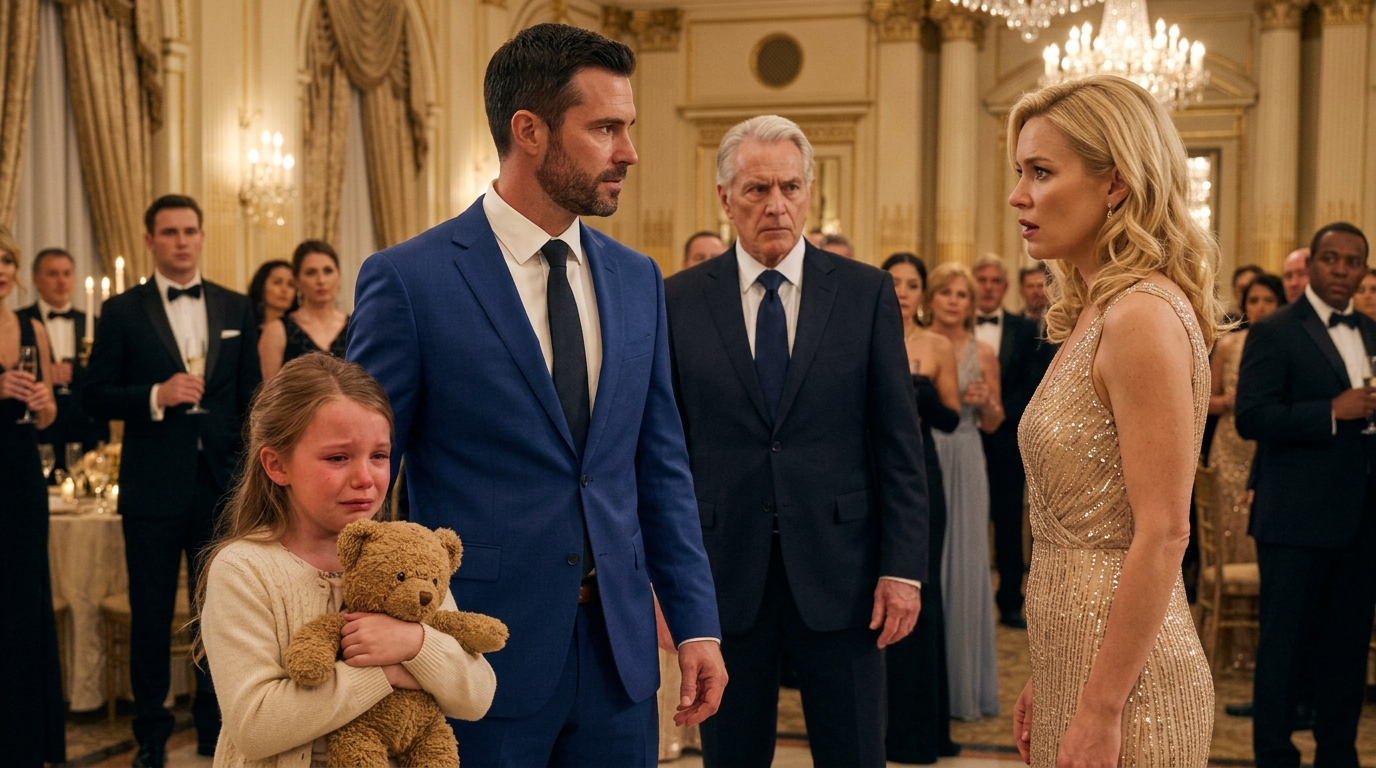
At my father’s black-tie charity gala, my wife grabbed my eight-year-old daughter’s teddy bear and told her she was too old to carry “that disgusting thing.”
My daughter Sophie immediately began crying.
I was across the ballroom speaking to one of my father’s business partners when I heard her voice.
“Give it back!”
I turned.
Claire was standing over her with the bear in one hand.
Sophie was reaching for it.
The expression on Claire’s face was not embarrassed.
It was furious.
“You are eight years old,” she snapped. “Stop acting like a baby.”
I crossed the room.
“Claire.”
She looked at me.
“Give Sophie the bear.”
Instead of returning it, she held it away.
“You do this every time.”
“Do what?”
“You keep treating her like she is more important than our marriage.”
The people nearest us stopped talking.
Sophie hid behind my arm.
I said quietly:
“She is my daughter.”
Claire laughed bitterly.
“And I am your wife.”
Before I could answer, my father walked through the crowd.
Henry Bennett was seventy-four and had spent most of his life building Bennett Industries from a regional construction company into a national business.
He rarely raised his voice.
He did not need to.
He stopped beside us and stared at the teddy bear.
“Where did you get that?”
Claire looked annoyed.
“It belongs to Sophie.”
My father’s face became rigid.
“No. Where did she get it?”
I answered.
“Laura gave it to her.”
My father reached for the bear.
Claire handed it over reluctantly.
He turned it in his hands.
Then he pressed a tiny hidden button in one paw.
A woman’s soft recorded voice came through the old speaker.
“Mommy loves you more than all the stars.”
Sophie started crying harder.
My father closed his eyes for a moment.
“That was Laura’s voice.”
My name is Michael Bennett.
Laura was my first wife and Sophie’s mother.
She died when Sophie was eleven months old.
She had fought an aggressive illness for almost a year.
During her final hospital stay, my father took her to a small gift shop inside the medical center.
Laura picked out a brown teddy bear.
She told him:
“I want Sophie to have something she can hug when I’m not there.”
The shop sold small recordable inserts.
Laura recorded one message.
It was only a few seconds long.
But for Sophie, it became priceless.
After Laura died, Sophie slept with that bear every night.
When she had nightmares, she held it.
When she started kindergarten, it waited in her backpack.
When she missed the mother she barely remembered, she pressed the paw.
I never tried to replace it.
Then I met Claire.
Claire was elegant, intelligent, confident, and at first incredibly patient with Sophie.
She attended school performances.
She helped with homework.
She remembered birthdays.
For nearly two years, I thought I had found someone who truly understood that Sophie and I were a package.
We married.
Then small things began changing.
Claire complained that Sophie came into my bedroom after nightmares.
She questioned why Sophie joined us on every vacation.
She suggested I needed to make our marriage the “primary relationship.”
I tried to explain.
“She’s eight.”
“She still needs me.”
Claire answered:
“She needs to become independent.”
At first, the comments sounded reasonable.
Then they became sharper.
Claire suggested boarding school.
She said Sophie needed discipline.
She complained about the teddy bear constantly.
“It smells old.”
“It looks terrible.”
“People are going to think something is wrong with her.”
I told her the bear belonged to Laura.
She knew that.
But I never told her the full story behind it.
That was my mistake.
My second mistake was believing the comments were only about parenting.
The gala changed everything.
My father hosted the Bennett Foundation gala every year.
It was held in a grand ballroom filled with donors, business leaders, politicians, and family friends.
Sophie had never attended before.
She was nervous.
Before we entered, she asked:
“Can Teddy come?”
I said yes.
Claire immediately objected.
“She cannot carry that thing into a black-tie event.”
I looked at her.
“She’s bringing it.”
Claire said nothing.
But I saw the anger.
For the first hour, Sophie stayed close to me.
Several longtime family friends told her how much she looked like Laura.
She smiled shyly.
Claire did not.
During photographs, Claire whispered to Sophie:
“Put the bear down.”
Sophie shook her head.
“No, thank you.”
Claire’s smile became tight.
Later, I was pulled away by a donor.
That was when I heard Sophie crying.
Claire had taken the bear.
By the time I reached them, several guests were already watching.
Claire said Sophie was embarrassing us.
I told her to return it.
Then my father arrived.
After he heard Laura’s voice come from the bear, he looked at Claire differently.
He handed it back to Sophie.
Then he said:
“You should be very careful how you speak about that child.”
Claire folded her arms.
“Why? Because she’s Michael’s daughter?”
My father answered:
“No.”
He looked at Sophie.
“Because Sophie is the sole beneficiary of the Bennett Family Trust.”
I stared at him.
“What?”
My father had never told me.
After Laura died, he had rewritten his estate plan.
I would continue managing my existing shares.
But the controlling family interest—the portion once intended for Laura—would pass directly to Sophie when she became an adult.
Until then, it would remain under independent professional trustees.
Claire looked at my father.
Then at Sophie.
Her expression changed.
“How much is the trust worth?”
The question landed like a slap.
My father’s face hardened.
“That is what you want to know?”
Claire immediately tried to recover.
“I was just asking.”
My father shook his head.
“No. You’ve been asking for weeks.”
I looked at him.
“What does that mean?”
He turned toward his attorney, who had been standing near the edge of the crowd.
The attorney opened a folder.
Three weeks before the gala, Claire had contacted his office.
She said she was helping me organize our family estate.
She asked whether marriage gave her any rights over my father’s future inheritance.
The attorney refused to discuss confidential information.
Then Claire asked another question.
If a minor beneficiary inherited through a trust, could a stepparent ever become guardian of the beneficiary?
The attorney asked why she wanted to know.
Claire mentioned Sophie by name.
I felt sick.
Claire stepped toward me.
“Michael, it was a general estate-planning question.”
My father answered:
“No, it wasn’t.”
The attorney produced another document.
Claire had contacted a private boarding school in another state.
She had requested tuition information.
Housing information.
And admission requirements.
She had asked how soon an eight-year-old child could be placed on the future enrollment list.
Sophie.
Claire wanted to send Sophie away.
Suddenly every argument from the previous year rearranged itself in my mind.
The complaints about dependence.
The insistence that Sophie spend more weekends with relatives.
The comments about boarding school.
The irritation whenever Sophie sat beside me.
The anger over the teddy bear.
I had interpreted them as adjustment problems.
Now they looked like strategy.
Claire looked at me.
“You are making this into something it isn’t.”
“What is it, then?”
“I was trying to plan our future.”
“Our future?”
“Yes.”
I looked down at Sophie.
She was holding the bear against her chest.
Then I looked back at Claire.
“Our future includes her.”
Claire exhaled sharply.
“You can’t build a marriage around a child.”
I answered:
“I can’t build one with someone who sees my child as an obstacle.”
Then I said:
“Take off your wedding ring.”
She stared at me.
“You’re serious?”
“Yes.”
Claire looked around the ballroom.
Two hundred people were watching.
“You’re humiliating me.”
I replied:
“You humiliated an eight-year-old girl.”
She removed the ring and placed it on a table.
Then she left.
The gala continued without us.
I took Sophie home.
My father came with us.
That night, after Sophie fell asleep, my father showed me the complete estate file.
He had changed the trust years earlier because Laura had asked him to.
During her illness, she told him:
“If anything happens to me, protect Sophie from people who might love her inheritance more than they love her.”
My father had never told me because he did not want money influencing how I raised her.
I understood.
Then he showed me one more thing.
Claire had made a second inquiry through another attorney.
She wanted to know whether a spouse could challenge an independent trustee if the beneficiary was a minor.
That was the moment every remaining doubt disappeared.
The next morning, I contacted an attorney.
Claire and I separated immediately.
The divorce was difficult but straightforward.
There were no children between us.
The prenuptial agreement protected both sides.
She tried to explain her questions as financial curiosity.
Maybe some of them were.
But trust had already ended.
I could not forget the image of Sophie crying while Claire held the teddy bear away from her.
Not because the bear was valuable.
Because Claire believed she had the right to decide which part of my daughter’s grief was acceptable.
Months later, Sophie began seeing a child therapist.
The therapist told me something I will never forget.
“Children do not need every adult to love them. They need the adults responsible for them to keep them safe.”
I realized I had spent too much time trying to create a perfect family.
Sophie did not need perfect.
She needed safe.
My father also updated the trust again.
No future spouse of mine could serve as trustee.
No family member could borrow against Sophie’s assets.
No guardian could move her permanently away from her existing support system without independent review.
Sophie would not receive full control until she was mature enough to understand the responsibility.
Years passed.
She stopped carrying Teddy everywhere.
Not because anyone told her to.
Because she slowly felt secure enough to leave him at home.
She still sleeps with him.
The recorded message still works.
“Mommy loves you more than all the stars.”
One evening, when Sophie was eleven, she asked me:
“Why did Grandpa put money in my name?”
I told her:
“Because your mom wanted to make sure you always had choices.”
She thought about that.
Then she asked:
“Can I use it to help kids whose moms are sick?”
I smiled.
“When you’re older, you can decide.”
My father later created a charitable program in Laura’s name supporting children whose parents were undergoing long-term treatment.
Sophie helped choose the logo.
It was a tiny star.
She said it reminded her of the message in the bear.
Claire disappeared from our lives.
I heard through mutual friends that she remarried.
I never contacted her.
There was nothing left to say.
People who attended the gala still remember the confrontation.
Some tell the story as if my father dramatically exposed a gold digger.
I do not tell it that way.
Because the most important part was never the money.
It was the way Claire treated Sophie before she knew Sophie had any.
That told me everything.
If someone becomes kinder after learning what a child may inherit, that is not kindness.
It is calculation.
Claire saw an old teddy bear and thought it was embarrassing.
My father saw the last gift his daughter ever chose.
Sophie heard her mother’s voice.
And I saw the warning sign I had been ignoring.
The night ended my marriage.
But it also saved me from teaching my daughter the worst possible lesson—that keeping an adult happy mattered more than protecting her heart.
I will never make that mistake again.