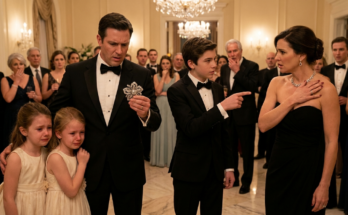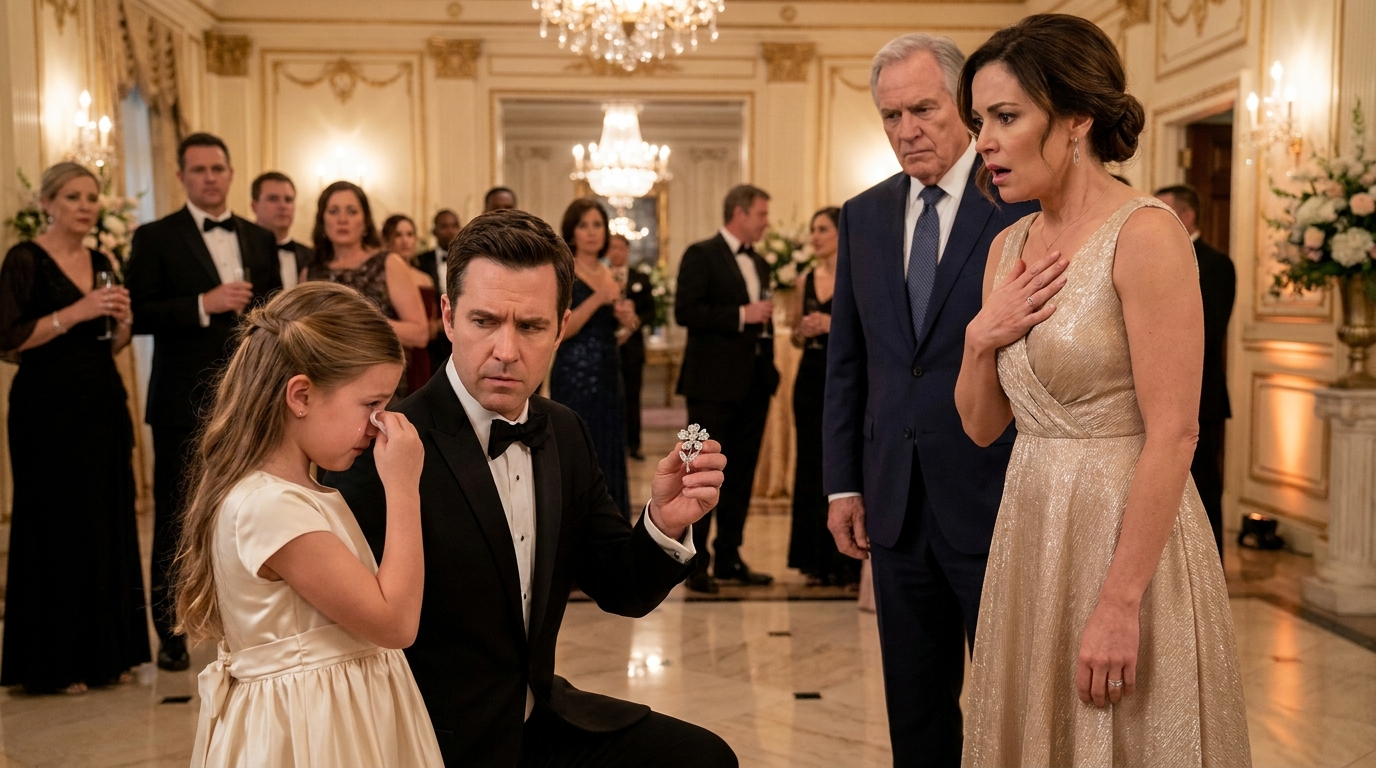
At my father’s black-tie charity gala, my seven-year-old daughter suddenly burst into tears beside me.
Her name is Lily.
She was wearing a simple cream dress with short sleeves.
At first, I thought the ballroom had overwhelmed her.
There were chandeliers.
Cameras.
Hundreds of guests.
Music.
People constantly stopping to shake my hand.
Then Victoria Lane stepped toward us.
Victoria was my father’s fiancée.
She wore a champagne satin evening gown.
Near her shoulder was supposed to be a small diamond brooch.
Except now it was gone.
She looked directly at Lily.
“She took it.”
I stared at her.
“What?”
Victoria pointed toward my daughter.
“She was standing beside me near the dessert table. Now my brooch is missing.”
Lily shook her head.
“I didn’t take anything.”
Victoria crossed her arms.
“Then she won’t mind being searched.”
I stepped in front of my daughter.
“No.”
Victoria looked offended.
“If she is innocent, why are you protecting her?”
“Because she’s seven.”
Lily was crying harder now.
She kept tugging at the side of her dress.
“It hurts.”
I knelt.
“What hurts?”
She pointed toward the seam near her waist.
Something metallic caught the chandelier light.
I carefully lifted the fabric.
Then I saw it.
A small silver brooch.
Diamonds around a floral setting.
The pin was pushed through the dress.
The clasp was still open.
Victoria immediately pointed.
“There! That’s mine.”
Several guests gasped.
For one second, even I was confused.
Then I looked closer.
The pin was facing inward.
The sharp end had been pressing against Lily’s dress lining.
She had not placed it in a pocket.
She had not hidden it.
Someone had pushed it through the fabric.
I asked Lily quietly:
“Did anyone touch your dress?”
She looked at Victoria.
Then whispered:
“She said I had a loose string.”
The ballroom went silent.
Victoria shook her head.
“That is ridiculous.”
My father walked toward us.
Robert Callahan was seventy-two.
He had spent forty years building Callahan Holdings into a successful family business.
He was also the host of the gala.
He looked at Lily’s tear-streaked face.
Then at the brooch in my hand.
“What happened?”
Victoria answered first.
“Lily stole my brooch.”
I said:
“No. Someone pinned it inside her dress.”
My father’s expression changed.
He asked security to pull the ballroom cameras.
Victoria protested.
“This is turning into a spectacle.”
My father replied:
“You accused my granddaughter of theft in front of three hundred people.”
The first video showed Lily near the dessert table.
She never touched Victoria.
The second angle showed Victoria walking behind her.
Victoria bent down.
She touched the side of Lily’s dress.
Her hand remained there for several seconds.
Then she stood up.
Five minutes later, she announced that the brooch was missing.
No one spoke.
My father turned toward her.
“You put it there.”
Victoria said:
“I was fixing her dress.”
“With your brooch?”
She had no answer.
Then she tried another explanation.
She said maybe the brooch caught accidentally.
Security zoomed in.
The video showed her removing the brooch from her own shoulder first.
Then approaching Lily.
That ended the argument.
I asked:
“Why?”
Victoria looked at me.
Then at Lily.
Her face was pale.
Finally, she said:
“She lies constantly.”
My daughter looked stunned.
“What?”
Victoria continued.
“She manipulates you. She cries and you believe everything she says.”
I felt anger rise in me.
“She is a child.”
Victoria replied:
“And that is exactly the problem. You never see what she’s doing.”
My father interrupted.
“What was the purpose of making everyone think she stole?”
Victoria said she wanted us to see that Lily could not be trusted.
But that answer made even less sense.
Then the head of security approached.
He had found another relevant camera clip.
Earlier in the evening, Victoria had been speaking with the family estate attorney in the corridor.
The hallway camera included limited audio.
Most of the conversation could not be heard.
But one sentence was clear.
Victoria said:
“If James loses custody, everything becomes simpler.”
My stomach dropped.
My father looked at her.
“What did you mean by that?”
She denied saying it.
Security played it again.
Her voice was unmistakable.
My father’s attorney stepped forward.
He carried a folder.
For months, Victoria had been asking him questions about the Callahan Family Trust.
The trust existed primarily for future generations.
Lily was one of its direct beneficiaries.
If I died or became legally incapable of acting as Lily’s guardian, an independent trustee would control her share until adulthood.
Victoria had asked whether marriage to my father could give her influence over trustee appointments.
The attorney told her no.
Then she asked whether guardianship disputes could affect access to family distributions.
Again, he told her no.
My father had never heard about those questions.
Now he had.
He stared at Victoria.
“You have been asking about Lily’s trust?”
She said:
“I was trying to understand the family finances.”
“You asked about custody.”
She said nothing.
Then the attorney produced one more document.
Three weeks earlier, Victoria had contacted a private investigator.
The investigator later withdrew from the assignment and notified the family office because Victoria’s request made him uncomfortable.
She had asked him to document incidents that might make me appear negligent as a parent.
She wanted photographs.
Schedules.
Anything showing Lily unsupervised.
The investigator refused after realizing there was no genuine child-safety concern.
That was the moment my father understood.
Victoria had not planted the brooch because of a sudden argument.
She had been building a narrative.
James was careless.
Lily was troubled.
Their relationship was unstable.
And Victoria could position herself as the responsible person closest to my father.
The exact financial plan was never completely clear.
Maybe she believed she could influence future trust decisions.
Maybe she wanted control over my father’s estate.
Maybe she simply wanted Lily and me pushed away.
It no longer mattered.
The behavior itself was enough.
My father looked at her.
“The engagement is over.”
Victoria stared at him.
“You’re ending our relationship over one mistake?”
He answered:
“You planted evidence on a child.”
“That is not one mistake.”
She became angry.
Then embarrassed.
Then defensive.
She said the family had never accepted her.
She said Lily always came first.
My father replied:
“She is seven years old.”
Victoria looked around the ballroom.
Everyone was watching.
She removed her engagement ring.
Placed it on a nearby table.
Then left.
Security escorted her out quietly.
Lily stayed close to me.
She asked:
“Am I in trouble?”
That question broke my heart.
I knelt beside her.
“No.”
“But the brooch was on me.”
“Someone put it there.”
She looked at Victoria’s empty place across the room.
“Why?”
I told her the simplest truth I could.
“Because sometimes adults make bad choices when they want people to believe something that isn’t true.”
She nodded.
Then asked:
“Do you believe me?”
“Yes.”
Immediately.
No hesitation.
That mattered to her.
Later that night, my father apologized.
Not only to Lily.
To me.
He said he had ignored small warning signs because he wanted companionship after years alone.
Victoria had criticized how much time he spent with us.
She had complained that family decisions always included Lily.
He saw it as jealousy.
He did not imagine it would become manipulation.
I told him:
“You ended it when you saw the truth.”
He said:
“I should have looked sooner.”
We all say that after something goes wrong.
Sometimes it is true.
Sometimes hindsight is simply cruel.
The important part was what happened next.
My father changed estate procedures.
No romantic partner could influence trust administration.
No custody-related information could be requested without direct notification to me.
Family security reports involving children had to be reviewed by independent counsel.
The gala security footage was preserved.
Not because we planned a dramatic lawsuit.
Because I wanted a clear record of what happened.
Victoria later sent letters.
She apologized to my father.
Then to me.
Then to Lily.
I did not give the letter directly to Lily.
A therapist helped me decide what was appropriate.
We kept the explanation simple.
An adult tried to blame her for something she did not do.
The adults responsible for protecting her stopped it.
That was enough.
Lily eventually stopped being afraid of formal events.
For months, she refused to wear the cream dress.
Then one day she asked if we could donate it.
I said yes.
Before we gave it away, she touched the repaired seam where the brooch had been pinned.
“Can another kid wear it?”
“If you want.”
She nodded.
“The dress didn’t do anything wrong.”
I smiled.
“No.”
Neither did she.
Years later, I still remember the moment I found that brooch.
Not because it was expensive.
Not because of the diamonds.
Because it was physical proof of something my daughter could not explain.
She only knew someone had touched her dress.
Then she was accused.
Without the camera, adults might have argued.
Memory against memory.
Adult against child.
But the pin told part of the truth.
The footage told the rest.
Victoria wanted everyone to believe Lily was dishonest.
Instead, she revealed exactly who she was.
And the lesson my father never forgot was simple:
A person who needs to make a child smaller in order to feel secure does not belong in a family built on trust.