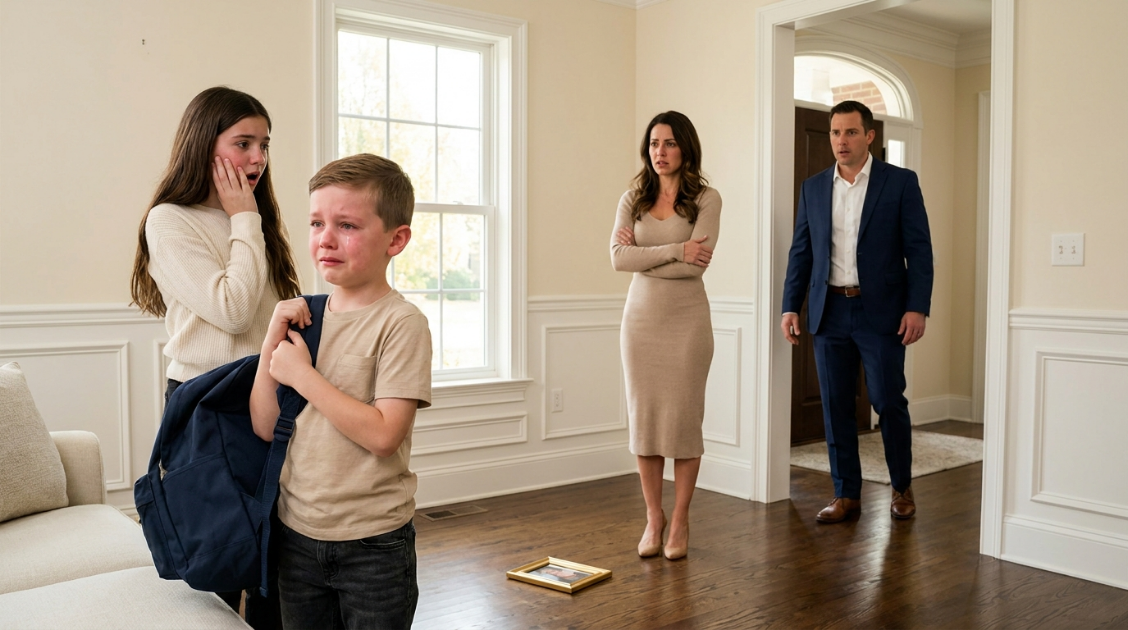
I walked into my house and found my eight-year-old son crying while my wife pulled his backpack from his hands.
My twelve-year-old daughter stood a few feet away.
One hand was pressed to her cheek.
Her eyes were wide.
“What happened?” I shouted.
My wife, Claire, turned toward me.
“Your son has been lying to us.”
Noah shook his head.
“I didn’t lie.”
His face was red from crying.
His backpack had fallen open.
Books and pencils were scattered across the hardwood floor.
Then I noticed something else.
A gold-framed photograph.
I picked it up.
For several seconds, I forgot how to breathe.
The photo was old.
Eight years old.
It showed my younger brother, Michael, sitting on our old living-room sofa.
He was holding newborn Noah in his arms.
Michael was smiling.
Noah was asleep against his chest.
My wife stared at the frame.
Her face went pale.
I looked at her.
“Where did he get this?”
Claire answered:
“He found it.”
Noah wiped his eyes.
“It was in the closet.”
I asked:
“Why are you crying?”
He pointed at Claire.
“She said I can’t take it to school.”
“What school?”
He explained that his class had a family-history project.
Each child was supposed to bring a photograph of someone important from the past.
Noah found the picture while searching through an old storage box.
He did not know who Michael was.
That was our failure.
After my brother died, we rarely talked about him.
The grief was too heavy.
My parents stopped celebrating his birthday.
I packed away most of his belongings.
Claire said it was better not to confuse the children with a story they were too young to understand.
At the time, I agreed.
Now I regretted it.
Noah asked Claire:
“Who is the man holding me?”
According to Emma, Claire replied:
“Nobody you need to know.”
Emma overheard.
She knew enough about Michael to recognize him.
“That’s Uncle Michael.”
Claire became furious.
She grabbed the backpack.
Took out the photograph.
Told Noah he was not taking it anywhere.
He started crying.
Emma stepped between them.
That was when I walked in.
I held the picture.
“What are you afraid of?”
Claire said:
“I’m not afraid.”
“Then why are you treating an old photograph like a secret?”
She crossed her arms.
“Because Michael’s death destroyed this family.”
I looked at her.
“That doesn’t explain this.”
Then Emma spoke.
“Dad, she’s been looking for stuff in Noah’s room.”
Claire spun around.
“Emma.”
My daughter ignored her.
“She took letters from the box.”
My heart started beating faster.
“What letters?”
Emma ran upstairs.
Claire followed her.
I stopped Claire in the hallway.
“Stay here.”
A minute later, Emma returned with a sealed envelope.
The paper was yellowed.
My name was written across the front.
David.
I recognized the handwriting immediately.
Michael.
My brother.
I looked at Claire.
She started crying.
“Please don’t.”
That told me everything.
Whatever was inside, she already knew.
The letter was dated three days before Michael died.
His death had been sudden.
A highway accident.
There had been no final conversation.
No goodbye.
Or at least that was what I thought.
I opened the envelope.
The first line said:
“David, there is something you need to know about Noah.”
My hands began shaking.
I kept reading.
Michael wrote that several months before Noah was born, Claire had come to him during one of the worst periods in our marriage.
At the time, Claire and I had separated briefly.
I remembered that.
Three weeks apart.
Fights.
Counseling.
Then reconciliation.
What I did not know was that Claire and Michael had become emotionally involved during that separation.
The letter said it happened once.
Michael regretted it immediately.
Claire later told him she was pregnant.
She did not know with certainty whether the child was mine or his.
Michael wanted us to know.
Claire begged him to stay silent.
He agreed.
Then Noah was born.
Michael became convinced the truth should be tested.
He wrote:
“You deserve the truth. And Noah deserves to grow up without secrets deciding who he is.”
I stopped reading.
The room felt completely silent.
I looked at Claire.
“Is this true?”
She covered her face.
Then nodded.
My knees almost gave out.
Noah was standing in the doorway.
I immediately folded the letter.
He did not need to hear this.
Not like this.
I told Emma to take him upstairs.
Claire and I went into the dining room.
I asked:
“Did you know this letter existed?”
“Yes.”
“How?”
“Michael told me he wrote it.”
“Why do you have it?”
She said the letter had arrived at our house after his death.
She intercepted it.
She never gave it to me.
She hid it among old family things.
Years passed.
She assumed it was gone.
Then several weeks earlier, she saw Noah going through storage boxes.
That was why she started searching his room.
She was afraid he would find the letter.
He found the photograph first.
I stared at her.
“For eight years?”
She cried.
“I was afraid.”
“Of what?”
“Losing you.”
I almost laughed.
Not because it was funny.
Because after eight years of silence, that answer felt impossibly small.
“You let me grieve my brother without telling me he left me a final letter.”
She looked down.
“Yes.”
“You let Noah grow up without knowing Michael might have been his biological father.”
“Yes.”
That word changed everything.
I asked whether a paternity test had ever been done.
No.
Michael died before anything happened.
Claire said she convinced herself it did not matter.
I was Noah’s father.
I raised him.
I loved him.
Michael was gone.
Why destroy a family?
I understood the fear.
I did not accept the lie.
We contacted a family counselor before doing anything else.
The first question was not biology.
It was how to protect Noah.
He was eight.
He knew adults were upset.
He knew the photograph mattered.
But he did not need the entire adult history dumped onto him in one night.
The counselor helped us explain part of the truth.
Michael was my brother.
He loved Noah.
There were complicated family questions we were still understanding.
Noah had done nothing wrong.
Most importantly:
I was his dad.
Nothing changed that.
Later, with legal and medical guidance, we explored whether testing was possible.
My parents still had some of Michael’s stored medical samples from earlier procedures.
Eventually, a DNA comparison confirmed what the letter suggested.
Michael was Noah’s biological father.
I read the result alone.
I expected devastation.
Instead, I felt something stranger.
Grief.
Anger.
Relief.
Love.
All at once.
Then I walked into Noah’s room.
He was building something with blocks.
He looked at me.
“Are you mad?”
“No.”
“Am I in trouble?”
“No.”
I sat beside him.
“I love you.”
He frowned.
“I know.”
Children can make the biggest sentences sound obvious.
That helped.
Claire and I separated.
Not because of Noah.
Never because of Noah.
Because eight years of hiding the truth had destroyed trust between us.
We entered counseling.
Eventually, the marriage ended.
But we worked hard not to make the children carry our anger.
Emma had her own guilt.
She thought showing me the letter caused the family to break apart.
I told her:
“No.”
The secret existed before she found it.
Finding truth does not create the damage that the lie caused.
That took time for her to believe.
Noah grew older.
We told him more as he became ready.
At ten, he learned Michael might have been biologically connected to him.
At twelve, he understood the full relationship.
At thirteen, he asked to see the letter.
I gave him a copy.
He read it quietly.
Then he looked at the photograph.
“Was he a bad person?”
I thought carefully.
“No.”
“Was Mom?”
“No.”
He frowned.
“But they did something bad.”
“Yes.”
That was the answer.
People can make terrible decisions without becoming simple villains.
Michael made a mistake.
Claire made one too.
Then she made another decision every day for eight years by continuing the silence.
That was harder to forgive.
Noah asked:
“Are you still my dad?”
I laughed.
“Yes.”
“Even if Uncle Michael was my biological father?”
“Yes.”
“Okay.”
That was it.
He went downstairs for cereal.
Years later, Noah keeps the gold-framed photograph on a shelf in his room.
Not hidden.
Not treated like evidence.
Just family history.
Michael holding him as a baby.
Sometimes I look at it and wonder what my brother would have done if he had lived.
Would we have fought?
Probably.
Would I have forgiven him?
Eventually, I think so.
Would Noah’s life have been different?
Certainly.
But I cannot answer imaginary questions forever.
I can only live with what is true now.
I am Noah’s father.
Michael was his biological father.
Claire is his mother.
Emma is his sister.
The family became more complicated.
But it also became more honest.
And when I think back to that afternoon, I remember how everything started.
Not with a DNA test.
Not with an attorney.
Not with a confession.
With an eight-year-old boy crying over an old photograph because he wanted to bring his family history to school.
He thought the picture was just a picture.
The adults were the ones who turned it into a secret.
And the lesson I learned was simple:
Children can survive complicated truths far better than families survive carefully protected lies.