I walked through the front door and heard my baby screaming.
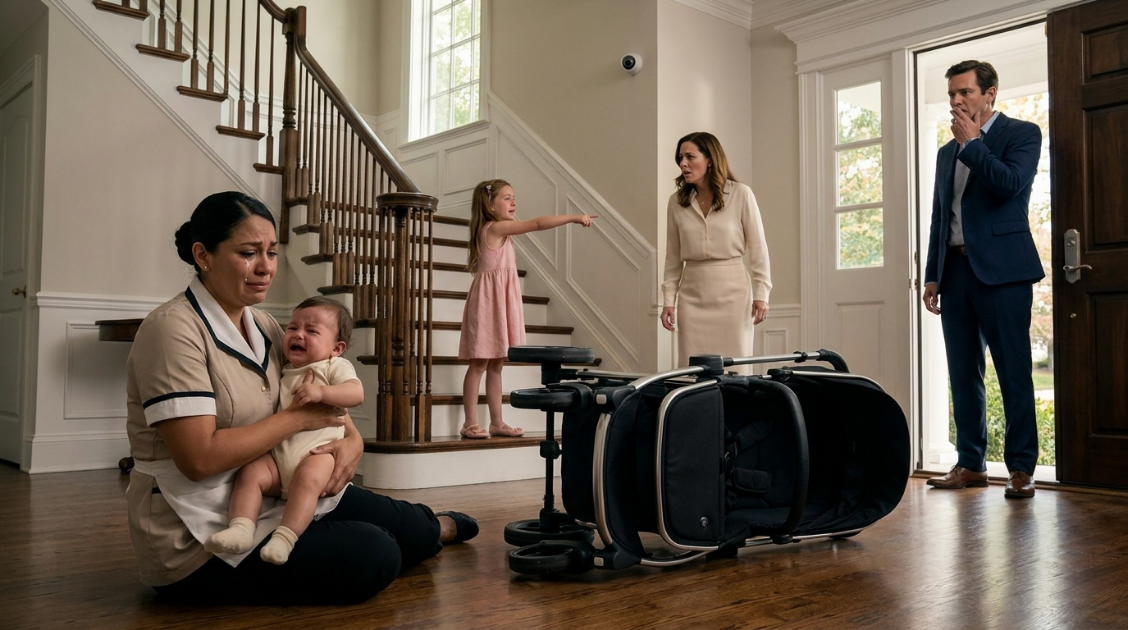
The sound came from the staircase.
Then I saw the stroller.
It was lying sideways at the bottom of the stairs.
Empty.
For one second, my mind stopped working.
Then I saw Maria.
Our housekeeper was on the hardwood floor near the bottom step.
She was holding my nine-month-old son, Oliver, tightly against her chest.
He was crying.
But he was alive.
My six-year-old daughter, Sophie, stood several steps above them in a pink dress.
She was sobbing.
“What happened?” I shouted.
Sophie pointed toward the hallway.
“She pushed it.”
My name is Daniel Mercer.
My wife, Emily, and I had two children.
Sophie was six.
Oliver was nine months old.
Our home had a wide dark-wood staircase in the center hallway.
We had always been careful around it.
Baby gates.
Stroller brakes.
Nothing left near the edge.
That afternoon, I was at work.
Emily was visiting her mother.
Her sister, Claire, had offered to come over and help.
Claire had been around our children many times.
I trusted her.
Maria had worked for our family for twelve years.
She knew the children almost as well as we did.
According to Maria, Oliver had fallen asleep in his stroller near the upstairs sitting area.
Sophie was coloring nearby.
Maria went downstairs to fold laundry.
Claire was upstairs.
Then Maria heard a sound.
Wheels.
Fast.
Then Sophie screamed.
Maria looked up.
The stroller was already moving toward the staircase.
It hit the first step.
Then another.
Maria ran.
She did not have time to think.
She reached the bottom just before the stroller came down.
She grabbed Oliver.
The stroller twisted sideways.
Maria fell backward.
Oliver landed against her chest.
The stroller crashed beside them.
That was the scene I came home to.
I rushed to Maria first.
“Is he hurt?”
She shook her head.
“I don’t think so.”
Oliver was crying hard.
I checked his head.
His arms.
His legs.
No obvious injury.
I called emergency services anyway.
Then I looked at Sophie.
She was shaking.
I climbed the first few steps.
“What happened?”
She pointed behind me.
“She pushed it.”
I turned.
Claire stood near the dining-room entrance.
Her face was white.
“That is not what happened.”
Sophie screamed:
“Yes, it is!”
Claire said the stroller had rolled on its own.
She claimed the brake failed.
She said she had been walking away when it happened.
I wanted to believe her.
Not because the explanation made sense.
Because the alternative was almost impossible to accept.
Then I remembered the camera.
Several months earlier, packages had disappeared from our front porch.
We installed cameras near the entrances.
One camera covered part of the central hallway and staircase.
I pulled out my phone.
Claire immediately said:
“Daniel, the baby needs you.”
I looked at her.
“He is with Maria.”
Then I opened the camera feed.
The recording began with Oliver asleep in the stroller.
Claire walked into frame.
She looked toward the staircase.
Then toward the hallway.
She checked whether anyone was nearby.
She bent down.
Her hand moved near the rear wheel.
She released the brake.
Then she stood behind the stroller.
For several seconds, she did nothing.
Then Sophie appeared in the far hallway.
Claire saw her.
She placed one hand on the stroller handle.
And pushed.
Not hard.
She did not need to.
The floor sloped slightly toward the stairs.
The stroller rolled.
Sophie screamed.
Claire stepped backward.
The stroller reached the first stair.
Then disappeared from the camera angle.
I replayed it.
Once.
Twice.
I could not speak.
Claire said:
“You don’t understand.”
I looked at her.
“You pushed my son toward a staircase.”
She started crying.
“It wasn’t supposed to happen like that.”
That sentence made everything worse.
“What was supposed to happen?”
She covered her face.
Maria, still holding Oliver, spoke from the floor.
“Sir, I heard her earlier.”
Claire turned.
“Maria, don’t.”
Maria ignored her.
She said Claire had been arguing on the phone that morning.
Maria only heard part of the conversation.
But one sentence stood out.
“If Daniel loses custody, Emily gets everything.”
I stared at Claire.
“What does that mean?”
She refused to answer.
The paramedics arrived.
Oliver was examined.
He was frightened but uninjured.
Maria had bruised her shoulder and knee.
Sophie was physically fine.
Emotionally, she was not.
She kept repeating:
“I saw her push him.”
A police report followed.
The camera footage was preserved.
Claire was removed from the house.
Then I called our family attorney.
I told him exactly what Maria heard.
There was a long silence.
Then he asked:
“Has Claire spoken to you about the children’s trust?”
“No.”
He told me something I had forgotten.
Years earlier, before Oliver was born, Emily and I created basic estate documents.
If both of us died, Claire was listed as one possible backup guardian for Sophie.
Later, after family circumstances changed, we created new documents.
I believed the old papers had no practical importance.
Legally, the newer documents controlled.
But Claire apparently did not understand that.
Two weeks before the incident, she had contacted the attorney’s office.
She asked general questions about guardianship.
She asked what happened if one parent became “unfit.”
She asked whether control of children’s assets could shift to another relative.
The staff member refused to discuss details.
Claire became angry.
Then she asked whether Emily would control everything if I lost custody.
That was the same phrase Maria heard.
Emily came home.
I showed her the video.
She watched only once.
Then she sat down.
“That’s my sister.”
I knew.
That was part of the horror.
Claire eventually admitted that she had become obsessed with the idea that our marriage was failing.
Emily had confided in her about ordinary arguments.
Work stress.
Sleepless nights.
Money disagreements.
Nothing unusual.
Claire turned those conversations into a story.
She convinced herself I was controlling the family.
That Emily needed to leave.
That the children would be better off away from me.
But instead of talking to us, she started researching custody and finances.
Then she learned that one of our trusts would continue supporting the children regardless of which parent had physical custody.
She misunderstood that as a financial opportunity.
She believed if something happened that made me look negligent, Emily would leave me.
Claire could then position herself as the indispensable helper.
The person Emily depended on.
The person helping raise the children.
The person with influence.
It was not a sophisticated financial conspiracy.
It was worse in another way.
It was emotional obsession mixed with entitlement.
Claire wanted to control what happened next in our family.
She convinced herself she was rescuing Emily.
That afternoon, she planned to create an “incident.”
She later claimed she expected the stroller to stop before the stairs.
The video made that difficult to believe.
The brake was released.
The stroller was pushed toward the staircase.
A baby was inside.
Whatever story Claire told herself, the risk was real.
Maria saved Oliver.
There is no softer way to say it.
If she had been ten seconds farther away, I do not know what would have happened.
Claire faced serious legal consequences.
I will not turn that process into a dramatic courtroom story.
Real investigations take time.
Evidence is reviewed.
Intent is argued.
Attorneys get involved.
But the camera footage was clear.
Our family relationship with Claire ended immediately.
Emily struggled with that.
She loved her sister.
She also watched her sister push our baby toward a staircase.
Both things could be true.
That was difficult to live with.
Sophie had nightmares.
For weeks, she refused to walk past the staircase alone.
Every time a stroller wheel moved, she panicked.
We found a child therapist.
The therapist told us not to force Sophie to “get over it.”
So we rebuilt safety slowly.
We moved the stroller downstairs.
We installed new stair gates.
We let Sophie help lock them.
She needed to see that the adults had changed the environment.
Not just hear promises.
Maria recovered.
Her shoulder was sore for weeks.
We offered her paid leave.
She came back sooner than expected.
The first day she returned, Sophie ran to her.
Oliver smiled when he saw her.
Maria cried.
So did I.
We tried to give her a financial reward.
She resisted.
“I just grabbed him.”
I said:
“You saved my son.”
She finally accepted enough to take a long vacation and help her own daughter with college expenses.
But money never felt like enough.
How do you price the moment someone catches your child?
You cannot.
Emily and I also changed our estate plan completely.
Independent trustees.
Clear guardianship instructions.
No outdated copies in family possession.
No assumptions.
No ambiguous access.
We learned that documents do not just protect money.
They protect expectations.
And unclear expectations can become dangerous when unstable people build fantasies around them.
Months later, Sophie asked me something.
“Dad, did Aunt Claire hate Oliver?”
I thought carefully.
“No.”
“Then why did she push him?”
That was harder.
“Because sometimes people convince themselves they are helping when they are actually doing something very wrong.”
Sophie frowned.
“She knew he could fall.”
“Yes.”
“So she was wrong.”
“Yes.”
Children sometimes understand moral clarity faster than adults.
Claire had explanations.
Grief.
Jealousy.
Fear.
Resentment.
A desperate need to be important.
All of those may have been real.
None made the push acceptable.
Years later, Oliver does not remember the fall.
Sophie does.
Maria does.
Emily and I certainly do.
The staircase is still there.
The dark wood was repaired where the stroller struck it.
There is a small mark near the third step.
I could have had it refinished.
I never did.
Not because I enjoy the memory.
Because every time I see it, I remember what actually saved my son.
Not wealth.
Not cameras.
Not lawyers.
A woman downstairs heard wheels moving where they should not move.
She ran toward danger.
She caught a baby.
And a six-year-old girl told the truth even while an adult insisted she was wrong.
The camera proved it.
But Sophie said it first.
“She pushed it.”
Three words.
That was how our family stopped protecting the wrong person.