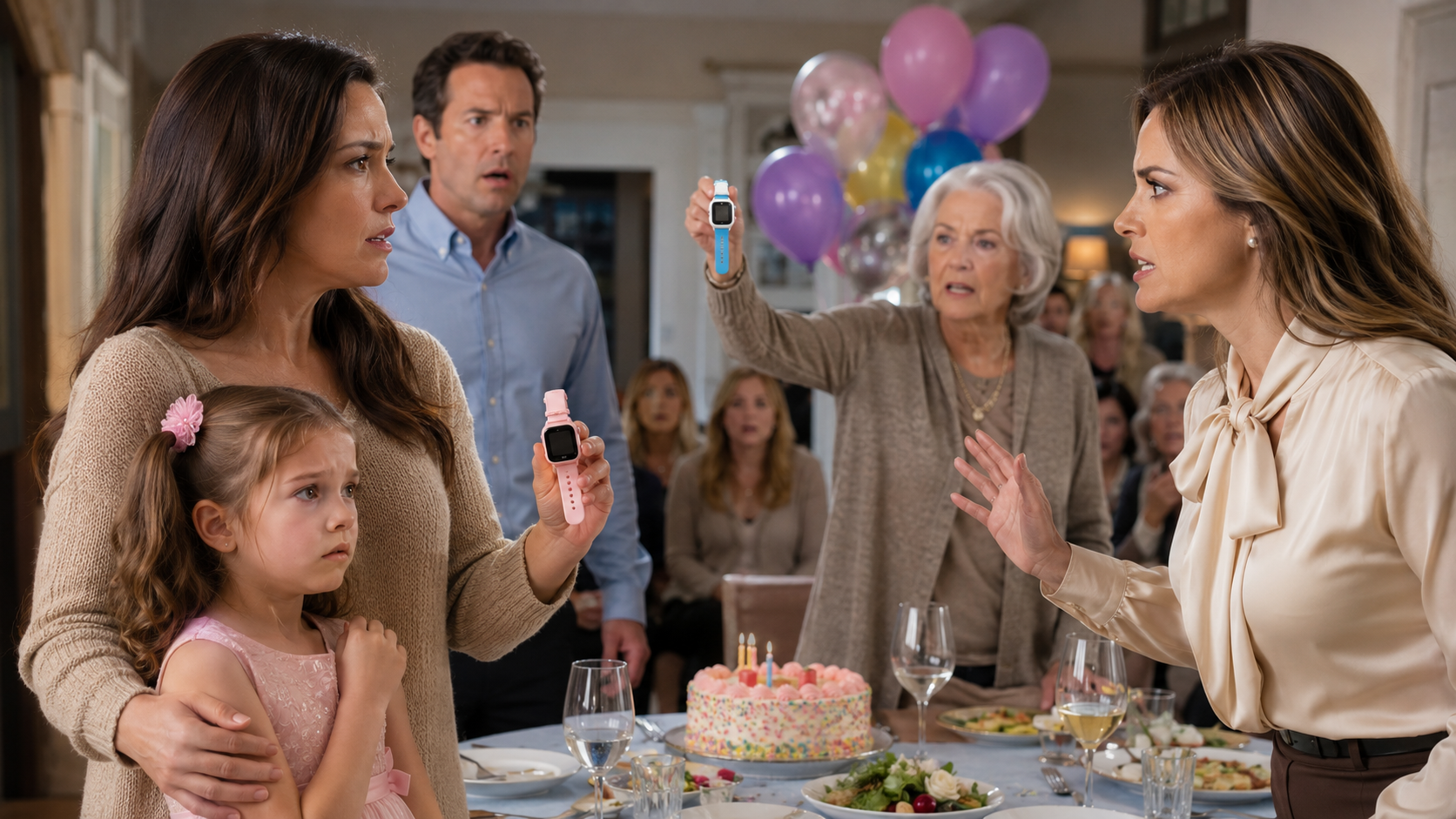
At my daughter Lily’s seventh birthday party, my sister-in-law Vanessa pointed at the pink watch in Lily’s hand and screamed so loudly that every conversation in the room stopped.

“PUT THAT DOWN! YOU STOLE IT FROM MY BAG!”

Lily’s face crumpled.

She was standing beside the dining table in her pale-pink birthday dress, tears already filling her eyes.

“No,” she cried. “Grandma gave it to me.”

Vanessa leaned toward her.

“LIAR!”

I moved before I even thought about it.

I pulled Lily against my side and stepped between my child and Vanessa.

“Don’t you dare scream at my daughter.”

Vanessa’s face twisted with contempt.

“Then teach your daughter not to steal.”

My husband Daniel rushed in from the kitchen.

He had been carrying a tray of drinks when the shouting started.

“What is going on?”

Vanessa pointed at the watch.

“That was in my purse. She took it.”

Lily shook her head so hard that one of the pink clips in her hair almost came loose.

“No, Daddy. Grandma gave it to me.”

Daniel looked toward his mother, Eleanor, who was seated at the far end of the table.

Before Eleanor could speak, Vanessa shouted again.

“She’s not even blood! She doesn’t belong here!”

The room went completely silent.

Daniel stared at his sister.

I felt Lily’s fingers tighten around mine.

Lily was adopted.

Daniel and I had finalized the adoption eighteen months earlier after fostering her for nearly a year.

To us, the word “adopted” described paperwork.

It did not describe the amount of love in our home.

Vanessa had never understood that.

From the day the adoption became official, she found small ways to remind Lily that she had entered the family differently.

She never did it loudly in front of Daniel.

She was smarter than that.

She would ask Lily whether she remembered her “real parents.”

She would introduce her as “Daniel’s adopted girl” instead of his daughter.

She once told another relative that Grandma Eleanor was “trying too hard to pretend blood doesn’t matter.”

Every time Daniel confronted her, Vanessa claimed it was a misunderstanding.

That afternoon at the birthday party, there was no misunderstanding left.

Grandma Eleanor slowly stood.

She was seventy-two, silver-haired, quiet by nature, and almost never raised her voice.

But when she lifted her wrist, everyone looked at her.

A blue-and-white safety watch was strapped around it.

It was almost identical to the pink one Lily was holding.

“Enough,” Eleanor said.

Vanessa stopped.

Eleanor pointed toward Lily’s watch.

“I bought both of them.”

Vanessa’s confidence disappeared for half a second.

Then she recovered.

“You bought me one too.”

“No,” Eleanor said. “I did not.”

Vanessa crossed her arms.

“Then how do you know she didn’t take mine?”

Grandma looked at Lily.

“Sweetheart, did you press the emergency button?”

Lily nodded.

Her lower lip was trembling.

“I was scared.”

Eleanor’s eyes hardened.

Two weeks earlier, Eleanor had purchased a paired family safety-watch system.

She wore the blue device.

Lily had the pink device.

Eleanor had chosen it because Lily had recently begun walking two blocks to a neighbor’s house with permission, and Eleanor wanted her granddaughter to have a simple way to call for help.

The emergency feature did something none of us had thought about during the party.

When Lily held the button for several seconds, the device sent an alert to the family account and saved a short audio recording.

Eleanor opened the companion app on her phone.

Vanessa immediately stepped forward.

“Turn that off.”

Grandma looked at her.

“Why?”

“Because this is ridiculous.”

Eleanor pressed play.

Vanessa’s own voice filled the dining room.

“Put it in your pocket, Lily. Then we’ll see who they believe.”

My stomach dropped.

Daniel stopped breathing for a moment.

Lily hid her face against my sweater.

The recording continued.

Lily’s tiny voice could be heard asking, “Why?”

Then Vanessa answered:

“Because your mother thinks marrying Daniel made both of you family. It didn’t.”

Daniel looked at his sister.

“What did you do?”

Vanessa’s eyes moved from him to Eleanor.

“It’s out of context.”

Grandma pressed play again.

Vanessa’s recorded voice continued.

“When everyone sees you stealing, maybe they’ll finally understand.”

Daniel took one step toward her.

“You framed a seven-year-old.”

Vanessa threw up her hands.

“Oh, stop making this dramatic.”

I could barely believe what I was hearing.

“You put a watch in my daughter’s pocket and then screamed that she stole it.”

“I was teaching her a lesson.”

“What lesson?”

Vanessa pointed at me.

“That walking into this family doesn’t make you entitled to everything.”

That was the moment the argument stopped being about a watch.

Three months before Lily’s birthday, Grandma Eleanor had updated her estate plan.

She had inherited several properties from my late father-in-law and had created an education fund for every legally recognized grandchild.

The language was clear.

Biological children.

Adopted children.

Any child legally recognized as a grandchild would receive equal educational support.

Lily was currently the only grandchild.

Vanessa was thirty-eight and had no children.

She had always assumed that if she eventually became a mother, her child would be first in line for everything Eleanor left behind.

Lily’s adoption changed that assumption.

Vanessa did not lose anything.

But in her mind, equality felt like theft.

Daniel had tried to ignore her increasingly bitter comments.

Eleanor had not.

Two months earlier, Vanessa sent Eleanor a message asking whether the education fund could be changed so that “biological descendants receive priority.”

Eleanor refused.

A week later, Vanessa suggested that Lily was too young to understand money and that I would probably spend the fund myself.

Eleanor refused again.

Then money began disappearing from an account that Vanessa had access to.

It was not the education fund.

It was a household account Eleanor used to pay maintenance expenses on a small lake property.

At first, the withdrawals were small.

Eight hundred dollars.

Twelve hundred.

Two thousand.

Vanessa told Eleanor the charges were reimbursements for repairs she had arranged.

Because Vanessa had helped manage the property after my father-in-law died, Eleanor trusted her.

Then the amounts grew larger.

Eleanor became suspicious.

She asked her attorney, Martin Hale, to review the statements.

He found invoices from a company called North Shore Residential Services.

The company existed.

But it had never worked on Eleanor’s property.

The invoice numbers belonged to unrelated jobs.

The payment destination belonged to a private account connected to Vanessa.

Eleanor did not confront her immediately.

Her lawyer advised her to gather records first.

That was why, when Vanessa began screaming about the pink watch at the birthday party, Eleanor already knew there was a larger problem.

After playing the recording of Vanessa framing Lily, Eleanor opened another saved audio clip.

It had been captured earlier that afternoon when Lily accidentally triggered the watch while hiding behind the hallway wall.

Vanessa was on the phone.

Her voice was clear.

“Once everyone thinks the girl steals, Eleanor will have to reconsider putting her in the trust.”

A pause followed.

Then Vanessa said:

“I just need one scene big enough that Daniel can’t defend her.”

Daniel’s eyes filled with tears.

Not because he doubted Lily.

Because he finally understood how long his sister had been planning to hurt her.

Vanessa grabbed her handbag.

“This family is insane.”

Daniel pointed toward the door.

“Get out.”

She stopped.

“You’d choose her over your own sister?”

Daniel moved in front of Lily.

“She is my daughter.”

Vanessa laughed bitterly.

“She doesn’t even have your blood.”

Daniel’s voice became louder.

“I said she is my daughter.”

For the first time that afternoon, Vanessa had nothing to say.

She turned toward Eleanor.

“You’re really going to destroy this family over a recording made by a child’s toy?”

Eleanor held up her phone.

“No.”

She looked at Vanessa for a long moment.

“You did that yourself.”

Then she added:

“And tomorrow, my lawyer will hear every second.”

Vanessa left.

The party ended ten minutes later.

We did not open the remaining presents.

Lily did not want cake.

She asked me whether she was in trouble.

That question hurt more than anything Vanessa had shouted.

I knelt beside her.

“No.”

“But Aunt Vanessa said I stole.”

“You didn’t.”

“Will Daddy believe me?”

Daniel dropped to his knees beside us.

He was crying now.

“I believe you.”

Lily looked at him.

“Even if I’m not blood?”

Daniel wrapped his arms around her.

“You are my daughter every day. Nothing she says changes that.”

The following morning, Eleanor met with her attorney.

She gave him the watch recordings, the account records, the suspicious invoices, and the text messages Vanessa had sent about excluding Lily from the education fund.

The financial review took several weeks.

What it uncovered was worse than we expected.

Vanessa had redirected almost $74,000 from Eleanor’s property-maintenance account over fourteen months.

Some payments went directly into her personal account.

Others passed through a business controlled by one of her friends.

She had used the money to pay credit-card debt, lease a luxury SUV, and put a deposit on an expensive apartment.

When questioned, Vanessa initially claimed Eleanor had authorized everything.

But the bank records did not support her story.

Neither did the forged invoices.

The watch recording did not prove the financial misconduct by itself.

What it proved was motive.

Vanessa had been trying to discredit Lily because she wanted Eleanor to remove her from the family plan.

The financial records proved something else.

Vanessa had already been taking money she believed would eventually belong to her.

Eleanor froze Vanessa’s access to every account.

Her attorney referred the financial evidence to investigators.

Vanessa hired a lawyer.

For months she insisted the situation was a family misunderstanding.

Eventually, after the bank completed its review, she agreed to repay the diverted funds and entered a plea on charges related to the falsified invoices and unauthorized transfers.

The legal outcome mattered.

But the family consequences mattered more.

Daniel stopped speaking to Vanessa for almost a year.

Eleanor removed Vanessa from every financial role.

More importantly, she changed the way she spoke about Lily.

She stopped allowing anyone to use phrases like “adopted granddaughter” when the word “adopted” was being used to reduce her place in the family.

“She is my granddaughter,” Eleanor would say.

“That is the complete sentence.”

We also took Lily to a child therapist.

The birthday confrontation had frightened her deeply.

For weeks, she refused to wear the pink watch.

She said it reminded her of Vanessa yelling.

Grandma never pressured her.

The blue watch stayed on Eleanor’s wrist.

One afternoon, months later, Lily asked whether Grandma still had the matching one.

Eleanor showed it to her.

Lily touched the blue face.

“Did it really save me?”

Eleanor shook her head.

“No, sweetheart.”

She pointed gently toward Lily’s chest.

“You saved yourself when you asked for help.”

That answer mattered.

We did not want Lily growing up believing technology had protected her while the adults around her failed.

We wanted her to know that speaking up was the brave part.

Nearly two years after the birthday party, Daniel received a letter from Vanessa.

She apologized to him.

Then to Eleanor.

Then, finally, to Lily.

The apology to Lily was only four sentences.

It said Vanessa had been jealous.

It said she had treated family like a competition.

It said she had tried to make a child carry the consequences of an adult’s resentment.

And it said she did not expect forgiveness.

We let Lily decide whether she wanted to read it.

She did.

Then she folded it and put it back in the envelope.

“Do I have to forgive her?”

“No,” I said.

“You only have to be safe.”

Lily nodded.

That evening, Eleanor came over for dinner.

She wore the same blue watch.

Lily disappeared upstairs for a few minutes and returned wearing the pink one for the first time since the party.

Grandma noticed but did not make a big announcement.

She simply smiled.

Lily sat beside her.

Their two watches rested on the table while they ate.

One blue.

One pink.

Vanessa had once looked at the pink watch and seen an opportunity to make a child look like a thief.

But the watch became the exact object that exposed her.

Not because it was expensive.

Not because it belonged to anyone important.

Because a frightened seven-year-old pressed one button when an adult tried to convince her that nobody would believe her.

Vanessa expected the entire family to hear an accusation.

Instead, they heard the truth.

And when Daniel stood between his sister and his daughter and shouted, “She is my daughter,” Lily finally heard the sentence that mattered most.

She belonged.