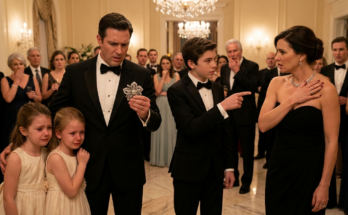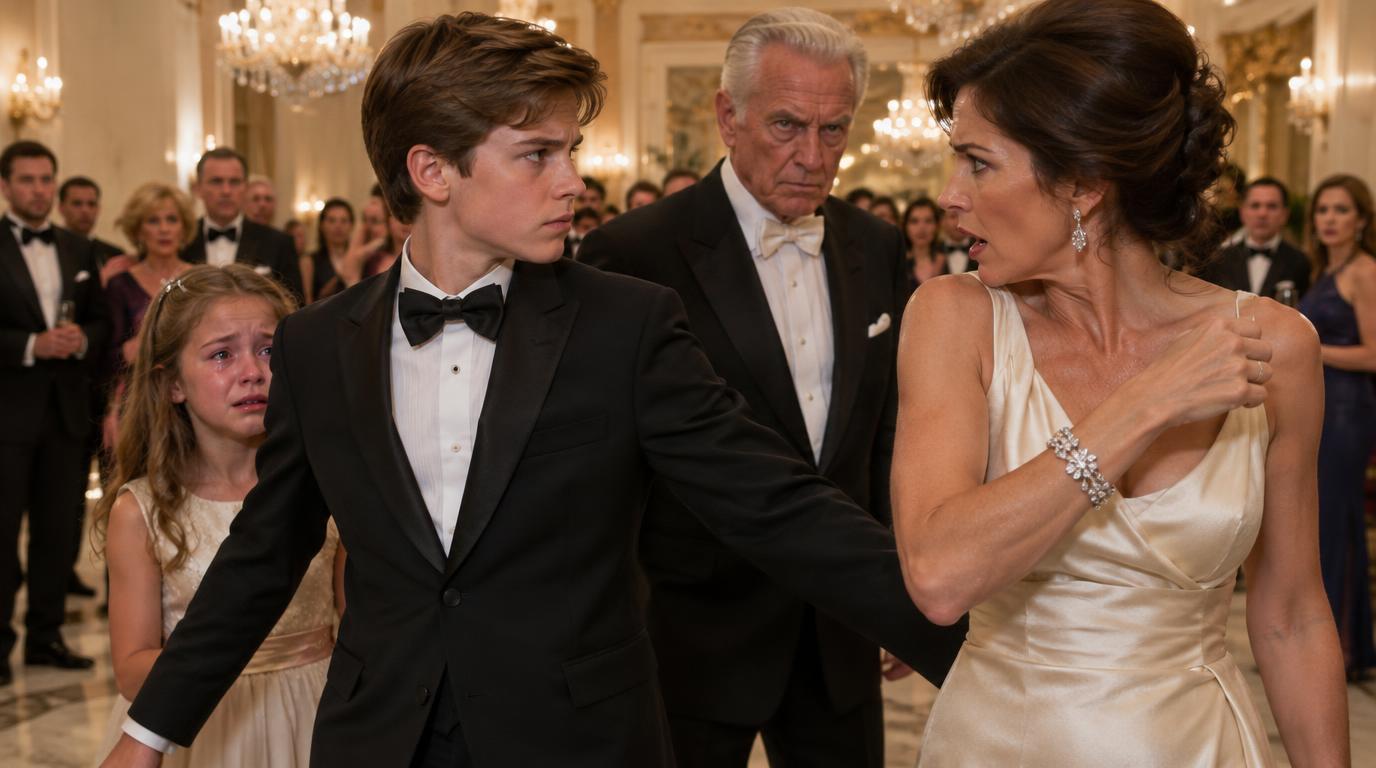
At my grandfather’s black-tie gala, a woman in a cream satin gown grabbed my seven-year-old sister by the wrist and accused her of stealing a diamond.
My sister, Lily, immediately started crying.
“I didn’t take anything.”
The woman, Vanessa Grant, leaned closer.
“You were standing beside me when I noticed it was missing.”
I stepped between them.
“Let her go.”
Vanessa turned toward me.
“You’re defending a thief?”
I was fourteen.
Old enough to know when an adult was trying to intimidate a child.
And old enough to notice something strange.
Vanessa kept talking about a missing diamond.
But the bracelet on her wrist still looked complete.
I stared at it.
Large clear stones.
Flower-shaped settings.
A custom clasp.
It looked expensive.
Very expensive.
Then my grandfather arrived.
Henry Cole was seventy-six and the host of the event.
He had spent most of his life building the Cole Foundation and several successful businesses.
When he saw Lily crying, he walked straight toward us.
“What happened?”
Vanessa answered first.
“Lily took a stone from my bracelet.”
My grandfather looked at her wrist.
Then his expression changed.
“Take that off.”
Vanessa frowned.
“Excuse me?”
“That bracelet.”
She laughed nervously.
“Henry, this is mine.”
“No.”
The room became quiet.
He stepped closer.
“That bracelet belonged to Grace.”
Grace was my mother.
Lily’s mother too.
She had died six years earlier.
For a moment, I forgot about Vanessa.
I only looked at the bracelet.
I had seen it before.
Not in real life.
In photographs.
My mother wore it at my parents’ anniversary dinner.
At my baptism.
At a foundation gala years before Lily was born.
After her death, several pieces of jewelry were placed in a family safe until Lily and I were older.
The bracelet was one of them.
Then it disappeared.
The estate manager told us it had probably been misplaced during inventory.
My grandfather was furious at the time.
But after months of searching, everyone stopped talking about it.
Now it was on Vanessa’s wrist.
Vanessa insisted my grandfather had given it to her.
He said:
“I never gave you anything from Grace’s collection.”
She replied:
“You must have forgotten.”
My grandfather looked at security.
“Bring me the archive photographs.”
Within minutes, an assistant returned with a tablet.
The first photo showed my mother wearing the bracelet.
Same stones.
Same floral pattern.
Same clasp.
Vanessa said:
“Lots of bracelets look like this.”
Then Lily stopped crying long enough to look closer.
She pointed.
“There are letters.”
Inside the clasp were tiny engraved initials.
G.C.
Grace Cole.
Vanessa’s face changed.
My grandfather asked:
“Where did you get this?”
She said it came from a drawer of old jewelry.
That answer created another problem.
The family jewelry collection was not kept in a drawer.
It was stored in a restricted archive room.
Only my grandfather, the estate attorney, the archive manager, and one security supervisor had access.
I remembered something.
Earlier that afternoon, I had gone looking for my phone charger near the private library.
I saw Vanessa come out of the archive corridor.
She carried a small dark velvet pouch.
At the time, I thought nothing of it.
Now I told my grandfather.
Vanessa immediately said I was mistaken.
Security checked the hallway camera.
The footage showed her entering the private corridor at 4:11 p.m.
She used a key.
At 4:22, she came back out.
She was holding the pouch.
The ballroom became even quieter.
My grandfather asked:
“Who gave you the key?”
Vanessa said she had found it.
“No,” he replied.
“All archive keys are numbered.”
Security asked her to empty her evening bag.
She refused at first.
Then the estate attorney arrived.
Vanessa finally opened it herself.
Inside were cosmetics.
A phone.
A wallet.
And the archive key.
Number 4.
The security supervisor checked the log.
Key number 4 belonged to Martin Hale, one of my grandfather’s longtime financial advisers.
Martin was standing across the ballroom.
When everyone turned toward him, he looked down.
My grandfather asked him to come forward.
Martin admitted he had given Vanessa access.
But he said he believed she only wanted to retrieve old photographs.
No one believed that explanation.
Then the estate attorney asked another question.
“Did she ask about Grace’s trust records too?”
Martin went pale.
That was when the entire situation changed.
The bracelet was valuable.
But the papers stored in the same archive room were worth far more.
My mother’s trust still owned a minority interest in several family companies.
Those shares were intended to pass to Lily and me when we became adults.
Vanessa had been asking questions about those holdings for months.
She wanted to know whether my grandfather could redirect them.
He could not.
The trust language was fixed.
Then investigators checked the archive cabinet.
Several folders had been disturbed.
One folder containing trust valuations had been removed and replaced incorrectly.
A page had been photographed.
The metadata on Vanessa’s phone later confirmed she had taken pictures inside the archive.
She claimed curiosity.
My grandfather called it what it was.
Unauthorized access.
But the accusation against Lily still did not make sense.
Why invent a stolen diamond?
Then security reviewed more ballroom footage.
Shortly before confronting Lily, Vanessa had overheard two older guests discussing the bracelet.
One woman said:
“Isn’t that Grace’s?”
Vanessa heard her.
She immediately looked nervous.
Minutes later, Lily walked past.
Vanessa suddenly announced that a stone was missing.
There was no missing stone.
Every setting was intact.
The accusation had been invented on the spot.
Vanessa needed everyone focused on a supposed theft by a child instead of asking where she had gotten Grace’s bracelet.
She chose Lily because she thought a crying seven-year-old would be easy to blame.
That was the part my grandfather could not forgive.
He looked at Vanessa and said:
“You used my granddaughter as cover.”
Vanessa began crying.
She said she never meant to hurt Lily.
I remember thinking:
She had grabbed her.
Accused her.
Humiliated her.
Then said she did not mean harm.
Adults say strange things when consequences arrive.
My grandfather asked security to escort Vanessa from the gala.
There was no dramatic arrest.
No shouting.
Just a closed door.
Martin was removed from his advisory position the next morning.
The family attorney began a complete audit.
No money had been transferred.
No trust assets had been taken.
But confidential information had been accessed.
The bracelet was returned to the family collection.
Months later, my grandfather had it cleaned and repaired.
Then he did something unexpected.
He gave it to Lily.
Not to wear yet.
To keep in trust until she was older.
He placed it inside a velvet box.
“This belonged to your mom.”
Lily looked at it.
Then asked:
“Can Ethan keep it until I’m bigger?”
I laughed.
“Why me?”
“Because you yelled at the lady.”
My grandfather smiled.
“You protected your sister.”
I did not feel heroic.
I had just been angry.
But the therapist we later spoke with explained something important.
Children remember who stands beside them when adults make them afraid.
Lily remembered.
For months after the gala, she became nervous around jewelry displays.
She worried someone would accuse her again.
We reassured her.
Slowly, that fear faded.
Vanessa disappeared from our family’s life.
She sent apologies.
My grandfather never renewed the relationship.
He said:
“Trust is not restored because someone regrets being caught.”
I remembered that.
Years later, when Lily was fifteen, she wore our mother’s bracelet for the first time.
Not at a gala.
At my college graduation.
Before we left the house, she looked at the clasp.
The initials were still there.
G.C.
She said:
“Mom wore this?”
“Yes.”
“Vanessa wore it too.”
“For one night.”
Lily thought about that.
Then smiled.
“Well, she doesn’t get the last memory.”
She was right.
The bracelet no longer reminded us of the accusation.
It reminded us of Mom.
That mattered.
People often think the biggest reveal in stories like this is the money.
The trust.
The secret documents.
The family fortune.
It was not.
The real reveal happened the moment my grandfather recognized the bracelet.
Because suddenly everyone understood two things.
Lily had stolen nothing.
And the person accusing her was wearing something that had belonged to Lily’s mother.
Vanessa tried to make a child look guilty.
Instead, the diamonds on her own wrist told the truth.