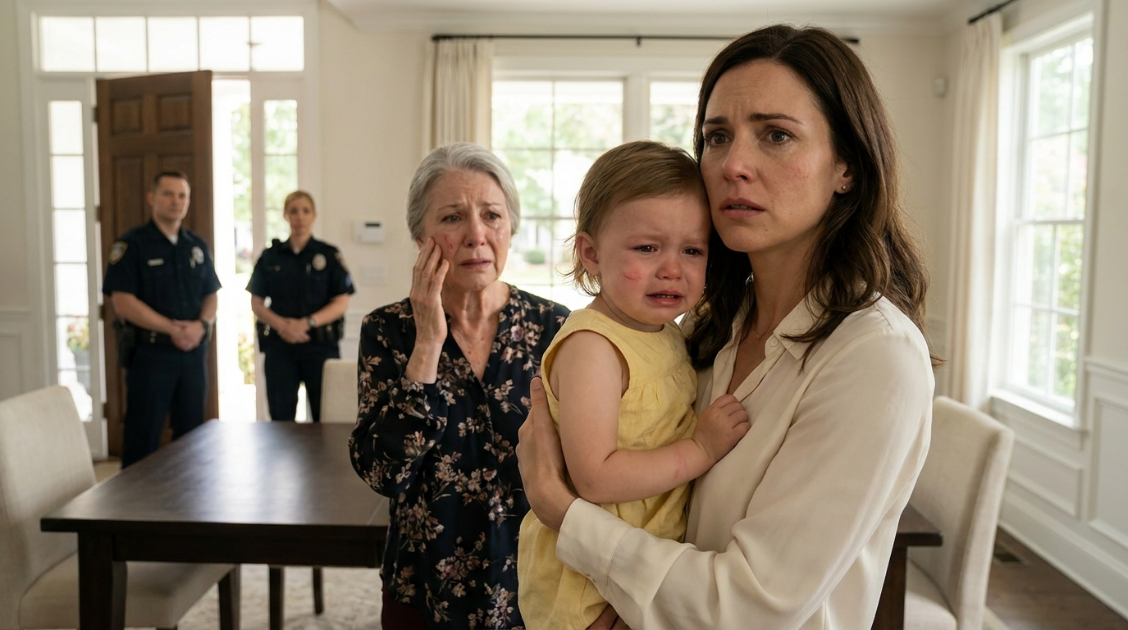
I walked into my mother’s dining room and heard my daughter screaming.
Ellie was fourteen months old.
She wore a bright yellow dress.
Her face was wet with tears.
Across one cheek was a red mark.
Nothing graphic.
No blood.
No open wound.
But enough to make my heart stop.
My wife, Sarah, reached her first.
She lifted Ellie out of the high chair and held her against her chest.
“What happened?”
My mother stood several feet behind the table.
Margaret was seventy-one.
Usually calm.
Usually composed.
But that afternoon, she looked terrified.
One hand was pressed to her own cheek.
Then I noticed it.
A red mark on her face too.
Sarah looked from Ellie to Mom.
“What happened here?”
Mom answered:
“It was an accident.”
That was all.
No explanation.
No details.
My name is Daniel Harper.
Sarah and I had left Ellie with Mom while we ran errands.
We were gone for less than ninety minutes.
Mom had watched Ellie many times before.
We trusted her.
She loved being a grandmother.
She had baby-proofed the house.
Bought a high chair.
Kept toys in the living room.
There had never been a problem.
Until that day.
Sarah touched Ellie’s cheek gently.
Ellie pulled away and cried harder.
My stomach turned.
I looked at Mom.
“Did you do this?”
Her eyes widened.
“No.”
“Then tell me what happened.”
She looked toward the hallway.
Then at the front door.
“It happened so fast.”
Sarah said:
“We need to call the police.”
Mom immediately shook her head.
“No.”
That response made everything worse.
Sarah asked:
“Why not?”
Mom said:
“You don’t understand.”
I told her:
“Then help us understand.”
She could not seem to get the words out.
So Sarah called.
The police did not arrive with sirens.
Two officers came calmly.
One stayed near the doorway.
The other sat with Mom.
He asked her to start from the beginning.
That was when the truth came out.
About twenty minutes after we left, someone knocked on the door.
Mom thought it was a delivery.
She opened it.
My older sister, Claire, was standing outside.
Claire and Mom had not spoken in almost a year.
Their relationship had deteriorated over family money.
After my father died, there had been arguments about his estate.
Nothing illegal.
Just resentment.
Claire believed Mom favored me financially.
Mom believed Claire only called when she wanted something.
Eventually, they stopped speaking.
That afternoon, Claire showed up without warning.
Mom tried to close the door.
Claire pushed inside.
She demanded to know whether Mom had changed her will.
Mom said:
“Yes.”
Claire became furious.
She accused Mom of cutting her out.
Mom said that was not true.
The will still included both children.
But the structure had changed.
Instead of leaving everything directly, Mom had placed part of the estate into trusts for the grandchildren.
Claire hated that.
She wanted control over her share.
The argument moved into the dining room.
Ellie was sitting in her high chair eating fruit.
At first, she was calm.
Then Claire raised her voice.
Mom told her to leave.
Claire stepped toward her.
According to Mom, Claire grabbed her jaw and turned her face.
Not a punch.
Not a prolonged attack.
But rough enough to leave a superficial red mark.
Mom pulled away.
Ellie started crying.
Mom moved between Claire and the high chair.
Claire turned sharply.
Her hand passed close to Ellie.
She wore a large ring.
The edge brushed across Ellie’s cheek.
The baby screamed.
Everyone froze.
Claire stared at the mark.
Then panicked.
Mom picked Ellie up immediately.
Claire said:
“I didn’t mean to touch her.”
Mom shouted:
“Get out.”
Claire backed toward the hallway.
Then she saw something on the desk.
A brown envelope.
She grabbed it.
Mom was too focused on Ellie to stop her.
Claire left.
Mom did not call the police.
She did not call us.
That part was difficult for me to understand.
“Why?”
Mom started crying.
“I was afraid.”
“Of Claire?”
“No.”
She looked at me.
“Of you.”
That hurt.
She said she believed I would blame myself.
I had asked her to watch Ellie.
I had told Sarah it would be fine.
Mom thought if I learned Claire had entered the house and Ellie got hurt, I would carry guilt forever.
So she cleaned Ellie’s face.
Held her.
Tried to calm her down.
Then we came home before she had decided what to say.
Her silence made her look guilty.
The officers asked whether there were cameras.
There were.
Mom had a doorbell camera.
The footage showed Claire arriving.
It showed her entering quickly.
Eleven minutes later, she came out again.
She was angry.
She was carrying a brown envelope.
That was enough for officers to take the report seriously.
A second camera covered part of the side hallway.
It did not capture the entire confrontation.
But it caught audio.
Raised voices.
Mom saying:
“Leave.”
Claire saying:
“You don’t get to decide everything.”
Then Ellie crying.
Then Mom yelling:
“Get away from her.”
The timeline matched Mom’s account.
Police contacted Claire.
She initially denied taking anything.
Then they told her the doorbell camera showed the envelope.
She changed her story.
She said the envelope contained papers that belonged to the family.
They did not belong to her.
The envelope contained a copy of Mom’s updated estate plan.
That made the confrontation even more complicated.
Claire had convinced herself that Mom planned to disinherit her.
The documents showed otherwise.
Claire still had a share.
But some assets were protected for the grandchildren.
Including Claire’s own children.
Mom had made the change because she worried about financial instability.
Claire had gone through a divorce.
She had large debts.
Mom wanted part of the inheritance to remain available for education and housing for the grandchildren.
Claire saw it as punishment.
Mom saw it as protection.
Neither justified what happened that afternoon.
Ellie was examined.
The mark was superficial.
No serious injury.
The doctor documented it.
Mom’s facial redness also faded quickly.
Again, the physical harm was minor.
The emotional damage was not.
Sarah was furious.
She said:
“Your mother should have called immediately.”
I agreed.
Mom agreed too.
She apologized.
Not for causing the injury.
Because she did not.
She apologized for hiding what happened.
That silence almost destroyed our trust.
Claire faced legal consequences for entering the home, taking documents, and the physical confrontation.
I will not pretend every detail ended in a dramatic courtroom.
Real family cases are slower.
Messier.
Police reports.
Attorneys.
Mediation.
Statements.
Eventually, the estate documents were returned.
The will remained unchanged.
Claire was barred from coming to Mom’s house without permission.
For months, we had no contact with her.
That was difficult.
She was my sister.
We grew up together.
Shared bedrooms on vacations.
Fought over television channels.
Sat beside each other at our father’s funeral.
Now I had camera footage of her leaving my mother’s home after my daughter was hurt.
Family history does not make consequences easier.
Sometimes it makes them harder.
Mom also changed.
She stopped trying to protect adults from uncomfortable truths.
She promised:
“If anything happens with Ellie, I call you immediately.”
No filtering.
No waiting.
No deciding what I can handle.
That mattered.
Sarah eventually trusted Mom to spend time with Ellie again.
But not immediately.
First, visits happened while we were present.
Then shorter unsupervised time.
Trust returned slowly.
Claire entered counseling.
Months later, she wrote to us.
She apologized to Sarah first.
Then me.
Then Mom.
The letter to us said:
“I went there angry about money and left realizing I had frightened a baby.”
That was the first time I believed she understood what mattered.
Money had started the argument.
But money was not the reason our family broke.
Control was.
Pride was.
Silence was.
Years later, Ellie has no memory of that afternoon.
She knows Aunt Claire exists.
Their relationship is limited.
Careful.
There are boundaries.
Mom is still part of our lives.
So is Sarah.
So am I.
The estate plan remains exactly what Mom wanted.
No one gets to force her to change it.
The red marks disappeared within days.
But I still remember walking into that room.
My baby crying.
My wife terrified.
My mother holding her cheek.
For several minutes, I did not know who to believe.
That was the worst part.
Then the cameras gave us facts.
Not feelings.
Not family loyalty.
Facts.
Someone entered.
Someone argued.
Someone left carrying documents.
And a child was caught in the middle.
That afternoon taught me something I never forgot:
When a child is involved, protecting family peace cannot come before telling the truth.