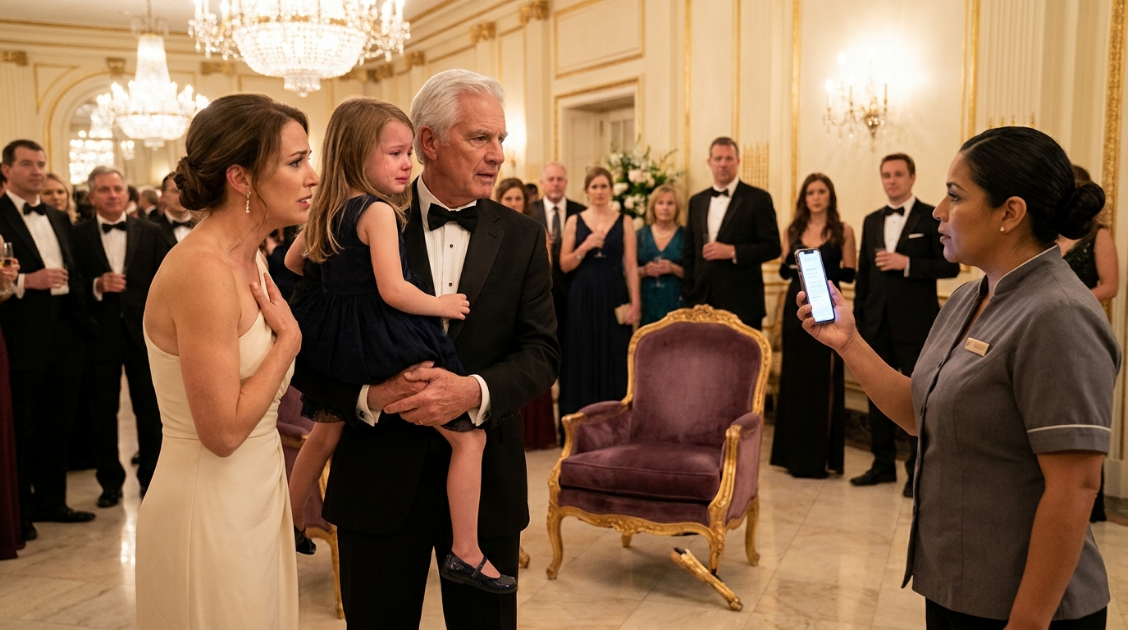
At my father’s black-tie charity gala, I heard my seven-year-old daughter screaming beside one of the ballroom’s antique purple chairs.
Sophie was crying so hard she could barely speak.
An elegant woman in a cream one-shoulder gown stood over her.
Her hands were on my daughter’s arms.
“Stop crying and tell me what you did.”
Sophie shook her head.
“I didn’t do anything!”
Before I could reach them, a hotel employee rushed from the corridor.
“Ma’am, let the child go.”
The woman turned.
“Stay out of this.”
Then my father entered the ballroom.
Robert Grant was seventy-four.
He owned the Grand Grant Hotel and had spent decades restoring its original architecture and historical furnishings.
When he saw Sophie crying, he crossed the room immediately.
He lifted her safely into his arms.
“What happened?”
The woman pointed toward the purple velvet chair.
“She damaged an antique and then lied about it.”
My father looked at the chair.
One of its carved gold legs was cracked.
The piece had tilted slightly toward the floor.
Then he looked at Sophie.
“Did you touch it?”
She shook her head.
“No, Grandpa.”
The woman scoffed.
“Of course she says that.”
That was when the employee who had rushed over lifted her phone.
“Mr. Grant, I saw what happened.”
Her name was Maria Alvarez.
She had worked at the hotel for eighteen years.
She was one of the people my father trusted most.
The entire ballroom became quiet.
Maria opened a video.
My name is Michael Grant.
Sophie is my daughter.
The Grand Grant Hotel had been in our family for generations.
My father loved its history more than almost anything.
The purple chairs in the ballroom were part of the original furniture collection.
They had been restored carefully.
Each had deep violet velvet upholstery.
Hand-carved frames.
Gold leaf along the legs and arms.
One chair in particular had recently been flagged for repair because the lower left leg had developed a hairline crack.
That evening, the chair should not have been moved.
Vanessa Cole did not know that.
Vanessa was one of the foundation’s largest donors.
She had been attending hotel events for years.
She was wealthy.
Polished.
Confident.
And accustomed to people making room for her.
Near the end of dinner, a photographer asked several guests to shift positions.
Vanessa wanted a better angle near the stage.
She grabbed the antique chair by its carved arm.
Maria, who was nearby, said:
“Ma’am, please leave that one. Staff will move it.”
Vanessa ignored her.
She pulled harder.
The chair caught slightly against the marble.
Then the weakened leg cracked.
The chair tilted.
Vanessa froze.
Sophie was sitting on another chair several feet away.
She had not touched the antique.
But Vanessa looked at her.
Then at the broken leg.
And made a decision.
She pointed at Sophie.
“What did you do?”
Sophie looked confused.
“Nothing.”
“You were playing here.”
“No.”
Vanessa stepped closer.
“You broke this chair.”
Sophie started crying.
That was when Maria began recording.
At first, she wanted documentation because the chair was part of the historical collection.
Then the situation became more serious.
Vanessa grabbed Sophie by the arms.
She demanded that the child admit she had climbed on the chair.
Maria immediately intervened.
That was the scene my father walked into.
He watched Maria’s recording once.
Then again.
The video clearly showed Vanessa moving the chair.
The crack happened before Sophie ever stood up.
My father looked at Vanessa.
“You knew she did not do this.”
Vanessa said:
“I thought she might have weakened it earlier.”
Maria shook her head.
Then she played the next few seconds.
After the chair cracked, Vanessa looked toward the damage and muttered:
“If they think the child did it, insurance will cover it.”
The room went silent.
Vanessa tried to explain.
She said she was upset.
She said she did not understand how hotel insurance worked.
My father asked:
“Why did insurance come to mind before you even checked whether the chair could be repaired?”
She had no answer.
The chair was insured for nearly forty thousand dollars.
But the money was not the most important issue.
The Grand Grant’s historical pieces were part of a protected collection.
When one became too damaged for use, it could be removed from public display.
Sometimes it was transferred.
Sometimes auctioned.
Sometimes sold to approved collectors.
My father had recently refused a proposal to sell several pieces privately.
Vanessa had strongly supported that proposal.
The dealer was someone she knew.
My father had assumed she simply preferred modernization.
Now Maria remembered something.
Earlier that night, Vanessa had been arguing with the hotel’s antique appraiser near the stage.
Maria had taken a short video because the conversation became heated.
She played it.
Vanessa said:
“These old pieces are useless. My dealer will pay more than your appraised number.”
The appraiser replied:
“Mr. Grant has already declined.”
Vanessa answered:
“Then maybe some of them won’t survive another season.”
The video ended.
My father stared at her.
“What did you mean?”
Vanessa said it was a joke.
Nobody laughed.
Security was called.
Not to arrest her.
To preserve footage.
The ballroom cameras showed Vanessa walking around several historical pieces during the evening.
She touched two chairs.
A decorative side table.
And an antique mirror stand.
None of that proved sabotage.
But it justified a larger review.
The review found something unexpected.
Two antique objects had disappeared after previous foundation events.
A small bronze sculpture.
And a decorative hotel desk clock.
Both had been listed as accidentally lost during event cleanup.
Both events had been attended by Vanessa.
Again, that did not automatically prove anything.
So my father contacted the dealer she had recommended.
The dealer initially refused to discuss private purchases.
Then the hotel attorney presented photographs.
The bronze sculpture appeared in a private catalog.
The desk clock had been sold through an intermediary.
The ownership history traced back to a company connected to one of Vanessa’s assistants.
That changed everything.
An internal investigation followed.
The hotel reviewed old access logs.
Staff statements.
Storage records.
Vanessa had not personally carried antiques out under her arm.
The scheme was subtler.
She used her foundation status to recommend that certain damaged or “unneeded” pieces be removed from the collection.
Then intermediaries acquired them cheaply.
The dealer resold them at much higher prices.
The hotel had lost valuable historical objects.
And the foundation had trusted her.
The broken purple chair appeared to be the first time the plan failed in public.
Vanessa denied intentionally cracking it.
That detail could never be proved with absolute certainty.
Maybe she simply moved it carelessly.
But the attempt to blame Sophie was undeniable.
The video showed that.
My father ended Vanessa’s relationship with the foundation immediately.
Her donor privileges were revoked.
Her access to hotel collections ended.
The dealer was barred from future transactions.
The missing antiques became a legal matter handled privately between attorneys, insurers, and law enforcement.
Some objects were eventually recovered.
The bronze sculpture came back.
The desk clock did not.
But the part I cared about most was Sophie.
For weeks after the gala, she was afraid of antique furniture.
If we visited my father’s hotel, she kept her hands behind her back.
She would ask:
“Can I sit here?”
Even on normal chairs.
That broke my heart.
One afternoon, my father took her back into the ballroom.
The purple chair had been repaired.
A conservator had reinforced the leg.
My father placed a small rope barrier around it.
Then he knelt beside Sophie.
“You did not break this chair.”
She nodded.
“I know.”
“I need you to really know.”
She looked at him.
Then touched his hand.
“I know, Grandpa.”
That helped.
Maria became one of Sophie’s favorite people.
Whenever we visited, Sophie ran to hug her.
Maria had protected her before she knew whether anyone important was watching.
My father never forgot that.
At the next staff meeting, he promoted Maria to guest-relations supervisor.
She protested.
“I was just doing my job.”
My father said:
“That is exactly why.”
He also changed hotel procedures.
Historical items could no longer be moved by guests.
Any damage required immediate photo documentation.
No insurance report could rely solely on a guest’s version of events.
And no child or employee could be pressured into admitting responsibility without evidence.
The repaired purple chair remained in the ballroom.
But my father added a small plaque beside it.
Not about Vanessa.
Not about the scandal.
Just the history of the chair.
Its year.
Its maker.
Its restoration.
I liked that.
Vanessa did not deserve to become part of the chair’s permanent story.
Sophie did not either.
She had done nothing wrong.
Years later, people who attended the gala still remember the moment my father carried Sophie across the ballroom.
They remember Vanessa’s shocked face.
They remember Maria holding up her phone.
But I remember something quieter.
After everything ended, Sophie asked me:
“Why did she say I did it?”
I answered:
“Because she was afraid of what would happen if she told the truth.”
Sophie thought about that.
Then she said:
“But lying made it worse.”
Exactly.
The chair could be repaired.
The gold leaf could be restored.
The broken leg could be reinforced.
But trust was different.
Once the video played, Vanessa lost something much more valuable than a donor position.
Everyone finally saw what she was willing to do when she thought the weakest person in the room could carry the blame.
She chose a seven-year-old child.
And that choice exposed everything.