Michael Bennett found his six-year-old daughter kneeling beside a hotel garbage cart while guests waited for his wedding.
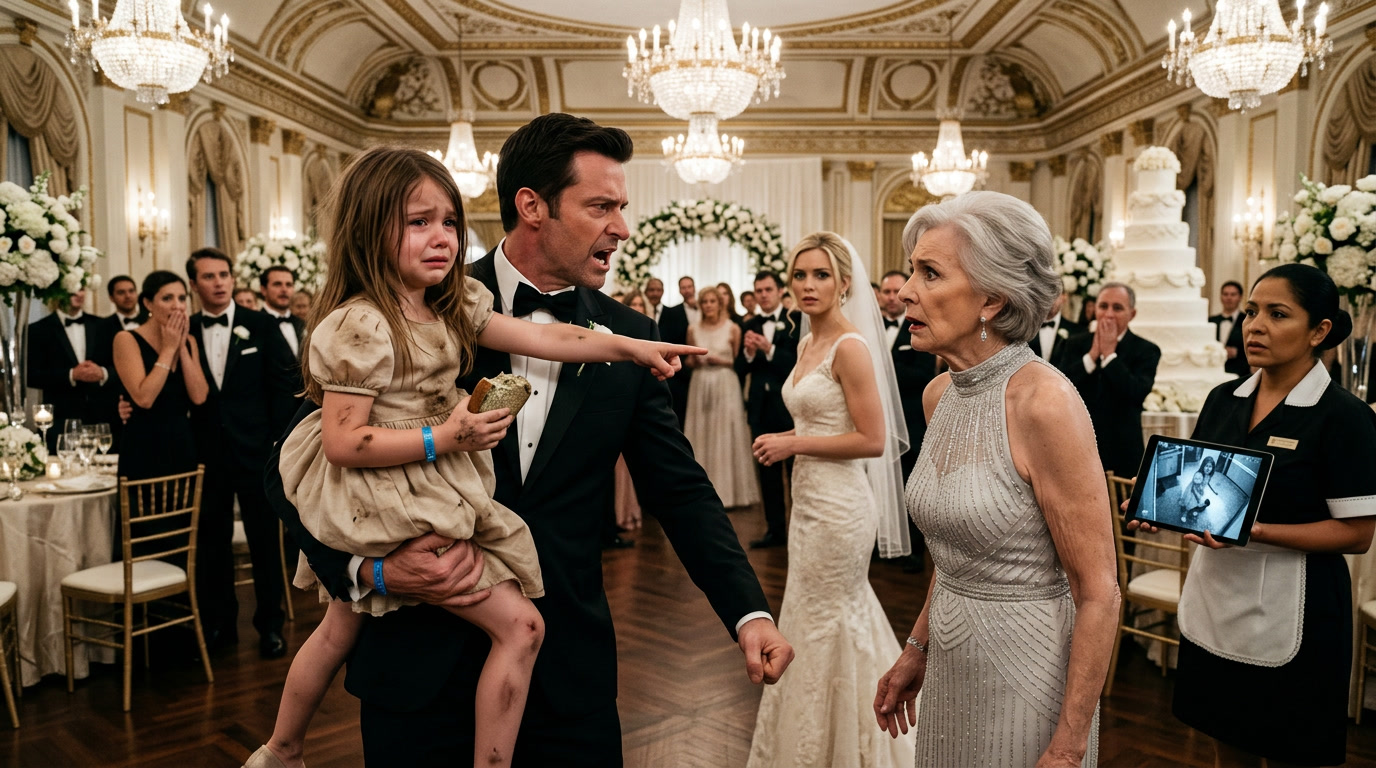
Sophia held a piece of moldy bread.
Her beige dress was dirty.
Both knees were bruised.
A faded blue staff bracelet circled one wrist.
She looked at Michael’s tuxedo and whispered:
“Daddy?”
Michael had been told Sophia was eighty miles away at St. Catherine’s Therapeutic Residence.
His mother, Eleanor, controlled the arrangements.
She said Sophia suffered a severe emotional relapse after the death of Michael’s first wife, Anna.
According to Eleanor, specialists believed contact with Michael before his new wedding could trigger violent behavior.
Michael accepted the reports.
He paid eighteen thousand dollars each month for treatment.
He received progress notes, school summaries, and invoices.
Sophia refused every video appointment.
At least that was what the reports claimed.
Now she stood barefoot beside hotel laundry carts.
Michael lifted her.
She felt dangerously light.
“What are you doing here?”
“Grandma said I had to stay until your new family left.”
“Did they feed you?”
Sophia held up the bread.
“The nice lady did. Grandma fired her.”
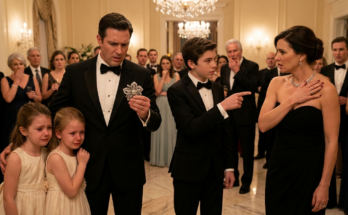
Michael carried Sophia into the ballroom.
Crystal chandeliers hung above hundreds of guests.
A towering white cake stood near the stage.
Eleanor wore a pale-silver beaded gown.
Michael demanded to know why Sophia had been searching through garbage.
Eleanor called the child manipulative.
She claimed Sophia had been temporarily discharged from St. Catherine’s and became impossible to manage.
Sophia said Eleanor locked her inside a hotel laundry room.
Rosa Martinez, a senior housekeeper, stepped forward.
She confirmed the accusation.
Eleanor ordered staff to keep Sophia below the ballroom.
No one could take her upstairs before midnight.
Rosa gave Sophia food until Eleanor fired her.
Rosa preserved hotel security footage.
The video showed Eleanor dragging Sophia through a service corridor.
Another clip showed food left outside a locked storage room.
A third showed Vanessa Cole, Michael’s bride, standing beside Eleanor.
Vanessa said:
“Keep her downstairs. Michael cannot see his dead wife’s leftover before the ceremony.”
Sophia pointed at Vanessa.
“She said Daddy would stop loving me when he got a pretty daughter.”
Vanessa claimed the child misunderstood.
Rosa played an audio recording.
“Once the trust transfer is signed, send the child somewhere permanent.”
Trust attorney Daniel Price entered with financial records.
St. Catherine’s discharged Sophia six months earlier.
The director believed she had returned home with Eleanor.
Someone continued submitting treatment invoices.
The payments moved into Haven Recovery Services.
Haven operated no clinic.
Vanessa’s father owned it.
More than 1.2 million dollars left Sophia’s trust.
Part of the money funded the wedding.
Another document transferred control of Sophia’s voting shares to Eleanor once Michael married Vanessa.
Michael’s signature had been copied from a prenuptial agreement.
Sophia’s late mother, Anna, owned thirty percent of Bennett Hotels.
Those shares passed to Sophia.
Eleanor controlled them only while the child received treatment.
If Michael remarried and approved the new guardianship plan, Eleanor could continue managing the shares until Sophia turned twenty-five.
Vanessa’s family would receive lucrative hotel contracts.
Michael asked his mother whether she starved a child to force a signature.
Eleanor answered:
“I protected the Bennett company from a damaged heir.”
Sophia held up the bread.
“Grandma said hungry children become obedient.”
Rosa played one final recording.
Eleanor’s voice said:
“Keep Sophia hungry. A frightened child signs anything.”
Detective Lena Brooks entered with officers.
Daniel had contacted her before arriving.
The wedding ended before the ceremony began.
Part 2 — Storage Room B-17
Police sealed the service corridor.
Child-protection specialists examined Sophia.
She was underweight, dehydrated, and anemic.
There were pressure marks around one wrist and bruises on both knees.
Her medical files contained no documented violent episodes.
The St. Catherine’s reports Michael received were fabricated after discharge.
Sophia had lived inside storage room B-17 for six months.
The room held a folding cot, one blanket, and a broken lamp.
It had no window.
During large hotel events, staff moved her behind carts so guests would not see her.
She could walk in the corridor only before dawn or after midnight.
Eleanor told Sophia that Michael did not answer because he wanted a new family.
Vanessa said the wedding would produce a better daughter.
Sophia stopped asking to call her father.
She learned not to cry near guests.
Eleanor described tears as proof of instability.
Rosa delivered food secretly.
When Eleanor discovered it, she fired Rosa.
For two days, no one entered B-17.
Sophia slipped through the door after a porter forgot to secure it.
She found stale bread inside a garbage cart.
Michael discovered her minutes later.
Sophia initially refused fresh food at the hospital.
She kept the moldy bread inside a plastic evidence bag.
She said it proved she was not lying.
The therapist told Michael not to force her to release it.
For months, adults demanded proof before responding to her fear.
The bread represented the first evidence she controlled herself.
Police searched Eleanor’s hotel suite.
They found Sophia’s passport, trust seal, forged guardianship forms, and prescriptions written under the child’s name.
Sophia had not taken the medication.
The false prescriptions created a record of serious psychiatric illness.
That record would justify moving her to a remote residential center overseas.
The transfer was scheduled three days after the wedding.
Vanessa’s father had already paid the center.
It employed guards but no licensed child psychiatrists.
Eleanor planned to keep Sophia outside the country until the trust transfer became difficult to challenge.
Charles Cole, Vanessa’s father, received stolen trust money through Haven Recovery Services.
He used it to rescue his failing real-estate company.
Vanessa claimed she did not understand the financial structure.
Emails showed that she approved payments and demanded additional money for the wedding ballroom.
One message read:
“The girl’s account is wasted on therapy. Move enough to finish the cake and floral contract.”
The cake cost more than the annual salary of several hotel workers.
It remained untouched after the arrests.
Eleanor, Vanessa, and Charles faced charges involving fraud, conspiracy, unlawful confinement, child abuse, and identity manipulation.
Another name appeared on the false medical reports.
Dr. Samuel Kline treated Sophia after Anna died.
He had also signed Anna’s final medical records.
Investigators reopened those records.
Anna died after a supposed accidental medication interaction.
Dr. Kline documented that she mistakenly combined a pain medication with a sedative.
The hospital retained no original blood sample.
However, Anna had privately emailed Daniel Price before her death.
She said Eleanor wanted control of Sophia’s shares.
Anna feared someone was changing medication inside her home.
Daniel never received the attached evidence because Eleanor persuaded a court to seal the trust dispute after Anna died.
The new investigation found pharmacy deliveries to Eleanor’s private address.
The same sedative detected in Anna’s final hospital test appeared in those purchases.
A household nurse testified that Eleanor prepared Anna’s evening medication on the night of her collapse.
Dr. Kline altered the timeline and described the death as accidental.
He received consulting payments from Haven Recovery Services.
Eleanor had not only exploited Anna’s death.
Evidence suggested she helped cause it.
Part 3 — The Untouched Cake
Dr. Kline accepted a plea agreement and testified.
He admitted altering Anna’s medical chart and signing false reports about Sophia.
He said Eleanor threatened to expose his earlier billing fraud.
She also paid him through shell companies.
The jury convicted Eleanor of charges connected to child abuse, unlawful confinement, fraud, conspiracy, and Anna’s death.
Vanessa pleaded guilty to financial conspiracy and child endangerment.
Charles Cole received a long sentence for trust theft and money laundering.
The remote residential center lost its license after investigators found other children kept through fraudulent placements.
Michael did not ask a court to return Sophia home immediately.
He wanted her safe with him.
But wanting it did not mean she was ready.
Sophia entered a therapeutic foster placement while Michael attended supervised visits and parenting counseling.
He had not deliberately abandoned her.
He had still failed to verify where she lived.
Money, reports, and specialists had allowed him to believe he was protecting her from a distance.
Sophia needed him to understand the difference between intention and action.
During their first visit, she brought the bag containing the bread.
Michael asked whether she wanted to throw it away.
“No.”
He accepted the answer.
Weeks later, she allowed the therapist to place it inside a memory box.
Months later, she chose to remove it.
She did not keep it forever.
She no longer needed it once adults believed her without seeing it.
Michael sold the penthouse where he had planned to live with Vanessa.
He returned every dollar taken from Sophia’s trust from his own holdings before the court completed restitution.
The Bennett Hotels board removed family members from direct control of child-owned shares.
An independent fiduciary managed Sophia’s inheritance.
Michael could not use it for household expenses or company votes.
He supported the restriction.
Rosa Martinez returned to the hotel as director of employee protection.
Michael offered her a large personal reward.
She refused.
She asked for a system allowing workers to report abuse without passing through family management.
The hotel created an independent hotline, legal protection, and emergency housing for employees facing retaliation.
Rosa accepted the job only after those policies became binding.
Michael converted the ballroom where the wedding failed.
He removed the wedding stage and sold the decorative fixtures.
The space became a child-and-family resource center connected to the hotel foundation.
It offered meals, legal assistance, temporary care, and help locating missing children.
Sophia’s name did not appear on the building.
She did not want strangers knowing her history.
Michael respected that.
The large wedding cake was donated to shelters after investigators released it.
Sophia refused to eat any.
She said it smelled like the room above her prison.
No one called her ungrateful.
The first time Sophia slept at Michael’s home again, she checked every door.
She asked whether the bedroom locked from outside.
Michael removed the lock in front of her.
She asked where he would sleep.
“Across the hall.”
“What if I call?”
“I will answer.”
“What if you are getting married?”
“I will still answer.”
Michael did not date for several years.
He did not make Sophia responsible for that choice.
He focused on becoming reliable.
He attended school meetings, therapy appointments, ordinary breakfasts, and difficult nights.
He learned that grand gestures did not repair abandonment.
Repetition did.
Sophia began calling him Daddy again only after months of using Michael.
He did not correct her.
One evening, she woke from a nightmare and shouted the word.
He entered, stopped at the doorway, and asked permission before approaching.
She nodded.
That moment mattered more than the ballroom confrontation.
At Eleanor’s sentencing, she told the court she had protected the Bennett legacy.
Sophia did not attend.
Michael submitted a written statement.
“A legacy that requires a hungry child is not worth preserving.”
The judge referenced the hotel footage and trust records.
Eleanor’s age and social position did not reduce the damage.
She had used both to make employees afraid to question her.
Vanessa wrote to Michael once.
She said Sophia had destroyed their future by entering the ballroom.
Michael returned the letter with one sentence:
“She did not enter our future. She escaped the place you hid her.”
Three years after the wedding day, Sophia attended a small hotel event with Michael.
There were no cameras and no formal guests.
Rosa served fresh bread at a community dinner.
Sophia took one piece.
She examined it carefully.
Then she ate.
Michael sat beside her.
Not above her.
Not across a ballroom.
Beside her.
Sophia asked whether he still remembered the cake.
“Yes.”
“Do you miss the wedding?”
“No.”
“Why?”
“Because finding you was the only promise that mattered that day.”
Sophia considered the answer.
“You did not find me. I got out.”
Michael nodded.
“You are right.”
She smiled slightly.
That correction captured the truth.
Michael did not rescue a passive child.
Sophia survived adults who controlled food, doors, medicine, and information.
She escaped the storage room.
She reached the garbage cart.
She held onto the bread.
And when her father finally carried her into the ballroom, she pointed at the person everyone else was too afraid to accuse.
The celebration stopped.
The truth did not.