Part 1 — The Bathroom Door
Everyone at Ben’s ninth birthday party was laughing when Megan Carter noticed the emergency alert on her phone.
The alert came from her four-year-old daughter’s child-safety watch.
Emma had been out of sight for eleven minutes.
Megan searched the dining room, kitchen, and backyard.
Lauren Hayes, Ben’s mother, said Emma was probably sulking because she could not open the presents.
Megan followed the watch’s indoor location signal toward the hallway bathroom.
The door was locked from outside.
Lauren said the lock sometimes jammed.
Megan forced it open.
She found Emma behind the toilet, hugging her knees and trying not to cry.
The child’s pale-yellow dress was torn near the hem.
There were scratches on her cheek, arm, and knee.
Megan carried her into the dining room.
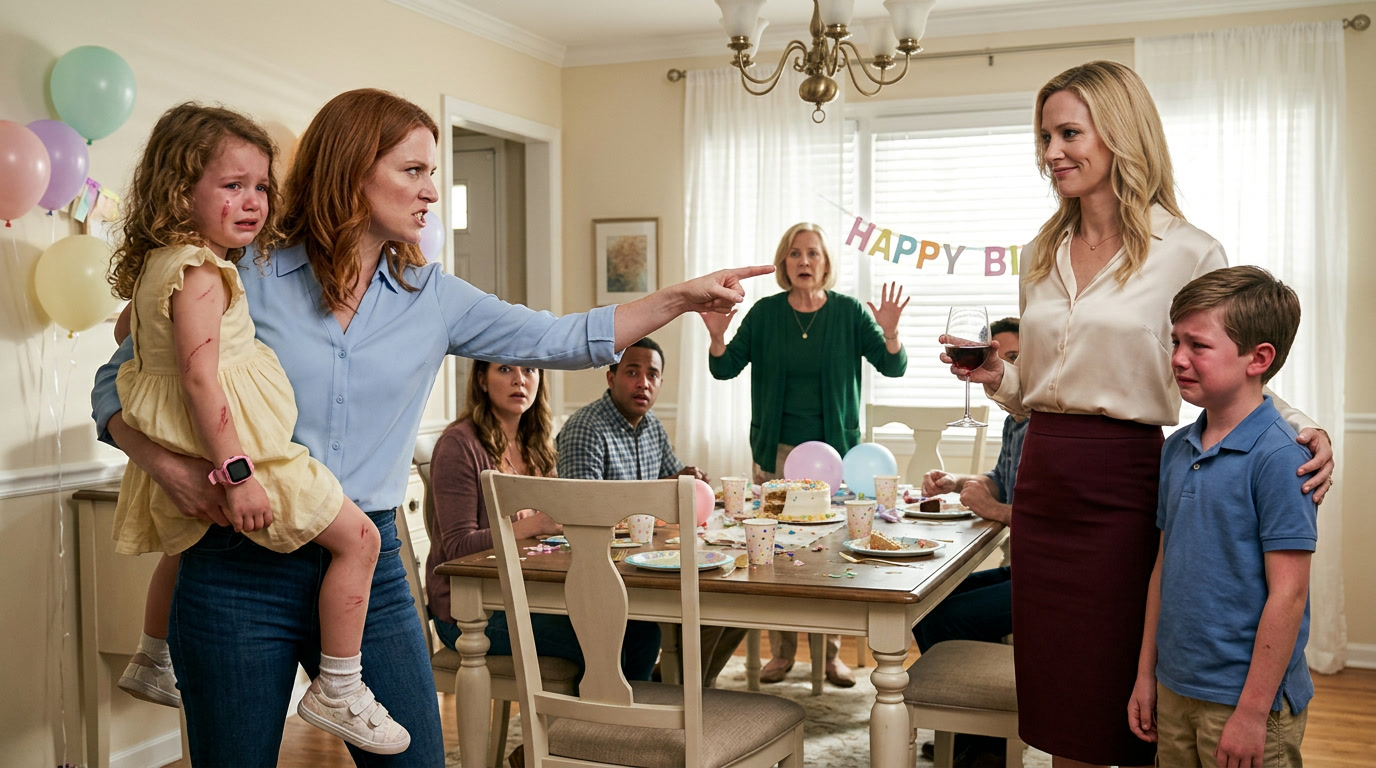
“Who locked my daughter in that bathroom?”
The room fell silent.
Lauren stood beside the birthday cake holding red wine.
She claimed Emma threw a tantrum and injured herself.
Emma whispered that Aunt Lauren told Ben to hide her.
Lauren called the child a liar.
Margaret Hayes, Lauren’s mother, entered from the hallway and attempted to calm the family.
Emma pointed toward Lauren.
“She changed Grandma’s medicine.”
Lauren accused Emma of searching private cabinets.
Megan asked why a four-year-old would invent a story about medication.
Emma said Lauren replaced Margaret’s pills and talked about making Grandma’s hand write her name.
Margaret opened her weekly organizer.
The tablets did not match her prescribed heart medication.
Daniel Carter used the pharmacy website to identify them.
They were sedatives.
Lauren claimed she wanted her mother to rest.
Margaret asked why she had not consulted a doctor.
Lauren said Margaret had become confused.
Margaret answered that Lauren was the one changing appointments and hiding information.
Then Megan noticed the red recording indicator on Emma’s watch.
Emma had activated the emergency mode.
Lauren attempted to seize it.
Daniel blocked her.
Ben stood near the balloons wearing his birthday badge.
Megan asked whether he locked Emma in the bathroom.
Lauren ordered him not to answer.
Ben began crying.
He said his mother told him to scare Emma because she saw some papers.
Lauren grabbed his shoulder and called him a coward.
Megan pulled him away.
Emma played the recording.
Lauren’s voice said:
“Lock Emma in the bathroom. When Mother is unconscious, I will copy her signature and sell the house before Megan knows.”
Ben asked what would happen if Emma cried.
Lauren answered:
“Everyone already thinks she is dramatic. No one will believe her.”
Megan understood why Emma had hidden silently.
Lauren had taught a frightened child that visible fear would make adults doubt her.
Margaret demanded to know why Lauren wanted the house.
Lauren finally exploded.
She said she had waited fifteen years while Megan behaved like the perfect daughter.
She believed Margaret owed her the property.
Daniel found forged power-of-attorney forms inside Lauren’s handbag.
They granted control of Margaret’s home, accounts, and medical treatment.
He also found Margaret’s missing bank card, the real heart medication, and a pen fitted with a signature stamp.
Detective Rosa Alvarez entered with officers.
Margaret had used her medical-alert bracelet to call for help as soon as she saw the altered medication.
The birthday party became a crime scene.
Part 2 — What the Watch Heard
A female officer interviewed Emma in a quiet room with Megan present.
Emma explained that she entered the kitchen for water.
She saw Lauren open Margaret’s pill organizer.
Lauren removed the pink heart tablets and replaced them with white pills.
Then she practiced Margaret’s signature on a legal document.
Emma recognized her grandmother’s photograph on the page.
She asked what Lauren was doing.
Lauren told her to leave.
Ben entered looking for birthday candles.
Lauren ordered him to take Emma into the hallway.
Ben resisted.
Lauren threatened to cancel his birthday, remove his dog, and tell everyone he ruined the family.
She claimed Margaret would lose the house if Emma spoke.
Ben pulled Emma away.
She tried to return to the adults.
He pushed her.
Emma struck the bathroom doorframe and scraped her cheek, arm, and knee.
Ben apologized immediately.
Lauren arrived and ordered him to put Emma inside the bathroom.
Emma crawled behind the toilet.
Lauren locked the door from outside.
She told the child no one believed girls who cried for attention.
Emma activated the watch.
The recording captured Lauren’s phone call with a man arranging the fraudulent house sale.
The caller warned that changing Margaret’s heart medication could kill her.
Lauren said:
“I need her weak, not dead. At least not before she signs.”
Digital records confirmed the audio was authentic.
The watch had uploaded it automatically to a secure account.
Police collected the forged documents and pills.
The power of attorney granted Lauren control over every part of Margaret’s life.
The home-sale proceeds would move into a company owned by Lauren’s boyfriend, Stephen Pike.
Lauren’s husband Mark learned about the affair at the party.
He also learned that Lauren had involved their son in the crime.
Mark asked why she used Ben.
Lauren said children were useful because adults dismissed their mistakes.
That sentence became part of the evidence against her.
Police did not treat Ben as an adult conspirator.
A child specialist interviewed him.
He described months of manipulation.
Lauren threatened to withdraw affection, cancel activities, and send away his dog whenever he questioned her.
She trained him to believe protecting her secrets proved loyalty.
Ben admitted pushing Emma.
He apologized.
Emma answered, “I was scared of you.”
She did not immediately forgive him.
The adults did not force her.
Margaret went to the hospital.
Tests showed that her heart-medication level had fallen dangerously low.
She had received sedatives over several days.
The combination could have caused a serious cardiac event.
Investigators charged Lauren with suspected elder abuse, fraud, child endangerment, unlawful confinement, and evidence tampering.
The court issued protective orders for Margaret, Emma, and Ben.
Lauren continued blaming Megan.
She claimed Megan wanted to replace her as Margaret’s daughter.
Margaret answered that love was not a position taken by someone else’s kindness.
The police searched Lauren’s laptop.
They found drafts of the forged documents.
They also recovered deleted kitchen-camera footage.
The video showed another person teaching Lauren how to copy Margaret’s signature.
It was Margaret’s financial adviser, Charles Denton.
Charles had attended the birthday party.
He sat at the dining table during Megan’s confrontation and pretended to be shocked.
Charles planned to notarize the forged power of attorney.
He expected a percentage of the house sale and access to Margaret’s investment accounts.
When police confronted him, he blamed Lauren.
Messages showed that he designed the entire financial plan.
Lauren supplied access to the medication and documents.
Charles created the shell company and buyer.
Stephen Pike agreed to move the money overseas.
All three were arrested.
Part 3 — The Children at the Table
The criminal case lasted more than a year.
Lauren pleaded guilty after the watch recording, security footage, pill bottle, documents, and messages made a trial dangerous for her.
She received a sentence for elder abuse, fraud, child endangerment, and unlawful confinement.
Charles Denton received a longer financial-crime sentence.
Stephen Pike cooperated after returning part of the money used in earlier schemes.
Margaret recovered physically.
She appointed an independent fiduciary.
No relative received automatic control of her finances or medical decisions.
She did not transfer the house to Megan.
Megan had never asked for it.
Margaret placed the property in a protected trust that would eventually benefit all grandchildren equally, with independent oversight.
She wanted the children to understand that telling the truth did not earn real estate.
It protected people.
Ben entered therapy.
Mark obtained primary custody while Lauren’s case proceeded.
Ben struggled with shame.
He believed one terrible action made him exactly like his mother.
His therapist helped him distinguish responsibility from permanent identity.
He had pushed Emma.
He had helped lock her in the bathroom.
He also confessed, surrendered evidence, and began changing his behavior.
Megan did not require Emma to visit him.
The first meeting happened only when Emma requested it.
They sat in Margaret’s backyard with adults nearby.
Ben brought the birthday badge he had tried to offer her during the arrest.
“I thought giving this to you would make it fixed.”
Emma looked at it.
“It did not.”
“I know.”
“Why did you push me?”
“I was afraid Mom would stop loving me.”
Emma thought about the answer.
“You made me afraid too.”
“I know.”
Ben placed the badge on the table rather than giving it to her.
“I’m sorry.”
Emma did not say she forgave him.
She asked whether he still hurt people when adults told him to.
“No.”
“What if they yell?”
“I find another grown-up.”
Emma nodded.
That was the beginning of trust, not the completion of it.
Megan also learned from the party.
Before the watch recording played, she knew Emma was afraid.
But part of her still wanted evidence strong enough to silence the relatives.
She later told Emma:
“You never need a recording before telling me something feels wrong.”
Emma asked whether Megan would always believe her.
Megan answered carefully.
“I will always listen, protect you, and find the truth. Believing you does not mean guessing. It means never punishing you for speaking.”
Daniel replaced Emma’s safety watch only after asking whether she wanted another one.
She chose a new watch but disabled constant location tracking.
The emergency recording remained available.
They taught her that safety tools supported her voice; they did not create its value.
Margaret changed family gatherings.
Children were no longer required to hug adults, remain quiet for appearances, or apologize simply to end conflict.
Every child learned which adults they could contact if they felt unsafe.
Margaret also stopped covering for relatives to preserve peace.
She admitted that Lauren had shown warning signs for years.
There were missing checks, changed appointments, and constant claims that Margaret was forgetful.
Margaret dismissed them because confronting a daughter felt unbearable.
Avoiding conflict allowed the danger to grow.
On Emma’s fifth birthday, the family gathered in the same dining room.
The bathroom lock had been removed.
The wooden table held a small cake, paper crowns, and fewer guests.
Ben attended with Mark after Emma agreed.
He did not wear the old birthday badge.
He gave it to Margaret to place inside a memory box with a copy of the watch transcript.
The box did not celebrate the crime.
It reminded the adults what happened when they laughed before checking where the children were.
During the party, Emma spilled juice.
The room went quiet for one second.
Emma froze.
Megan handed her a towel and said, “Accidents happen.”
No one shouted.
No one called her dramatic.
Ben helped wipe the floor.
Later, Emma asked Margaret whether Lauren still blamed her.
Margaret answered honestly.
“Lauren blames many people because accepting responsibility is painful.”
“Did I send her away?”
“No. She made choices. You told the truth.”
Emma looked at her watch.
Then she pressed the button that ended the old saved recording.
She did not erase the evidence.
The case was finished.
She simply stopped replaying Lauren’s voice.
At Ben’s birthday, the adults had laughed while one child disappeared and another obeyed out of fear.
The party stopped because Megan refused to protect the celebration at the cost of her daughter.
The watch exposed the crime.
But Emma’s courage began before the recording.
It began behind the toilet, when a frightened four-year-old pressed one small button and decided that someone outside the locked room might listen.