My husband had been buried for three hours when I discovered my key no longer worked.
I stood on the front porch wearing the same black dress I had worn at the cemetery.
My feet hurt.
My eyes burned.
All I wanted was to go inside, remove my shoes, and sit in Charles’s chair for a few minutes before relatives returned with food.
Instead, the key stopped halfway into the lock.
I pulled it out.
Tried again.
Nothing.
I looked at the brass hardware.
It was new.
At first, I genuinely thought I had walked to the wrong door.
Grief does strange things to your mind.
Then the door opened.
My son Ethan stood inside.
Thirty-eight years old.
Dark hair.
Expensive charcoal suit.
Black funeral tie loosened around his neck.
He had helped carry his father’s coffin that morning.
Now he was blocking the entrance to the house where his father had lived for thirty-four years.
“Ethan?”
He didn’t move.
I lifted my key.
“What happened to the lock?”
He looked uncomfortable for half a second.
Then the expression disappeared.
“I changed it.”
I thought I had misunderstood.
“Today?”
“Yesterday.”
“Why?”
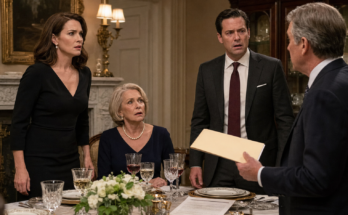
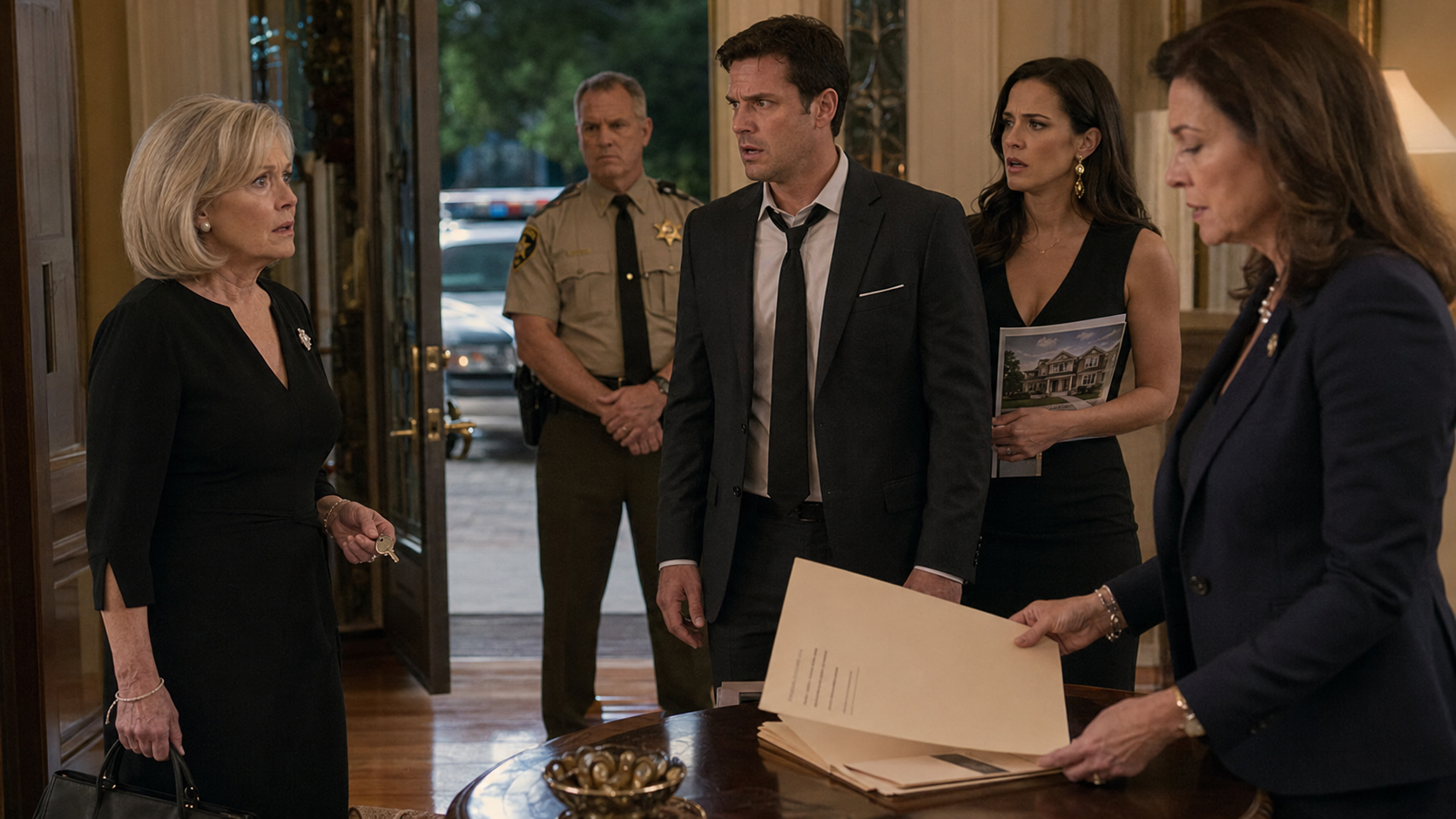
Behind him, my daughter-in-law Natalie walked into the foyer.
She had already changed out of her funeral coat but still wore her fitted black dress.
A glossy real-estate brochure was in her hand.
That detail registered before her words did.
“Margaret, this is going to be easier if everyone stays calm.”
I stared at her.
“Why are you holding a real-estate brochure?”
Ethan exhaled.
“Mom, we need to discuss the house.”
“No.”
He frowned.
“No?”
“We buried your father this morning.”
“I know.”
“Then whatever this is can wait.”
I stepped toward the doorway.
He remained in front of me.
“You can’t stay here tonight.”
That sentence hurt more than I understood at first.
Not because I thought he could actually stop me.
Because my son had clearly planned the moment.
The changed lock.
Natalie standing ready with paperwork.
The deliberate timing.
I looked at Ethan.
“What did you just say?”
“The house needs to be prepared for sale.”
I laughed.
Not because anything was funny.
Because the alternative was crying.
“This house isn’t for sale.”
“It has to be.”
“No.”
“Mom.”
“No.”
Natalie stepped forward.
“We found a beautiful senior community fifteen minutes away.”
I turned toward her.
“You found me what?”
“A two-bedroom apartment.”
“I have four bedrooms.”
“You don’t need four.”
“This is my home.”
Ethan’s patience disappeared.
“No, Mom.”
Something in his voice made me stop.
He continued.
“Dad left the house to me.”
The porch became very quiet.
Even the distant voices of relatives near the cars seemed to disappear.
“What?”
“You heard me.”
“Your father did not leave you this house.”
“He did.”
“I signed the purchase papers with him thirty-four years ago.”
“That doesn’t mean anything after death.”
For one strange second, I wondered whether I had misunderstood our estate planning.
Charles handled more of the legal details than I did.
Not because I was incapable.
Because he enjoyed paperwork and I hated it.
We had wills.
Trusts.
Investment accounts.
Insurance.
But we rarely discussed who would receive specific things after one of us died because neither of us expected death to arrive so quickly.
Charles had been diagnosed with pancreatic cancer eleven months earlier.
By the time we understood how serious it was, our lives became appointments and medications.
Not estate planning.
At least, that was what I thought.
I looked past Ethan.
“Move.”
“Mom.”
“I said move.”
He lowered his voice.
“I’m trying to avoid making this humiliating.”
That sentence stunned me.
“For whom?”
He didn’t answer.
Natalie did.
“You.”
I stared at her.
She opened the real-estate brochure.
“We already spoke with an agent. This neighborhood is at a record high. If we list quickly, the house could sell for close to $1.8 million.”
We.
Not me.
Not the estate.
We.
I asked:
“Who is ‘we’?”
Ethan crossed his arms.
“You’re making this harder than it needs to be.”
“Your father died yesterday morning.”
“And bills don’t stop because somebody dies.”
That was when grief became anger.
“What bills?”
He looked away.
I noticed.
Natalie stepped in.
“Property taxes. Insurance. Maintenance.”
“I pay those.”
“With Dad’s money.”
“With our money.”
“Mom—”
“No.”
I pointed toward the foyer.
“That chair belonged to your grandmother.”
Then the staircase.
“You broke your arm jumping from that landing when you were eleven.”
Then the kitchen beyond it.
“I made your school lunches in that kitchen for twelve years.”
My voice broke.
“And your father died upstairs.”
Ethan’s face softened.
Only briefly.
Then he said:
“Memories aren’t a financial plan.”
I almost didn’t recognize him.
A vehicle pulled into the driveway.
I turned.
A sheriff’s cruiser.
Behind it came Rebecca Cole’s silver sedan.
Rebecca had been Charles’s attorney for nearly twenty years.
Sheriff Daniel Brooks stepped out first.
Rebecca followed carrying a thick cream folder.
Ethan muttered:
“You called them?”
“I didn’t.”
Rebecca walked toward us.
“Margaret.”
I wanted to cry simply because someone said my name normally.
“Rebecca?”
She looked at the new lock.
Then at Ethan.
Then Natalie.
“Apparently I arrived at the right time.”
Ethan stepped onto the porch.
“What is this?”
Rebecca ignored him.
She looked at me.
“Did you authorize anyone to change the locks?”
“No.”
“Did you authorize a sale?”
“No.”
“Did you apply for a home-equity loan yesterday?”
I stared at her.
“What?”
That answer changed Sheriff Brooks’s posture.
He had been calm before.
Now he became attentive.
Ethan frowned.
“Loan?”
Natalie said nothing.
Rebecca noticed.
“So that’s a no?”
“Of course it’s a no.”
Rebecca nodded.
“Good.”
She opened the cream folder.
Ethan stepped closer.
“What is happening?”
Rebecca looked at him.
“First, we should correct something.”
“What?”
“You just told your mother Charles left you this property.”
“He did.”
“No.”
She removed a trust document.
“Twelve years ago, Charles and Margaret transferred the house into the Lawson Family Residence Trust.”
I remembered the name.
Vaguely.
Charles had described it as asset protection.
Rebecca continued.
“Margaret retained full lifetime ownership, possession, and control.”
Ethan’s expression changed.
“That isn’t what Dad told me.”
Rebecca looked directly at him.
“After Margaret’s death, remaining ownership passes according to the trust terms.”
“To me.”
“Partially.”
His jaw tightened.
“But until then?”
Rebecca looked toward me.
“This is Margaret’s house.”
I felt my knees weaken.
Not because I had gained something.
Because for ten minutes my own son had convinced me to question whether I still had a home.
Ethan grabbed the brochure from Natalie.
“This is ridiculous.”
Rebecca asked:
“Where is the document you believe gives you ownership?”
He went inside.
A minute later he returned with a photocopy.
Rebecca read it.
Then handed it back.
“This is a draft.”
“No.”
“Yes.”
“Dad kept it in his office.”
“Charles kept every draft anyone ever sent him.”
Rebecca pulled another page from her folder.
“This proposal would have given you the residence after Charles’s death.”
Ethan pointed.
“Exactly.”
“It was never executed.”
Silence.
“He rejected it.”
Ethan looked at me.
“You knew?”
“No.”
He laughed bitterly.
“Of course.”
Rebecca continued.
“There is a second problem.”
Sheriff Brooks stepped closer.
She handed him a document.
“A lender contacted my office this morning because Charles’s death triggered a fraud review on a pending home-equity application.”
I stared at her.
“How much?”
“One hundred fifty thousand dollars.”
My stomach tightened.
“Against this house?”
“Yes.”
“Who applied?”
Rebecca looked at me.
“Supposedly you.”
I almost laughed again.
“I was sitting beside my dying husband yesterday.”
“The application was submitted electronically.”
She showed me the page.
My name.
My address.
My date of birth.
An electronic signature.
I had never seen it.
The requested funds were supposed to go to a company.
Lawson Property Ventures LLC.
I shook my head.
“I don’t know that company.”
Natalie suddenly spoke.
“It’s ours.”
Everyone turned toward her.
She corrected herself.
“Mine.”
Ethan looked shocked.
“Natalie.”
“What? They’ll find out anyway.”
Rebecca asked:
“What does the company do?”
“Property investment.”
“How long has it existed?”
Natalie didn’t answer.
Rebecca already knew.
“Six weeks.”
Ethan looked at his wife.
“You said that was for the rental project.”
“It is.”
Sheriff Brooks asked:
“Why was Margaret’s loan being transferred there?”
Natalie crossed her arms.
“It wasn’t.”
Rebecca held up the application.
“It was.”
Natalie shook her head.
“That must be an error.”
Rebecca replied:
“Then we have several errors.”
She removed emails.
The lender had exchanged messages with someone using my name.
The writer discussed paying off “temporary family obligations.”
They requested expedited processing.
They sent scans of my driver’s license.
A tax statement.
The trust cover sheet.
Documents stored inside our home office.
I slowly turned toward Ethan.
“You had access to Dad’s files.”
“Because he asked me to organize them.”
“Did you give Natalie my identification?”
“No.”
Natalie interrupted.
“He didn’t.”
I looked at her.
“Then how did you get it?”
She said nothing.
Ethan stared at his wife.
“Natalie.”
She looked at him.
“Don’t.”
“What did you do?”
She became angry.
“Oh, don’t act shocked now.”
Sheriff Brooks raised one hand.
“Let’s keep this calm.”
Natalie laughed.
“Everybody’s making this sound like I robbed a bank.”
Rebecca answered:
“No one said that.”
“It’s family property.”
“No.”
Rebecca’s voice stayed calm.
“It is Margaret’s property.”
Natalie looked at me.
“You were going to give Ethan everything eventually.”
My stomach turned.
Eventually.
The same word people use when they decide someone else’s future consent already belongs to them.
I asked:
“Why did you need $150,000?”
She didn’t answer.
Ethan did.
“Her business.”
Natalie looked at him.
“Your business too.”
“No.”
“Yes.”
Sheriff Brooks asked:
“What business?”
Ethan rubbed his face.
Months earlier, he and Natalie had invested in two rental properties.
One required major repairs.
The second had been purchased using short-term financing.
Interest rates increased.
A contractor sued them.
Their finances were collapsing.
Charles knew some of it.
I didn’t.
Ethan had apparently asked his father for money twice.
Charles refused.
That explained several arguments during the final months of his illness.
I thought they were fighting because Ethan wasn’t visiting enough.
Maybe they were.
But money had been part of it.
Rebecca opened her folder again.
“Charles emailed me six weeks ago.”
She looked at Ethan.
“He was concerned.”
“About what?”
She read from the message without quoting every word.
Charles said Ethan repeatedly brought property forms for Margaret to sign.
He instructed Rebecca not to accept any transfer, mortgage, power of attorney, or trust amendment unless she spoke with me alone.
I felt something break inside me.
“Charles knew?”
Rebecca looked sad.
“He suspected.”
“Why didn’t he tell me?”
“He planned to.”
“When?”
Her silence answered.
He ran out of time.
I looked toward the upstairs bedroom window.
My husband had spent his final weeks worrying our son might take advantage of me after his death.
And he had died without knowing whether he had protected me enough.
Ethan sat on the porch step.
He looked sick.
“I didn’t know about the loan.”
Natalie stared at him.
“You knew we needed money.”
“I didn’t know you used Mom.”
“You said once the house became ours—”
“It isn’t ours!”
“For once, stop pretending you’re better than me!”
Sheriff Brooks interrupted.
“We need to establish what property inside the home belongs to Margaret.”
I frowned.
“Why?”
He looked toward Rebecca.
She answered carefully.
“Is there a jewelry safe in your bedroom?”
My heart stopped.
“Yes.”
“What kind?”
“Small. Gray. Fireproof.”
“Where?”
“Closet floor.”
Ethan looked at Natalie.
Natalie looked away.
I saw it.
So did the sheriff.
I pushed past them and entered the house.
The new lock no longer mattered.
I went upstairs.
Rebecca followed.
Sheriff Brooks behind her.
My closet door was open.
Clothes moved.
Storage boxes shifted.
The space where the safe had been was empty.
For several seconds, I couldn’t speak.
The jewelry inside wasn’t worth millions.
Maybe $70,000 altogether.
My mother’s diamond ring.
Charles’s watches.
Family pieces.
But one envelope inside the safe mattered more.
Original property documents.
Investment information.
Insurance records.
“Where is it?”
No answer.
I turned toward Ethan.
“Where is my safe?”
He looked at Natalie.
She snapped:
“Stop looking at me!”
“Because you know.”
“I moved it.”
My mouth went dry.
“Where?”
“For safekeeping.”
Sheriff Brooks said:
“Where?”
Natalie crossed her arms.
“In the car.”
Ethan stared.
“My car?”
She didn’t answer.
We went outside.
The safe was in Ethan’s SUV.
So was a banker’s box.
Inside were copies of our property records.
My driver’s license photocopy.
Bank statements.
And something Rebecca didn’t expect.
A purchase agreement.
For the house.
Signed by Ethan as seller.
The buyer was a private investor group.
Closing date:
nineteen days away.
Proposed sale price:
$1.62 million.
I stared at Ethan.
“You sold my house?”
“No.”
Sheriff Brooks pointed toward the contract.
“Your signature is here.”
“It was contingent.”
“On what?”
“Estate confirmation.”
Rebecca read the document.
“No.”
“What?”
“You represented that you had authority to convey the property.”
“I thought I did.”
Rebecca looked at him.
“Did you?”
Ethan didn’t answer.
The buyer had already sent a $50,000 deposit to an escrow arrangement connected to the transaction.
Unlike the home-equity application, that money remained untouched.
But the contract included something else.
A promise that the house would be delivered vacant.
I looked at my son.
“Vacant?”
“Mom.”
“What did you tell them would happen to me?”
He began crying.
Finally.
“We found you somewhere good.”
That answer hurt more than the contract.
“You found me somewhere.”
“Senior apartments aren’t prisons.”
“I never said they were.”
He wiped his face.
“You shouldn’t be alone here.”
“I wasn’t alone yesterday.”
He closed his eyes.
His father.
We all thought of Charles.
I continued.
“You didn’t wait one day.”
“That’s not fair.”
“You changed the locks before the funeral.”
Natalie interrupted.
“Because you would never agree!”
I looked at her.
“Correct.”
She seemed stunned by the answer.
“No.”
I repeated it.
“I would never agree.”
“So what were we supposed to do?”
“Accept it.”
Her mouth opened.
Closed.
That seemed to be the concept neither of them understood.
No.
A complete sentence.
Not a delay.
Not an obstacle.
Not an invitation to forge paperwork.
No.
The sheriff did not arrest anyone on the porch.
Real investigations do not work as quickly as television.
Documents had to be reviewed.
Electronic records preserved.
Signatures analyzed.
The lender froze the home-equity application.
The house sale was halted.
The locks were changed again that afternoon.
This time, I received every key.
Natalie and Ethan were told to leave.
Ethan stood at the driveway for several minutes.
“Mom.”
I looked at him.
“I didn’t know everything she was doing.”
I believed him.
Partly.
That didn’t make him innocent.
“You changed my locks.”
He looked down.
“Yes.”
“You signed the sale contract.”
“Yes.”
“You planned to remove me.”
He began crying again.
“I thought Dad left me the house.”
“Then you should have asked Rebecca.”
“I knew she’d call you.”
There it was.
The truth.
He didn’t ask because asking risked hearing no.
I went inside.
The following weeks were brutal.
I was grieving Charles while lawyers and investigators reconstructed what my son and daughter-in-law had done.
Digital records showed Natalie completed the home-equity application.
She used financial documents from our office and electronic signature files Charles had stored for legitimate business purposes.
Ethan had not submitted the loan.
But emails showed he knew Natalie was “finding financing against the house.”
He claimed he believed that meant after ownership passed to him.
Investigators found no evidence he directly forged my signature on the loan.
The house sale was different.
He had personally signed that agreement.
He insisted he believed the old draft gave him ownership after Charles died.
Rebecca acknowledged that someone unfamiliar with trusts might misunderstand parts of the estate structure.
But Ethan wasn’t entirely unfamiliar.
Charles had discussed the trust with him.
More importantly, Ethan knew he had never received a final deed.
He simply assumed the paperwork would catch up with what he wanted.
Natalie faced the more serious consequences.
The forged loan application.
Use of my identity.
Unauthorized financial documents.
Removal of my safe.
The case continued for more than a year.
She eventually entered a plea agreement involving fraud and identity-related offenses and was ordered to pay restitution and comply with probationary conditions.
The missing jewelry was recovered.
Nothing had been sold yet.
That mattered to me.
Not financially.
Emotionally.
My mother’s ring came back.
Charles’s watch came back.
I put them in a bank deposit box.
I no longer kept important documents at home.
Ethan and Natalie separated during the investigation.
I didn’t celebrate.
Their marriage was their business.
My relationship with Ethan was mine.
For six months, I refused to speak to him.
Not because Rebecca advised it.
Because I couldn’t hear his voice without remembering the changed lock.
Eventually, he wrote me a letter.
The first paragraph began with explanations.
I stopped reading.
Two weeks later, another arrived.
Shorter.
No explanation.
It began:
I changed the locks on your house before Dad’s funeral because I wanted to make your decision impossible.
I finished that one.
He admitted he was in debt.
Admitted he felt humiliated every time Charles refused to bail him out.
Admitted he resented the possibility that I might live another twenty or thirty years while he waited for property he had mentally treated as already his.
That sentence was ugly.
But truthful.
I treated your death like a future closing date.
I cried when I read it.
Not because I hated him.
Because I finally understood the depth of what had happened.
Inheritance had changed the way he viewed me.
Not as his mother.
As the current obstacle between him and an asset.
I did not answer for another month.
Then I wrote:
If we ever rebuild anything, it begins with understanding that nothing I own is waiting for me to die. It is mine while I am alive.
He replied:
I understand.
I wrote back:
Understanding is the beginning, not the repair.
Our first meeting took place at Rebecca’s office.
Neutral territory.
Ethan looked thinner.
Older.
He sat across from me and cried.
“I miss Dad.”
“So do I.”
“I think I lost my mind when he got sick.”
“No.”
He looked surprised.
I continued.
“You made decisions.”
He nodded.
That was important.
Grief explained some things.
Debt explained others.
Natalie’s influence mattered.
But explanations were not erasers.
“I changed your locks.”
“Yes.”
“I had no right.”
“No.”
“I signed a contract for your house.”
“Yes.”
“I was wrong.”
“Yes.”
He laughed through tears.
“Are you going to say anything else?”
“Eventually.”
That was the beginning.
Not forgiveness.
Not restoration.
A beginning.
I sold the house eighteen months later.
That shocked everyone.
Especially Ethan.
When I told him, he stared at me.
“You’re selling?”
“Yes.”
“Why?”
“Because I want to.”
He looked down.
Then smiled slightly.
“That sounds fair.”
It did.
For the first time, the decision was actually mine.
The house held thirty-four years of life.
But after Charles died, seven empty rooms felt less like memories and more like echoes.
I bought a smaller home near my sister.
Not a senior community Ethan selected.
A house I selected.
Three bedrooms.
A garden.
A screened porch.
Plenty of space.
I sold the old house for $1.74 million.
The proceeds went into my trust.
No one received an early inheritance.
I took something else instead.
A trip.
Charles and I had always planned to see New Zealand.
We never did.
So I went alone.
Ethan drove me to the airport.
Before I got out of the car, he asked:
“Dad would’ve liked this, right?”
I smiled.
“He would’ve complained about the flight.”
Ethan laughed.
Then his face became serious.
“Mom?”
“Yes?”
“Thank you for letting me drive you.”
Such a small sentence.
But I understood what he meant.
Thank you for letting me back into part of your life.
I touched his hand.
“Be here when I get back.”
“I will.”
He was.
We continue rebuilding.
Slowly.
He has never asked about my will.
Not once.
I don’t know whether that is discipline, shame, or growth.
Maybe all three.
My estate plan changed after everything.
Rebecca asked whether I wanted to disinherit him completely.
I said no.
Then she asked whether I wanted him managing anything.
That answer was easy.
“No.”
An independent trustee will handle the estate.
Ethan knows.
He accepts it.
Trust can return emotionally without returning administratively.
Charles taught me that from beyond the grave.
He suspected something.
He put protections in place.
He warned Rebecca.
He couldn’t stop every bad decision.
But he made sure the worst one failed.
The morning after his funeral, my son believed the house had become his because his father was dead.
He changed the locks.
Packed my important documents.
Signed a sale contract.
And let his wife apply for a loan using my identity.
They thought grief would make me easier to move.
They were wrong.
The sheriff didn’t save my house.
Rebecca didn’t give it back to me.
The trust didn’t suddenly make it mine.
It had been mine all along.
That was the part Ethan had forgotten.
And eventually, the part he had to learn:
Inheritance begins after someone’s life ends. Entitlement begins when you start treating them as though it already has.