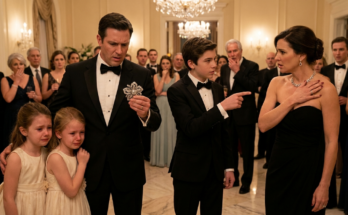
At my father’s black-tie charity gala, a little girl in a lavender dress stood crying in the middle of the ballroom while clutching an old silver pendant.
I noticed her because everyone else was staring.
She looked about seven.
Light-brown hair.
Tear-streaked cheeks.
Both hands wrapped tightly around the chain at her neck.
In front of her stood my cousin Victoria.
Victoria wore an elegant cream evening gown.
She looked furious.
“Where did you get that?”
The girl shook her head.
“My mom gave it to me.”
Victoria pointed at the pendant.
“That belongs to our family.”
A young man beside her—Victoria’s son—looked just as confused.
Then the ballroom doors opened.
My father entered.
Charles Hale was seventy-four.
He had built a national hotel company and chaired the Hale Foundation for more than three decades.
He was calm in almost every situation.
But when he saw the pendant, he stopped.
His expression changed instantly.
“Bring that to me.”
The girl backed away.
I stepped toward her slowly.
“It’s okay.”
She looked at my father.
Then held out the necklace.
My father took it carefully.
The pendant was oval.
Silver.
A dark-blue stone was set into the center.
I knew it.
I had not seen it in twenty-eight years.
My grandmother had owned that locket.
When she died, it passed to my younger sister, Anna.
Then Anna disappeared.
I was twenty-four.
She was nineteen.
One day she left home after an argument.
She never came back.
For months we searched.
Private investigators.
Police reports.
Hospitals.
Friends.
Former classmates.
Nothing.
Then, almost a year later, we received word that a young woman matching Anna’s identity had died in another state.
The documentation was incomplete.
But there was enough confusion, enough grief, and enough distance that our family accepted it.
My father was destroyed.
My mother never fully recovered.
The locket was assumed lost with Anna.
Now it was in the hands of a seven-year-old girl.
My father pressed the tiny clasp.
The locket opened.
Inside was a faded photograph.
My mother.
Holding Anna when she was a baby.
On the back was an engraving.
For Anna — Always Come Home.
My father sat down.
I had never seen him look that old.
Then he looked at the little girl.
“What is your name?”
“Lucy.”
“Lucy what?”
“Reynolds.”
My heart started pounding.
Reynolds was my mother’s maiden name.
My father asked:
“What is your mother’s name?”
The girl answered:
“Anna.”
The entire room seemed to disappear.
Victoria said:
“That proves nothing.”
My father ignored her.
He knelt in front of Lucy.
“Where is your mother?”
Lucy began crying again.
“She said she couldn’t come.”
“Why?”
“She said she was scared.”
Then Lucy reached into a small lavender purse.
She pulled out a folded envelope.
On the front were four words.
For Charles Hale Only.
My father recognized the handwriting.
Anna’s.
His hands began shaking.
He opened the letter.
The first sentence said:
Dad, if you are reading this, I am alive.
He stopped.
Then he read again.
I moved closer.
So did Victoria.
My father continued.
Anna wrote that she had left home because she believed she was in danger.
At nineteen, she had discovered financial records connected to one of the Hale family trusts.
The records suggested money had been diverted.
She confronted the person whose name appeared repeatedly.
Our uncle, Richard Hale.
Victoria’s father.
Richard had been my father’s younger brother.
He managed several family accounts at the time.
Anna said Richard warned her to stay quiet.
She refused.
Then he told her something that changed everything.
He claimed our father already knew.
According to Anna, Richard told her:
“Charles chose the company. He will never choose you over this family.”
Anna believed him.
She left.
She stayed with a friend.
Then moved out of state.
Richard found her months later.
Not physically.
Through contacts.
He convinced her that our father was furious and wanted her cut off.
He sent her legal-looking documents.
Letters.
Messages.
All claiming the family had moved on.
Anna stopped trying to contact us.
Then came the report of her death.
That part had never made sense to her either.
She wrote that she later learned someone had used an old identity document connected to her name.
Whether the mistaken death report had been deliberately created or simply exploited, she did not know.
But by the time she realized the family thought she was dead, years had passed.
Shame became another prison.
She built a new life under the Reynolds name.
She had a daughter.
Lucy.
Then Richard died.
Only after his death did Anna feel safe enough to search for us again.
But she did not know whether my father had truly been involved.
That was why she sent Lucy first.
The locket was proof.
The letter was a test.
If Charles Hale reacted with anger, Lucy was supposed to leave.
If he reacted like a father who had lost his daughter, Anna would know Richard had lied.
My father finished the letter.
Then he stood.
He looked at Victoria.
“Did you know?”
Victoria was crying now.
“No.”
“Did your father ever tell you?”
“No.”
She looked genuinely shaken.
For the first time that evening, I believed her.
Victoria had recognized the locket and assumed it had been stolen.
She had no idea Lucy might be family.
My father turned back to the child.
“Where is Anna?”
Lucy hesitated.
Then pointed toward the ballroom entrance.
A woman stood just outside the open doors.
She was older than the sister I remembered.
Of course she was.
Nearly three decades had passed.
But I knew her immediately.
Anna.
My father did not walk.
He ran.
I had never seen him run.
Not in business.
Not in emergencies.
Not even at weddings.
He crossed the ballroom and stopped several feet from her.
Anna was crying.
So was he.
For a few seconds, neither moved.
Then my father said:
“I thought you were dead.”
Anna answered:
“I thought you didn’t want me.”
That sentence explained twenty-eight years.
My father wrapped his arms around her.
The ballroom erupted in tears.
I stood there unable to move.
My sister was alive.
She had a daughter.
And the family story we had repeated for almost thirty years had been built on manipulation, fear, and missing information.
The weeks that followed were complicated.
Nothing became perfect overnight.
Anna had questions.
So did we.
The financial records she found as a teenager were reviewed.
Some of Richard’s old transactions were improper.
Others were legal but poorly documented.
The full truth was messier than the letter suggested.
But one fact became clear.
My father had never known Anna was threatened.
He had never chosen the company over her.
Richard lied.
He isolated her.
And once enough time passed, everyone’s assumptions did the rest.
Anna had tried to contact us twice in her twenties.
Both letters were returned.
One had been sent to an old corporate address controlled by Richard’s office.
We found a record of it decades later.
That hurt.
One letter might have changed everything.
Lucy adjusted faster than any of us.
Children often do.
She called my father “Grandpa Charles” within a month.
The first time she did, he left the room to cry.
Anna moved closer to us but not into the family estate.
She wanted independence.
My father understood.
Their relationship had to be rebuilt.
Not resumed as if no time had passed.
There were birthdays he missed.
School graduations.
Illnesses.
Breakups.
Jobs.
Twenty-eight years cannot be compressed into one reunion.
But they started.
Slowly.
Honestly.
Victoria apologized to Lucy.
She admitted she had frightened her at the gala.
Lucy eventually forgave her.
The locket stayed with Lucy.
My father insisted.
“It found its way home.”
Years later, the Hale Foundation added a new policy requiring independent oversight of family trusts.
No single family member could control information, access, and communication the way Richard once had.
My father said:
“Money did not take my daughter away.”
“Secrecy did.”
That became the lesson.
When people talk about the night Anna returned, they remember the ballroom doors.
They remember my father running.
They remember the letter.
But I remember the first thing I saw.
A seven-year-old girl crying while holding a silver locket.
Everyone around her thought the jewelry was the important part.
It was not.
The important part was the photograph inside.
A mother holding a baby.
A tiny message engraved on the back.
For Anna — Always Come Home.
It took twenty-eight years.
But she did.