My wife called me from the kitchen crying so hard I could barely understand her.
“Daniel, come home. Something is wrong with Noah.”
I left work immediately.
Our house was only fifteen minutes away.
It felt like an hour.
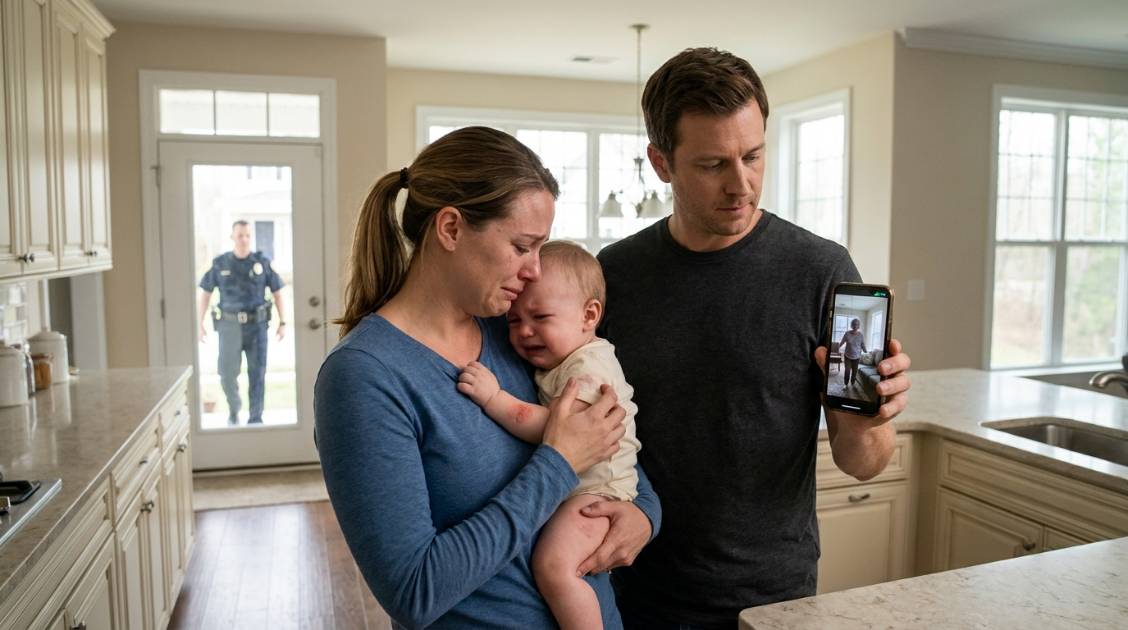
When I walked through the door, Emily was standing in the kitchen holding our ten-month-old son against her chest.
Noah was crying.
Not normal tired crying.
Not hungry crying.
He sounded frightened.
“What happened?”
Emily shook her head.
“I don’t know.”
She turned him slightly.
On his left forearm was a small red mark.
Nothing graphic.
No blood.
No open wound.
But the skin looked irritated.
When Emily touched near it, Noah pulled his arm away and cried harder.
My name is Daniel Carter.
Emily and I had been married for six years.
Noah was our first child.
Like most new parents, we worried about everything.
Sleep.
Food.
Temperature.
Coughs.
Falls.
We probably checked the baby monitor more often than necessary.
But that day felt different.
My mother, Margaret, had been watching Noah.
She had been helping us regularly for several months.
At first, we were grateful.
Childcare was expensive.
Emily worked part-time.
I worked long hours.
Margaret lived twenty minutes away and constantly told us:
“I want time with my grandson.”
She seemed patient.
She bought him toys.
She took pictures.
She told everyone how happy she was to be a grandmother.
So when she offered to stay with him that morning, we did not hesitate.
Emily left first.
I had already gone to work.
Margaret arrived around 9 a.m.
Emily returned shortly before noon.
Margaret told her:
“He’s been fussy all morning.”
Then she left.
Emily tried feeding Noah.
He refused.
She changed him.
He kept crying.
Then she noticed the mark.
That was when she called me.
For several minutes, neither of us knew what to do.
Then I remembered the cameras.
We had installed two small indoor security cameras after packages disappeared from our porch.
One covered part of the living room.
Another covered the kitchen entrance.
We rarely watched them.
I opened the app.
Emily stood beside me.
The video began around 9:15.
Margaret sat on the floor with Noah.
She gave him a toy.
He smiled.
Nothing looked wrong.
At 9:38, she fed him.
At 9:52, she changed him.
Everything seemed normal.
I almost stopped watching.
Then at 10:07, Noah crawled toward a low cabinet.
Margaret pulled him back.
He tried again.
She said something we could not hear clearly.
Then she reached down.
Her hand closed around his forearm.
Too tightly.
She pulled him backward.
Noah screamed.
Margaret immediately let go.
She looked shocked.
For a moment, I thought it had simply been an accident.
Then she looked toward the camera.
Directly at it.
She knew exactly where it was.
She picked Noah up.
She carried him out of the room.
Several minutes later, she returned.
Noah was wearing a long-sleeve shirt he had not been wearing earlier.
Emily covered her mouth.
“She covered his arm.”
I did not answer.
I replayed the video.
Same thing.
She looked at the camera.
Then changed his clothes.
I wanted another explanation.
Maybe the room was cold.
Maybe his shirt got dirty.
Maybe we were interpreting everything through panic.
Then Emily said:
“Check the kitchen.”
I switched cameras.
Around 10:20, Margaret stood near the counter with her phone.
She was speaking quietly.
The camera audio was clearer.
“I told you I can’t keep doing this.”
Pause.
“No, he cries constantly.”
Another pause.
Then:
“If Daniel finds out, he’ll never let me see the baby again.”
I froze.
Who was she talking to?
We did not know.
Emily called Noah’s pediatrician.
They advised us to have the arm checked.
The mark did not appear severe, but with a baby, they wanted to be careful.
We began packing a diaper bag.
Then the front door opened.
Margaret.
She had a key.
She walked in carrying Noah’s bottle.
“I forgot this.”
Emily stared at her.
Margaret looked at Noah.
Then at us.
“What?”
I asked:
“What happened this morning?”
She sighed.
“He was fussy.”
“What happened to his arm?”
Her expression changed.
“I don’t know.”
I held up my phone.
“We watched the camera.”
She became still.
Emily said:
“You grabbed him.”
Margaret replied:
“I was stopping him from hitting the cabinet.”
“Why did you change his shirt?”
“It was dirty.”
“Why did you say I could never find out?”
Margaret looked at me.
Her eyes filled with tears.
“You don’t understand.”
I said:
“Then explain it.”
Before she could answer, someone knocked at the door.
A police officer stood outside.
Emily had called the non-emergency line after we saw the video.
She wanted the incident documented before anyone could pressure us to ignore it.
The officer was calm.
Professional.
No shouting.
No dramatic arrest.
He asked questions.
He viewed the footage.
He photographed the visible mark.
He told us to have Noah medically evaluated.
Margaret started crying.
She said:
“I would never hurt him.”
The officer replied:
“Then explain exactly what happened.”
That was when the story changed.
Margaret admitted she had been overwhelmed for weeks.
She had not told us.
She said Noah cried more than she expected.
He crawled constantly.
He grabbed things.
He resisted naps.
All normal behavior for a baby.
But Margaret had started feeling angry.
She was embarrassed by that anger.
So she hid it.
Then came something worse.
This was not the first incident.
She admitted that two weeks earlier, she had lost patience when Noah would not stop crying.
She had yelled at him.
Not hit him.
But yelled loudly enough that he became terrified.
Another time, she had put him in his crib and left the room longer than she should have because she needed to calm down.
She said:
“I thought if I told you, you’d think I was a terrible grandmother.”
I answered:
“I would have stopped asking you to babysit.”
She cried.
“I know.”
That was exactly why she stayed silent.
She wanted access to Noah more than she wanted to admit she was struggling.
Emily asked:
“Who were you talking to on the phone?”
Margaret hesitated.
“My sister.”
My aunt.
Apparently, Margaret had been complaining to her for weeks.
My aunt repeatedly told her:
“Just tell Daniel you can’t handle childcare.”
Margaret refused.
She was afraid of losing her role.
That fear became secrecy.
And secrecy created risk.
Noah was examined later that afternoon.
Thankfully, there was no serious injury.
The redness was mild.
No fracture.
No deeper damage.
The doctor documented everything.
But the medical result did not erase the problem.
A baby had been handled too roughly.
And the adult responsible tried to hide it.
The police report remained on file.
Child welfare professionals were consulted because that is standard in situations involving possible harm to a child.
Emily and I cooperated fully.
Margaret was not allowed to care for Noah alone.
That boundary was immediate.
She protested at first.
Then she accepted it.
The hardest part was emotional.
I loved my mother.
She raised me.
She had supported me through school.
She helped when my father died.
Part of me wanted to believe one mistake should not change everything.
But becoming a parent changes your priorities.
The question was no longer:
Is my mother a bad person?
The question was:
Is my child safe?
Those are different questions.
A person can love a child and still be unsafe to care for that child alone.
That was difficult to accept.
Margaret entered counseling.
She also saw her doctor.
We learned she had been dealing with anxiety and sleep problems.
Again, those issues explained some of her behavior.
They did not excuse it.
Over time, supervised visits resumed.
Emily or I was always present.
Margaret never changed diapers alone.
Never babysat.
Never handled stressful routines without us.
At first, she hated the rules.
Then something shifted.
One afternoon, Noah started crying during a visit.
Margaret immediately looked at me and said:
“I need a minute.”
She walked into the kitchen.
Took a breath.
Came back calm.
That sentence meant more to me than any apology.
“I need a minute.”
That was what she should have said months earlier.
There is no shame in saying:
I am overwhelmed.
I need help.
I cannot safely do this right now.
The shame comes when adults protect their pride instead of protecting the child.
Years later, Noah has no memory of that day.
I do.
Emily does.
Margaret certainly does.
The red mark disappeared quickly.
The trust took much longer.
We kept the cameras for several years.
Not because we wanted to spy on family.
Because we had learned that love does not replace accountability.
Eventually, we removed them.
By then, boundaries were clear.
Margaret had rebuilt some trust.
But she never became our regular childcare provider again.
She became Grandma.
That was enough.
When people hear this story, some say:
“You called the police on your own mother?”
Yes.
Because the person involved was my mother.
But the person who needed protection was my son.
Family relationships do not cancel responsibility.
If anything, they make honesty more important.
I still remember standing in the kitchen holding my phone.
The video was only a few seconds long.
A hand gripping an arm.
A baby crying.
A woman looking toward the camera.
Then a long-sleeve shirt.
Small details.
But those details told us what words did not.
Something happened.
It was hidden.
And the hiding was the reason we had to act.
Noah was safe.
That is what mattered.
And from that day forward, one rule became permanent in our home:
No adult gets more protection than the child.